EV Charging Permit Requirements in Texas
Texas is the most permitting-fragmented state in this series. There is no statewide building code that applies uniformly to commercial construction, so the first question on any Texas project isn't what the state requires, it's what the local jurisdiction has adopted.

Do you need a permit to install an EV charger in Texas?
Within incorporated city limits: yes. Permit requirements vary by municipality; cities including Austin, Houston, Dallas, and San Antonio each maintain their own permit portals. For commercial installations, fleet depots, DCFC corridors, workplace charging, an electrical permit is required in every major Texas city, and most require plan review with engineered drawings for DCFC and larger commercial L2 installations.
In unincorporated areas, the answer is less clear. A permit is almost always required for 240V installs under TDLR rules, but final inspection isn’t universal; it depends on your city or county. Some counties don’t regulate commercial construction at all. For a commercial project in an unincorporated area, verify permit requirements with the county before design.
One significant addition to the Texas regulatory picture as of 2025: TDLR began issuing registrations for EV supply equipment (EVSE) and administering consumer safety protections and consumer complaint procedures under Senate Bill 1001. Public commercial EV chargers must now be registered with TDLR. This is separate from the local building permit; it’s an operational registration requirement that applies once the charger is in service.
How EV Charger Permitting Works in Texas
The permit structure in Texas has three layers that operate independently: TDLR electrical licensing, local jurisdiction building and electrical permits, and TDLR EVSE registration for public chargers. None of these automatically coordinates with the others.
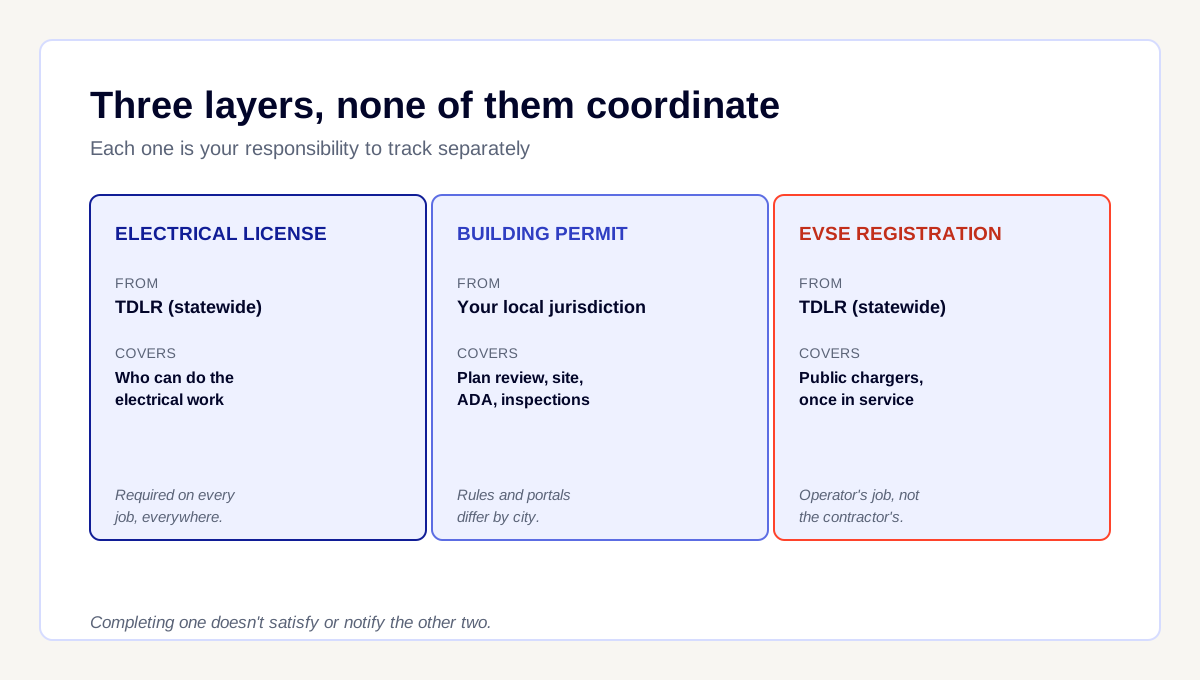
TDLR electrical licensing is the statewide baseline. All electrical work requiring a permit must be performed by a licensed electrician under TDLR’s Electrical Contractor Licensing Act. The license authorizes the work; compliance with NEC Article 625 is a separate knowledge requirement. Texas adopted the NEC through TDLR, which sets the statewide code baseline. Local jurisdictions including Houston, Austin, Dallas, and San Antonio may adopt local amendments or enforce specific inspection procedures, but they cannot fall below NEC minimums.
Local permits are where the process diverges by city. There’s no single statewide commercial building code authority in Texas; each jurisdiction adopts the International Building Code with its own local amendments and enforces it through its own plan review process. Major Texas cities use different portals, review paths, and document requirements. Some Texas municipalities including Houston and Dallas have added local amendments that require engineered drawings and a state-licensed PE stamp on any commercial EV installation. Confirm what your specific jurisdiction requires before finalizing your submittal package.
TDLR EVSE registration applies to public commercial chargers. Unless exempted by law, an electric vehicle supply provider must register all electric vehicle supply equipment charging units operating in Texas before making them available for use on a digital network for a commercial transaction. Any public charging unit installed after December 1, 2024, funded by a public grant or state rebate program, must also be equipped with connectors widely compatible with as many EV types as practicable.
Houston’s no-zoning structure affects site planning. Houston is the largest city in the United States without a traditional zoning ordinance; voters rejected zoning proposals three separate times. For EV charging site plans in Houston, the building code is the primary land-use instrument. There’s no separate zoning review or conditional use permit process that most other cities require. This can simplify site approval but places more weight on the building permit submittal itself.
Active Jurisdictions in Texas
Texas has 254 counties and over 1,200 incorporated municipalities. These are the jurisdictions with the most commercial EV charging permit activity:
| Jurisdiction | Authority | Notes |
|---|---|---|
| Houston | Houston Permitting Center | No traditional zoning ordinance. Building permit is the primary land-use instrument. CenterPoint Energy serves this area; coordinate service upgrades directly with CenterPoint. PE-stamped engineered drawings required for commercial DCFC. Conduit minimum burial depth: 24 inches under parking surfaces. |
| Austin | Austin Development Services | Electrical permit and building permit both required for commercial EV installations. Austin Energy is the municipal utility; interconnection is separate from the city permit process. PE-stamped drawings required for commercial installations. |
| Dallas | Dallas Building Inspection | Commercial electrical permit required. Oncor Electric Delivery serves Dallas; coordinate service upgrades with Oncor separately from the jurisdiction permit. PE stamp required for commercial EV work. Dallas has been active in multifamily EV charging policy. |
| San Antonio | San Antonio Development Services | Commercial electrical and building permits required. CPS Energy (municipal utility) serves San Antonio and coordinates interconnection separately from city permitting. ADA slope requirements are actively enforced; a 2% grade error can fail inspection. |
| Fort Worth | Fort Worth Development Services | Oncor territory. Commercial electrical permit required. Fort Worth provides its own permit checklist and submittal requirements, separate from Dallas despite proximity. |
| Austin Energy territory | Austin Energy (municipal utility) | Austin Energy administers interconnection and runs the Plug-In EVerywhere program with 1,000+ public Level 2 ports. Utility coordination for commercial installations runs through Austin Energy separately from the city development services permit. |
| Unincorporated areas | Varies by county / TDLR | Some Texas counties have no permit requirement for commercial construction. Verify with the county before design. TDLR electrical licensing still applies to the electrical work regardless of local permit requirements. |
Don’t see your jurisdiction? Texas has over 1,200 incorporated municipalities. Contact us at hello@rhonda.build if you need requirements for a specific Texas city or county.
Relevant Code References
NEC Article 625, Electric Vehicle Power Transfer System (adopted via TDLR)
Texas adopted the NEC through TDLR, making Article 625 the statewide baseline for EVSE installation. Circuit sizing, disconnecting means, continuous load calculations, GFCI requirements, and grounding all flow from here.
Texas Occupations Code Chapter 2311, Electric Vehicle Charging Stations
The statutory basis for TDLR’s EVSE regulatory framework, enacted by Senate Bill 1001 (88th Legislature, 2023). Establishes registration requirements for public commercial chargers, TDLR inspection authority, consumer disclosure requirements, and the connector compatibility standards for publicly funded installations. Implemented through Texas Administrative Code Title 16, Chapter 96.
Texas Utilities Code Chapter 42
Governs electric utility service and is part of the statutory framework referenced by TDLR’s EVSE regulatory structure. Relevant for projects involving utility service changes or interconnection agreements with Oncor, CenterPoint, AEP Texas, or TNMP.
NEC Article 220, Branch Circuit, Feeder, and Service Load Calculations
Required for all commercial EV charging permit applications in Texas. Panel ampere rating indicates service entrance size, not available capacity. A 200-ampere panel with a 180-ampere calculated load has only 20 amperes of headroom, insufficient for even a 40-ampere EV circuit. A full load calculation is required to determine actual available capacity before sizing an EV charger circuit.
ADA Standards for Accessible Design (2010)
Federal accessibility requirements apply to all public-facing commercial EV charging installations regardless of state or local code. Texas does not have a state-level accessibility code equivalent to California’s Chapter 11B; federal ADA standards are the applicable floor.
Common Permit Corrections and Rejections for EV Charging Projects in Texas
Texas’s jurisdiction-by-jurisdiction fragmentation means correction patterns vary more city to city than in states with uniform statewide codes. The corrections below are consistent across the major markets. PE stamp requirements and portal-specific submittal failures add a Texas-specific layer on top.
Electrical
Missing or incorrect load calculations
The branch circuit must be sized at 125% of the EVSE nameplate amperage per NEC 625.41. A load calculation under NEC Article 220 is the only reliable method for determining true available capacity before sizing an EV charger circuit. Projects that omit the full load calculation, or that calculate against panel rating rather than actual connected load, receive a correction before plan review moves forward.
No PE stamp on commercial submissions
Some Texas municipalities including Houston and Dallas require engineered drawings on any commercial EV install. Submitting commercial DCFC or multi-port L2 packages without a Texas-licensed PE stamp is a rejection at intake in those cities. Budget PE drawing costs into every commercial submittal from the start.
Wrong NEC edition assumed
Confirm which NEC edition the jurisdiction is enforcing before design; some municipalities operate under a prior adopted edition. Submitting plans citing 2023 NEC requirements to a jurisdiction still operating under an earlier edition creates mismatches that require resubmittal.
Unlicensed or improperly licensed contractor
All commercial electrical work in Texas requires a TDLR-licensed electrical contractor. The license must appear on the permit application. Applications without a valid TDLR license number are rejected at intake.
Wiring method not specified
Plans must specify conduit type, burial depth, support intervals, and routing. Houston requires a minimum burial depth of 24 inches under parking surfaces for conduit. Plans that omit wiring method specifications are flagged at plan review.
Site / ADA
ADA grade violations
ADA compliance is actively enforced on commercial EV installations in Texas. A 2% grade error on accessible EV parking spaces can result in a failed inspection. The accessible space and access aisle must not exceed 1:48 slope in any direction. Plans must document existing and finished grade at every accessible stall.
No accessible route shown
Plans must show a continuous accessible route from accessible parking spaces to the charger controls. This is the most frequent ADA correction on commercial submittals across all Texas markets.
Clear floor space not documented
The U.S. Access Board requires a minimum clear ground space of 30 inches by 48 inches at each accessible charger, unobstructed by curbs, wheel stops, bollards, or landscaping. Plans that don’t show this receive a correction.
TDLR accessibility guidance in flux
TDLR withdrew its EV charging accessibility technical memo in 2024 and is developing new rules through the Elimination of Architectural Barriers Advisory Committee. Until new rules are published, federal ADA standards are the applicable floor.
Signage omitted
Accessible EV stalls require specific marking and signage under federal ADA standards. Consistently missing from civil and site sheets on first submittal.
Utility Coordination
ERCOT grid structure is not the same as utility service
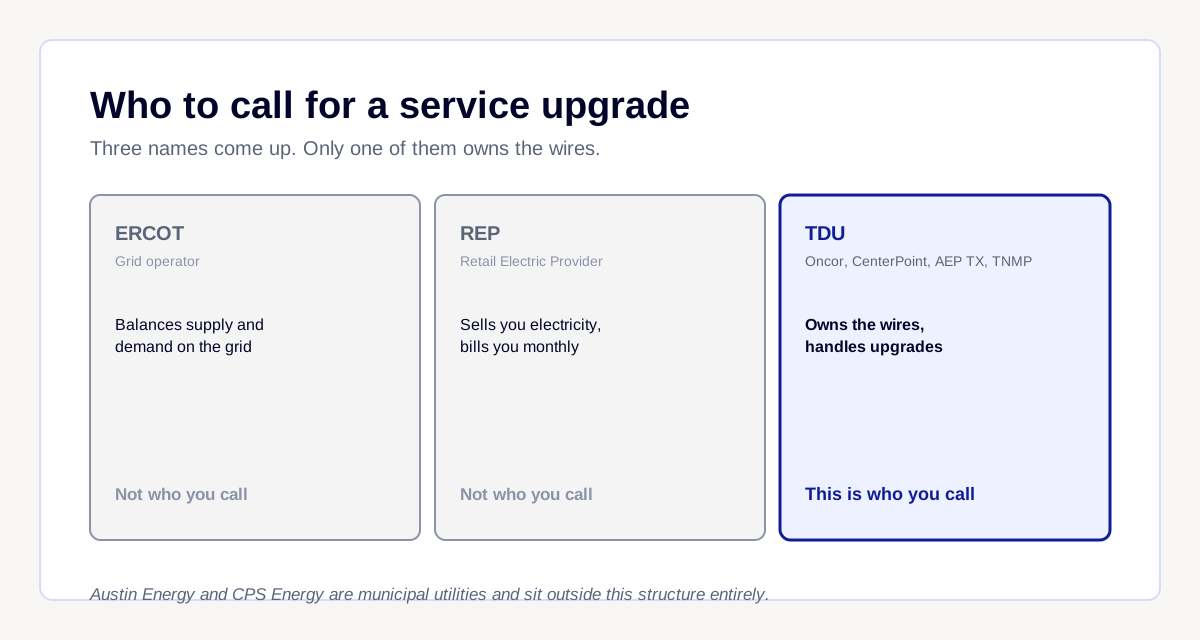
Texas operates the ERCOT grid, which is separate from the investor-owned transmission and distribution utilities that serve customers directly. For commercial EV charging projects, the relevant utility coordination is with the Transmission and Distribution Utility (TDU) serving the project site: Oncor (Dallas/Fort Worth), CenterPoint Energy (Houston), AEP Texas (West and South Texas), or TNMP (parts of West Texas and the Panhandle). Austin Energy and CPS Energy (San Antonio) are municipal utilities operating outside ERCOT’s retail competition structure. ERCOT itself is not the entity to contact for service upgrades or interconnection; the TDU is.
Starting utility coordination after permit approval
The TDU interconnection process runs on its own timeline, separate from the jurisdiction permit. DCFC installations requiring service upgrades or new transformer capacity trigger extended engineering review at the TDU. Starting TDU coordination at the same time as the permit application is the biggest schedule compression available on commercial projects.
Confusing the REP with the TDU
In ERCOT’s deregulated market, commercial customers choose a Retail Electric Provider (REP) for their electricity supply. The REP is not the entity that owns the wires or handles service upgrades; that’s the TDU. Applications for new service or service upgrades go to the TDU, not the REP.
Austin Energy and CPS Energy operate differently
Austin Energy and CPS Energy are municipal utilities that aren’t part of ERCOT’s competitive retail market. Their interconnection processes, program requirements, and customer contact points differ from the investor-owned TDUs. Projects in Austin or San Antonio that apply Oncor or CenterPoint assumptions to their utility coordination will encounter gaps.
TDLR EVSE registration not filed before commissioning
Public commercial chargers must be registered with TDLR before being made available for use on a digital network for a commercial transaction. This is separate from the local building permit and is the operator’s responsibility. Projects that commission chargers without completing TDLR registration are out of compliance under Texas Occupations Code Chapter 2311.
Permitting shouldn’t be the bottleneck on your next charging site.
Rhonda makes permitting for commercial solar, battery storage, and EV charging infrastructure predictable. Pre-check your plan set against the specific jurisdiction requirements for your Texas project before you submit. See what Rhonda catches before your jurisdiction does.
← Back to the State and City Requirement Guide Library
Footnotes
- TDLR, Electric Vehicle Charging Stations
- TDLR EVSE At a Glance, FY25
- Texas Occupations Code Chapter 2311 (AFDC: Texas EV Charger Inspection Regulations)
- Texas Administrative Code Title 16, Chapter 96 (AFDC: Texas Publicly Funded EV Charger Standards)
- NEC Article 625, Electric Vehicle Power Transfer System (adopted via TDLR)
- NEC Article 220, Branch Circuit, Feeder, and Service Load Calculations
- Houston Permitting Center
- Austin Development Services
- Dallas Building Inspection
- San Antonio Development Services
- PUCT, Texas TDU overview
- U.S. Access Board, EV Charging Station Accessibility
- TDLR, Elimination of Architectural Barriers, EV charging accessibility memo withdrawn
- TxDOT Texas Electric Vehicle Infrastructure Plan, August 2025