EV Charging Permit Requirements in California
California requires a permit for every EV charger installation, and in most commercial cases you'll need two: an electrical permit and a building permit, both reviewed by the same local jurisdiction. Here's how the process works, and where commercial projects most often get stuck.

Do you need a permit to install an EV charger in California?
Yes. An electrical permit is required for the installation of an EV charging station. A building permit is also required where new building construction is proposed, or where additions or alterations are proposed to an existing structure. For commercial installations, fleet depots, DCFC corridors, workplace charging, retail, plan review is required, typically including ADA compliance documentation, load calculations, and utility coordination for service upgrades.
Permitting delays aren’t unique to California, but the state has one of the most complex permitting environments in the country. Washington splits its two EV charger permits between a statewide electrical authority and local building departments; California routes both through the same local jurisdiction, and that doesn’t make the process faster. The median timeline for a commercial MDHD charging site from application to energization is 983 calendar days, per a Cadmus Group evaluation of California’s transportation electrification programs.
How EV Charger Permitting Works in California
California’s permit structure differs from most states because the local jurisdiction, not a separate statewide electrical authority, is the single point of contact for both the electrical and building permit. Every city and county is its own authority.
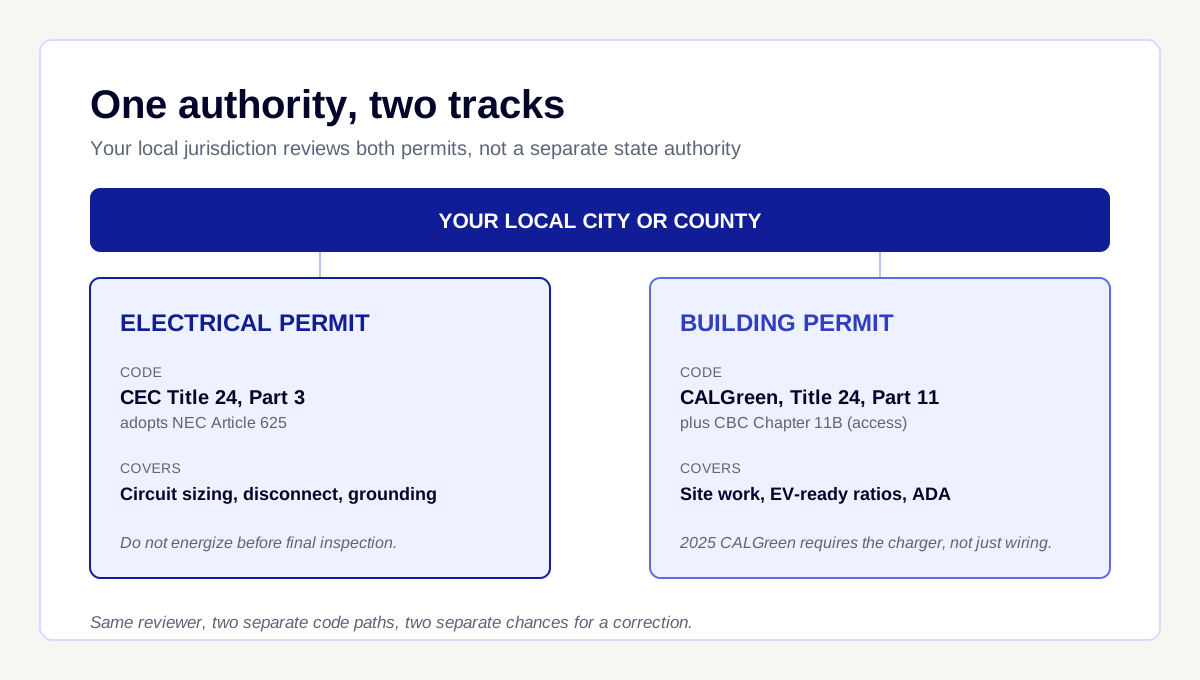
The electrical permit is filed with your local jurisdiction under the California Electrical Code (CEC), Title 24, Part 3. The CEC adopts NEC Article 625, which governs EV charging system installation. A rough-in inspection covers conduit, wiring, and panel connections. The final inspection covers the complete installation. Do not energize the circuit before final inspection approval.
The building permit is required for new construction and for alterations or additions that trigger CALGreen compliance. CALGreen (Title 24, Part 11) sets minimum ratios for EV Capable and EV Ready parking spaces in new residential and nonresidential development. Accessibility requirements for EV charging stations fall under California Building Code Chapter 11B.
The 2025 CALGreen update, effective January 1, 2026, is a significant change. Projects adding or modifying parking spaces under a building permit must now equip each new or altered stall with an installed Level 2 charger, with limited exceptions. Prior editions required EV-capable wiring. The 2025 edition requires the charger itself.
Local amendments add another layer. San Francisco’s Green Building Code contains local amendments specifying EV charging infrastructure types and quantities for residential and non-residential projects, on top of the CALGreen baseline. Many jurisdictions, including the City of San Luis Obispo, require 100% EVSE-installed parking or higher power levels. Verify local amendments before design. The state baseline is not the number that controls in those cities.
California has mandatory permit streamlining timelines that developers can invoke. Under AB 1236 (2015) and AB 970 (2021): for 1–25 stations at a single site, jurisdictions have 5 business days to deem an application complete and 20 business days to issue approval. For 26 or more stations, those timelines extend to 10 and 40 business days. If the jurisdiction fails to act within the applicable period, the application is deemed complete by operation of law. These timelines are on the books, but at least 37% of localities had not fully complied with them as of the California Attorney General’s March 2025 legal alert (OAG 2025-001). If your jurisdiction is running over the statutory timeline, that document is the citation to hand them.
Active Jurisdictions in California
California has 58 counties and over 480 incorporated cities, each administering its own building and site review process. These are the jurisdictions currently seeing the most commercial EV charging permit activity:
| Jurisdiction | Authority | Notes |
|---|---|---|
| Los Angeles (City) | LADBS (LA Dept. of Building and Safety) | Separate permitting authority from LA County. LADBS handles commercial plan review. Online permit portal available for qualifying projects. |
| Los Angeles County (unincorporated) | LA County Public Works Building and Safety | Both electrical and building permits may be required depending on project scope. Some areas within the county are served by LADWP rather than SCE; confirm utility jurisdiction before design. |
| San Francisco | SF DBI (Dept. of Building Inspection) | Projects with scope beyond EVSE installation and safety equipment may require additional permits. Projects where CBC Chapter 11B applies require “With Plans” service. SFGBC local amendments apply on top of CALGreen. |
| San Diego (City) | San Diego Development Services Dept. (DSD) | Electrical and building permits both required. EVSE must be listed and labeled by a Nationally Recognized Testing Laboratory. Simple Permit track available for single-family residential installations. |
| San Diego County (unincorporated) | San Diego County Planning & Development | One of the first jurisdictions in the region to receive state recognition for a streamlined EV charger permitting process (2020). Checklist available on county website. |
| San Jose | San Jose Planning, Building and Code Enforcement | Despite being in the heart of Silicon Valley, San Jose has been documented as one of the slower permitting jurisdictions for EV chargers in the state. Online portal available. |
| Sacramento (City) | Sacramento Community Development | SMUD (Sacramento Municipal Utility District) serves this area, a municipal utility with a different interconnection process than PG&E or SCE. |
| Oakland | Oakland Planning & Building Dept. | Served by PG&E for utility coordination. Oakland’s reach code requirements have been evolving; verify current local amendments before design. |
| Riverside / San Bernardino | Varies by city/county | A major fleet depot and DCFC corridor. SCE territory. Generally follows the state baseline with fewer local amendments than coastal jurisdictions. |
Don’t see your jurisdiction? California has over 480 incorporated cities. Contact us at hello@rhonda.build if you need requirements for a jurisdiction not listed here.
Relevant Code References
California Electrical Code (CEC), Title 24, Part 3, Article 625
The CEC sets minimum standards for electrical safety across residential, commercial, and industrial work, including EV charger installation. California adopts Title 24 on a three-year cycle, and local jurisdictions may add amendments, so the exact requirements depend on the edition your city or county has adopted. NEC Article 625 is the governing section for EVSE: circuit sizing, disconnecting means, continuous load calculations, and grounding requirements all flow from here.
CALGreen, Title 24, Part 11
CALGreen sets minimum ratios for EV Capable and EV Ready parking spaces in new residential and nonresidential development. The 2025 edition, effective January 1, 2026, requires installed Level 2 chargers at new or altered parking stalls in most project types.
California Building Code Chapter 11B
Governs accessibility requirements for EV charging stations in California, including accessible route, clear floor space, reach range, and signage. Applies to commercial EV installations at facilities subject to California accessibility law.
AB 1236 (2015) and AB 970 (2021), Government Code §§ 65850.7 and 65850.71
Establish mandatory streamlined permitting timelines for EV charging station applications statewide. Every California jurisdiction is required to comply. In March 2025, California Attorney General Rob Bonta issued a legal alert after data showed at least 37% of localities had not fully complied.
Public Utilities Code § 740.20, EVITP requirement
Chargers funded through the CPUC, Energy Commission, or Air Resources Board require at least one EVITP-certified electrician on the crew, rising to 25% of the crew for charging ports of 25 kW or more. This applies to incentive-funded projects, which includes most large commercial deployments pursuing CPUC or CEC program funding.
Common Permit Corrections and Rejections for EV Charging Projects in California
First-pass approval on commercial EV charging permits in California is the exception, not the rule. The process involves the local jurisdiction, the California Electrical Code, and the serving utility, each with distinct requirements. The corrections that delay projects most frequently fall into three categories.
Electrical
Missing or incomplete load calculations
The branch circuit must be sized at 125% of the EVSE nameplate amperage per NEC 625.41, with GFCI protection per NEC 625.54. Projects that omit the continuous load multiplier, or that calculate against a partial panel load without accounting for existing connected loads, receive a correction before plan review begins. This is the most documented source of electrical corrections on EV charging submittals statewide.
CEC Article 625 gaps
Article 625 governs EVSE installation specifically. Reviewers flag missing disconnecting means, unlabeled equipment, and inadequate circuit sizing. Grounding, bonding, and GFCI compliance are checked at final inspection; plans that don’t document these elements are sent back before field work begins.
Wiring method not specified
Plans that don’t specify the wiring method, conduit type, support intervals, routing, are flagged routinely. For commercial EVSE, conduit is almost always required. NM cable in locations requiring conduit is among the most common inspection failures.
Unlicensed contractor on the application
Commercial electrical work in California requires a C-10 Electrical Contractor license from the CSLB. Applications submitted with an expired or missing C-10 license are rejected at intake. Work performed without a proper license cannot be permitted and cannot pass inspection.
EVITP certification missing on incentive-funded projects
For projects receiving CPUC, CEC, or CARB incentive funding, EVITP certification documentation must accompany the permit application. As more projects pursue program funding, this is flagged at intake with increasing frequency.
Site / ADA
Chapter 11B accessibility documentation missing
California Building Code Chapter 11B is more detailed than federal ADA standards on EV accessibility. Projects where Chapter 11B applies require “With Plans” service from the jurisdiction. Plans submitted without Chapter 11B documentation, accessible route, clear floor space dimensions, reach range, and signage, come back on the first review.
No accessible route shown
Plans must show a continuous accessible route from accessible parking spaces to the charger controls, paved and free of changes in level. The route cannot cross active traffic lanes without a marked crossing. This is the most frequent ADA correction on commercial submittals.
Clear floor space violations
The U.S. Access Board requires a minimum clear ground space of 30 inches by 48 inches at each accessible charger, not sloped more than 1:48, and unobstructed by curbs, wheel stops, bollards, or landscaping. Plans that show chargers without documenting the clear space receive a correction.
Accessible stall signage omitted
Accessible EV stalls require specific marking and signage under both federal ADA standards and California Chapter 11B. This is consistently missing from civil and site sheets on first submittal.
Planning permit improperly required
AB 1236 requires by-right approval for qualifying EV charging stations and prohibits local agencies from imposing discretionary approvals or design standards except to address health and safety. Some jurisdictions still route qualifying applications through discretionary planning review. If your project meets the AB 1236 checklist criteria and the jurisdiction is requiring a planning permit, that’s a compliance failure on the jurisdiction’s part. OAG 2025-001 is the document to cite.
Utility Coordination
Starting utility coordination after permit approval
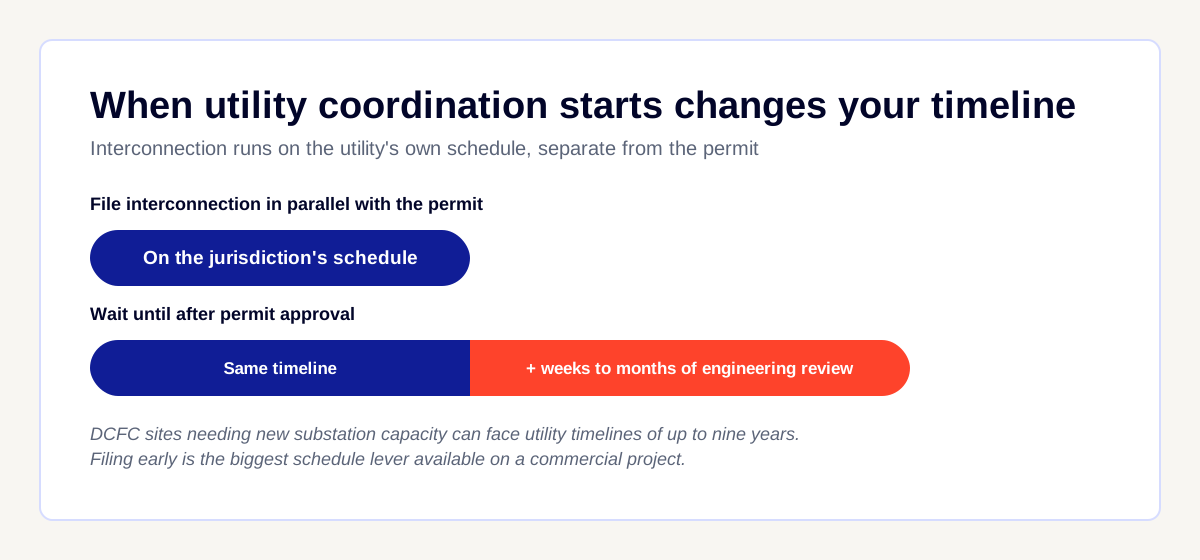
Interconnection with PG&E, SCE, or SDG&E runs on the utility’s timeline, separate from the jurisdiction’s permit process. Filing the interconnection application in parallel with permitting is the biggest schedule compression lever available on commercial projects. Teams that treat interconnection as a post-permit task routinely add weeks to months to the project schedule.
DCFC load triggering extended engineering review
DCFC installations requiring significant service upgrades or new transformer capacity trigger extended utility engineering review. Fast-charging plazas and large fleet depot sites often require substation upgrades. The CPUC has established maximum utility timelines for these larger projects of up to nine years for new substations. DCFC projects requiring new transformer capacity carry the most schedule risk in the state.
Service upgrade not coordinated with the permit
The sequencing dependency between permit approval and utility energization runs in both directions. Delays in permitting delay utility energization. Contact PG&E, SCE, or SDG&E early to find out if a service upgrade or interconnection agreement is needed, and start that process before the permit is in hand.
Solar + storage + EV combined load not disclosed to the utility
Projects combining solar generation, battery storage, and EV charging must coordinate with the utility on combined load. Battery systems that export to the grid may require revenue-grade metering at the point of interconnection. Projects that don’t disclose the full system configuration at the outset frequently encounter late-stage interconnection requirements.
SMUD and LADWP territory: different rules
PG&E, SCE, and SDG&E are investor-owned utilities regulated by the CPUC. Sacramento Municipal Utility District (SMUD) and Los Angeles Department of Water and Power (LADWP) are municipal utilities operating under different oversight. Their interconnection processes, timeline expectations, and program requirements differ from the investor-owned utilities. Projects in Sacramento or LADWP territory that apply investor-owned-utility assumptions to their utility coordination planning will encounter gaps.
Permitting shouldn’t be the bottleneck on your next charging site.
Rhonda makes permitting for commercial solar, battery storage, and EV charging infrastructure predictable. Pre-check your plan set against California’s state code and the specific local amendments for your jurisdiction before you submit, so corrections don’t cost you weeks. See what Rhonda catches before your jurisdiction does.
← Back to the State and City Requirement Guide Library
Footnotes
- California Electrical Code (CEC), Title 24 Part 3 (California Building Standards Commission)
- CALGreen, Title 24 Part 11, 2025 edition, effective January 1, 2026 (California Building Standards Commission)
- California Building Code Chapter 11B (accessibility for EV charging stations)
- AB 1236 (2015) and AB 970 (2021), California Government Code §§ 65850.7 and 65850.71
- AB 970 Permitting Fact Sheet (California Governor’s Office of Business and Economic Development)
- California Attorney General Legal Alert OAG 2025-001 (oag.ca.gov)
- EVITP certification requirement, Public Utilities Code § 740.20 (AFDC: Electricity Laws and Incentives in California)
- C-10 Electrical Contractor License (CSLB)
- Cadmus Group, 983-day median MDHD site timeline (Ventera/Cadmus 2024 evaluation)
- U.S. Access Board, EV Charging Station Accessibility (access-board.gov)
- CPUC D.24-09-020, energization timeline caps for EV charging (CPUC)
- GO-Biz EV Charging Station Permitting Guidebook (business.ca.gov)
- San Francisco DBI Information Sheet E-02 (sf.gov)
- San Diego Development Services Bulletin 187 (sandiego.gov)