EV Charging Permit Requirements in Washington State
Washington requires two separate permits for most EV charger installations: an electrical permit reviewed under NEC Article 625, and a building or site permit that varies by city and county. Here's how the process works, and where projects most often get stuck.

Do you need a permit to install an EV charger in Washington State?
Yes. Washington requires two separate permits for most EV charger installations: an electrical permit for the charging equipment itself, reviewed under the National Electrical Code (Article 625) as adopted through WAC 296-46B, and a building or site permit from the local city or county where the charger is installed. There is no single statewide EV charging permit. The electrical side is regulated by the Department of Labor & Industries statewide, while the building side is governed by a mix of the state building code’s baseline EV-readiness requirements and whatever stricter amendments the local jurisdiction has added on top.
Permitting delays aren’t unique to Washington. They’re the single biggest bottleneck in EV charging buildout nationwide, and Washington’s split-permit system adds its own local wrinkle.
How EV Charger Permitting Works in Washington State
Washington splits EV charging permits into two separate tracks, and mixing them up is one of the most common sources of delay.
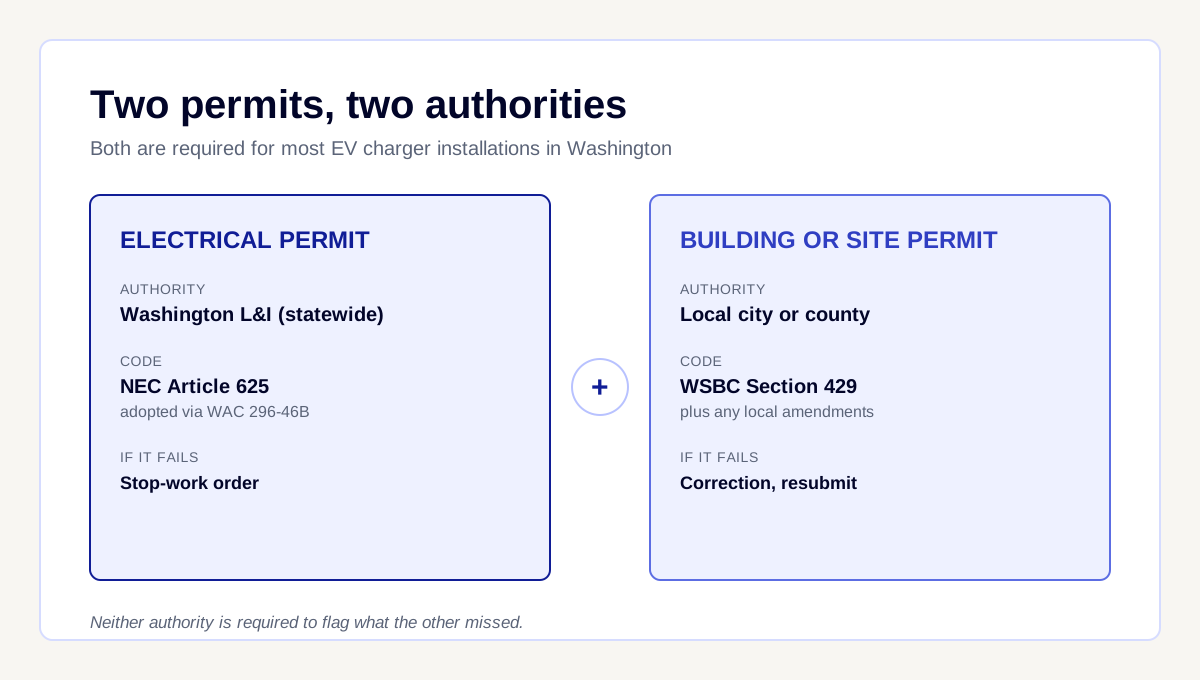
- Split authority: L&I is the statewide electrical authority (adopts NEC via WAC 296-46B); local building departments (city or county) handle the building/site/zoning side
- Washington State Building Code (WSBC) Section 429 / WAC 51-50-0429 sets a baseline EV-readiness requirement (a percentage of parking spaces, per Table 429.2) for new construction
- Local jurisdictions can and do exceed the state baseline: Seattle’s amendment requires 20% EV-ready + 20% EV-capable in new multifamily buildings, stricter than the state minimum
- Practical implication: a project can be state-code-compliant and still fail locally if the jurisdiction has its own amendment
The electrical permit covers the actual charging equipment: wiring, circuits, grounding, and the charger itself. This falls under Washington’s Department of Labor & Industries (L&I), which serves as the authority having jurisdiction for electrical work statewide. Washington adopts the National Electrical Code by reference through the Washington Administrative Code (WAC 296-46B), so NEC Article 625, the section governing EV charging systems specifically, is enforced as state law here, not as a voluntary standard. A failed Article 625 inspection isn’t a suggestion to fix something later. It’s a stop-work order.
The building or site permit is separate, and this is where things get local. The Washington State Building Code sets a baseline requirement for EV-ready and EV-capable parking spaces in new construction (WAC 51-50-0429, Section 429), tied to a percentage of total parking based on occupancy type. But this is a floor, not a ceiling. Individual cities and counties can, and often do, adopt their own amendments on top of it. Seattle’s building code amendment, for example, requires 20% of new multifamily parking to be EV-ready and another 20% EV-capable, well above the state’s baseline percentages.
That means a project can be fully compliant with the state electrical code and still get bounced back at the local level, or vice versa. The building permit reviewer at your city or county isn’t necessarily checking the same things L&I is, and neither one is required to flag what the other missed. Anyone permitting EV chargers in more than one Washington jurisdiction needs to check both the state baseline and whatever the local municipality has layered on top of it, every time, since the local requirement changes by city.
Active Jurisdictions in Washington
Washington doesn’t have a single statewide permitting authority for EV charger installations. Each city or county listed below administers its own building and site review process, on top of the state electrical code enforced by L&I.
These are the jurisdictions currently seeing the most EV charging permit activity in Washington:
| Jurisdiction | Authority | Notes |
|---|---|---|
| Seattle | SDCI (Seattle Dept. of Construction & Inspections) | 20% EV-ready + 20% EV-capable requirement for new multifamily buildings, stricter than the state baseline. |
| Bellevue | Bellevue Development Services | Requires EV-ready spaces in new multifamily/commercial builds under LUC 20.20.585. The city has a stated goal to streamline and reduce permitting costs for EV charging installations. |
| King County (unincorporated) | King County Permitting Division | |
| Tacoma | Tacoma Planning & Development Services + Tacoma Public Utilities | Local amendment (TMC Section 427) applies to new buildings and additions adding 10+ parking spaces. Tacoma runs its own public utility, so the electrical permit for chargers goes through Tacoma Public Utilities rather than a private utility. Public/right-of-way charging stations require a separate RCON permit on top of the electrical permit. |
| Spokane | City of Spokane Building Services (in-city) or Spokane County (unincorporated) | No distinct local EV-ready amendment found beyond the state baseline. Spokane’s municipal climate code (SMC 15.05.050) addresses EVs, but permitting largely follows state building code as-is. |
| Vancouver, WA | Vancouver Community Development | No distinct Vancouver, WA ordinance on EV charging confirmed in public sources. |
| Pierce County | Pierce County Planning & Public Works | Requires all new single-family homes to be EV-ready under Ordinance 2021-46s, effective January 1, 2022, predating and exceeding the state minimum. Codified at PCC 17C.30.150; applies where off-street parking exists. Whether a separate local permit is required for home charging beyond the L&I electrical permit should be confirmed directly with the county. |
| Snohomish County | Snohomish County Permit Center | Has its own dedicated zoning code section for EV charging stations (SCC 30.91E.082), a level of specificity most counties on this list don’t have. |
Don’t see your jurisdiction? Washington has 39 counties and nearly 300 incorporated cities, each with its own permitting process. Contact us at hello@rhonda.build if you need requirements for a jurisdiction not listed here.
Relevant Code References
NEC Article 625 (Electric Vehicle Power Transfer System)
Governs the conductors, equipment, and installation requirements for EV charging equipment, from the connection point at the building through to the vehicle. Adopted into Washington law by reference through WAC 296-46B. Enforced by L&I as the statewide electrical authority.
NEC 625 in Washington is not a guideline, it’s enforceable law. Non-compliance leads to failed inspections and stop-work orders, not just a warning.
WAC 51-50-0429 / Washington State Building Code Section 429
Sets the baseline requirement for EV charging stations, EV-ready spaces, and EV-capable spaces in new construction, scaled by total parking count and occupancy type under Table 429.2. Includes narrow exceptions (no on-site parking, no available utility service).
RCW 19.28
Referenced within WAC as governing EVSE installation requirements alongside NEC Article 625. Covers broader electrical licensing and installation standards in Washington.
Local amendments (jurisdiction-specific)
Cities and counties can adopt EV-readiness requirements stricter than the state baseline. These vary significantly and are covered in the jurisdiction table above, since there is no single statewide number that applies everywhere.
Common Permit Corrections and Rejections for EV Charging Projects in Washington
First-pass approval on EV charging permits in Washington is the exception, not the rule. The process involves at least three separate authorities: the local jurisdiction, Washington State L&I, and the serving utility, each with distinct requirements that don’t automatically align. The corrections that delay projects most frequently fall into three categories.
Electrical
Missing or incomplete load calculations
Load calculations must follow NEC Article 220 and account for all existing connected loads alongside the new EVSE demand. The most common error: failing to treat EV charging as a continuous load. Under NEC 625.41, the branch circuit supplying EVSE must be rated at no less than 125% of the maximum load. Projects that omit this multiplier or calculate against a partial panel load routinely receive a correction before plan review even begins.
NEC Article 625 gaps
Article 625 governs EVSE installation specifically. Reviewers flag missing disconnecting means, unlabeled equipment, and inadequate circuit sizing. Plans that don’t explicitly reference Article 625 compliance, particularly for DCFC installations, are frequently sent back for revision.
Wiring method violations
Using NM cable in locations that require conduit, or failing to meet conduit support interval requirements, is among the most common inspection failures statewide according to L&I records. For commercial EVSE, conduit is almost always required; plans that don’t specify the wiring method get flagged.
Unlicensed contractor on the application
All commercial EVSE electrical permits in Washington must be pulled by a licensed electrical contractor holding an active EL01 General Electrical Contractor license through L&I. Applications submitted without this, or with an expired license, are rejected at intake.
EVITP certification missing on public works projects
As of January 1, 2026, EV chargers installed on public works projects in Washington must be installed and maintained by persons holding an Electric Vehicle Infrastructure Training Program (EVITP) certification or an equivalent program. Missing credential documentation is a new and increasingly common cause of rejection on public-sector EV projects.
Site / ADA
Incomplete site plan
Washington jurisdictions require site plans drawn to 1:20 scale showing size and location of new construction, distances from lot lines, grades and elevations, existing and new utilities, easements, parking layout, and ADA access routes to chargers. Ellensburg’s EV charging guidance bulletin is representative of what most Washington jurisdictions require at submittal; plans missing any of these elements will receive a correction.
No accessible route shown
Commercial EV charging installations that serve the public or employees must comply with ADA accessibility standards. The most frequent ADA correction: plans that don’t show a continuous accessible route from accessible parking spaces to the charger controls. The route must be paved, free of changes in level, and not cross active traffic lanes without a marked crossing.
Clear floor space violations
The U.S. Access Board requires a minimum clear ground space of 30 inches by 48 inches at each accessible charger. That space must be free of changes in level, not sloped more than 1:48, and unobstructed by curbs, wheel stops, bollards, or landscaping. Plans that show chargers without documenting the clear space, or that show bollards within it, receive a correction.
Reach range not documented
Charger controls must fall within accessible reach range per ADA standards. Plans that don’t show control heights or that specify equipment without confirming reach range compliance are flagged.
Accessible stall signage omitted
Accessible EV stalls require specific marking and signage. This is consistently missing from civil/site sheets on first submittal.
Critical area review not initiated
Projects located in or near a Critical Area under local municipal code require critical area review and approval before permit issuance. This step is frequently overlooked on infill and retrofit projects where the site appears straightforward.
Utility Coordination
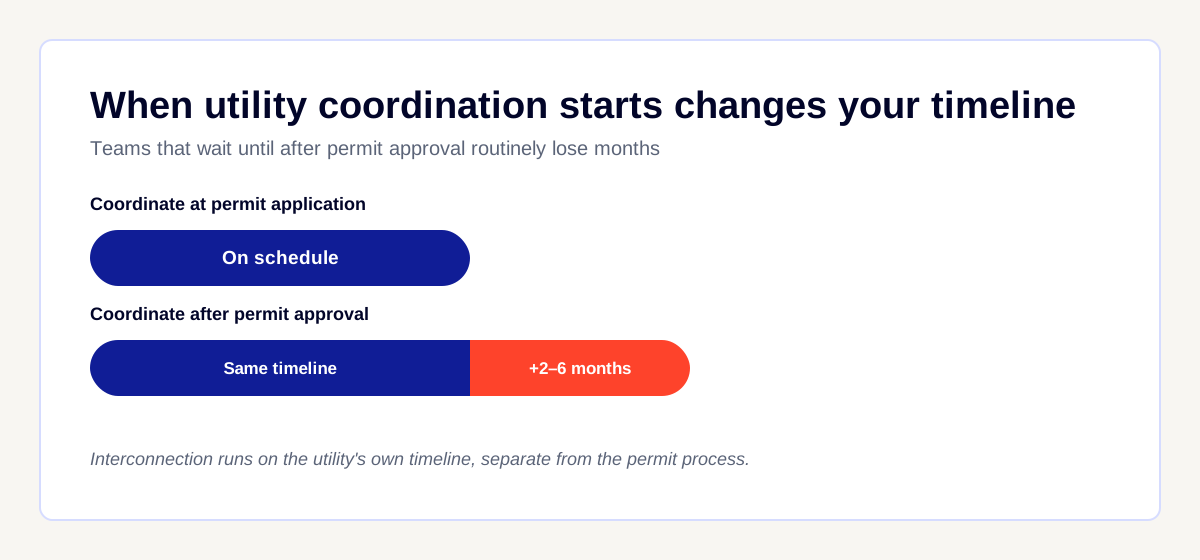
Starting utility coordination after permit approval
This is the single most schedule-damaging mistake on EV charging projects in Washington, and it doesn’t generate a correction letter. It generates months of delay. Interconnection with PSE, Seattle City Light, Snohomish County PUD, or Tacoma Power runs on the utility’s timeline, entirely separate from the local permitting process. Teams that treat utility coordination as a post-permit step routinely add two to six months to their project schedule. Utility coordination should begin at the same time as permit application, not after.
Engineering review triggered by DCFC load
DCFC installations above approximately 50 kW per charger, and aggregated EV loads that exceed the serving transformer’s rated capacity, trigger extended engineering review at the utility. This review is rarely anticipated in project schedules and can add weeks to months depending on the utility and the complexity of the service upgrade required.
Service upgrade application not filed separately
Seattle City Light requires a separate electric service application for any service alteration or upgrade. The permit number is required before permanent connection approval, creating a sequencing dependency: the building permit must be in hand before SCL will complete energization. Teams that don’t initiate the SCL service application early can find themselves with a valid permit but no path to energization.
Transformer lead times
Seattle City Light has published transformer and underground wire lead times of approximately 18–24 months. DCFC projects requiring new transformer pads are the most vulnerable.
Solar + storage + EV combined load not flagged at utility
Projects that combine solar generation, battery storage, and EV charging must coordinate with the utility on combined load and, where battery systems export energy to the grid, may require revenue-grade metering at the point of interconnection under WAC 480-100. Projects that don’t disclose the full system configuration to the utility at the outset frequently encounter late-stage interconnection requirements that require redesign.
Permitting shouldn’t be the bottleneck on your next charging site.
Rhonda makes permitting for commercial solar, battery storage, and EV charging infrastructure predictable. Pre-check your plan set against state code and the specific local amendments for your jurisdiction before you submit, so corrections don’t cost you weeks. See what Rhonda catches before your jurisdiction does.
← Back to the State and City Requirement Guide Library
Footnotes
- Washington State L&I Electrical Licensing
- NEC Article 625: Electric Vehicle Power Transfer System (adopted in Washington via RCW 19.28)
- Ellensburg, WA EV Charging Station Guidance Bulletin BG-02
- SDCI Electrical Permit Tips 132 and 133 (Commercial EV Charger Installation)
- Seattle City Light: Apply for New or Upgraded Electric Service
- Washington Utility Interconnection for EV Charging (PSE, SCL, Snohomish PUD)
- U.S. Access Board: Design Recommendations for Accessible EV Charging Stations
- AFDC: ADA Compliance for EV Charging Infrastructure
- AFDC: Electricity Laws and Incentives in Washington (EVITP requirement)
- WAC 480-100 (Washington UTC metering requirements)