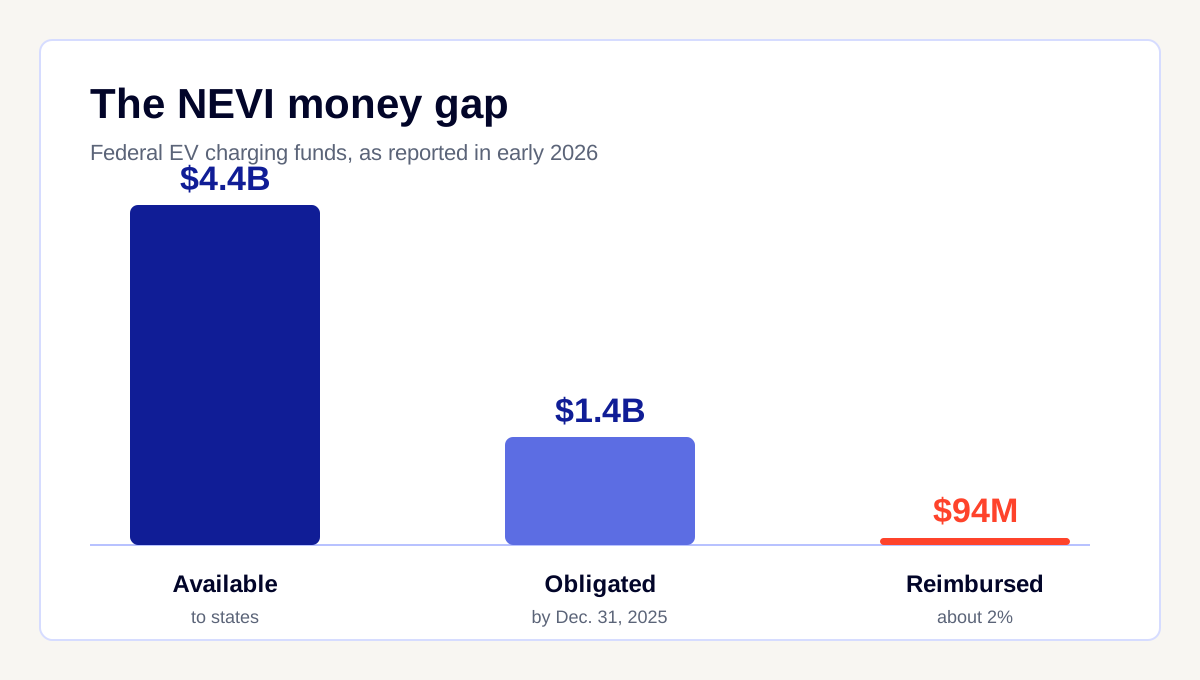
Congress made $4.4 billion available to states for electric vehicle charging infrastructure in 2021. Four years later, states had asked the federal government to reimburse them for only $94 million of it.1
That’s roughly 2 cents of every dollar.
The number came from FHWA data filed in a lawsuit in early 2026. It generated headlines, mostly focused on the obvious political target: the Trump administration froze NEVI (National Electric Vehicle Infrastructure) funding in February 2025, states sued, and the program stalled for seven months until new guidance came out in August 2025.
The freeze had real consequences. In Arkansas, 9 of the 19 station builders that had been awarded contracts backed out during the pause. The state is now looking for replacements, a process that could take another year.1
But the freeze alone explains less than it appears to. The program had been moving slowly since the beginning.
What the numbers actually show
The distinction between obligated and spent matters here. By early 2025, states had obligated roughly $527 million, meaning they had approved plans and committed the money in principle. But actual disbursements, the money that came back to states after construction was complete and receipts were submitted, were only $94 million.2
That gap is partly due to timing. Federal highway funding works on a reimbursement model: build it, submit receipts, then get paid. Some of the lag reflects projects that were underway when the freeze hit. As of December 31, 2025, obligated funds had grown to $1.4 billion.2
But only 57 NEVI-funded charging stations had opened across 15 states as of February 10, 2025, after more than three years of program operation.3 That’s not just a funding problem, or purely a freeze problem. A state that obligates $15 million and opens two stations has a deployment problem.
The private fast-charging market shows the contrast. Paren counted more than 18,000 new DC fast-charging ports deployed across the U.S. in 2025, a 30% year-over-year increase. NEVI-funded installations represented about 3% of those new ports.4
What deploying a NEVI station actually requires
To understand why, follow a NEVI project from authorization to ribbon-cutting:
- States receive their NEVI allocation and submit a deployment plan to FHWA for approval.
- The state issues a solicitation, EV charging companies apply, and the state awards a contract.
- The EV charging company acquires or leases the site.
- The EV charging company designs the station.
- The EV charging company submits for permits.
- Only when permits are cleared does the project finally get built.
The permitting step comes after the work of funding, contracting, securing a location, and site design has already become sunk cost. That’s where the timeline starts to fall apart.
Every NEVI-funded charging station still needs a local building permit, typically from the city or county where the site is located. Each jurisdiction has different written and unwritten requirements that take project planners long hours to research. A missed requirement can derail design plans that worked in other jurisdictions, which makes repeatable processes difficult to rely on.
NEVI has no authority over local permitting. Federal highway funding cannot instruct a county building department to move faster. The state plan can be approved, the contract can be signed, the equipment can be ordered, and the project can still sit for months waiting on a permit from a jurisdiction that has never reviewed this type of installation before.
An Atlas Public Policy analysis, summarized by NRDC, found that permitting delays were consistently cited as the biggest bottleneck in the service activation timeline across EV charging projects. The same analysis put a number on the cost: nearly $90 billion in potential savings to the EV charging sector if energization timelines were meaningfully reformed.5
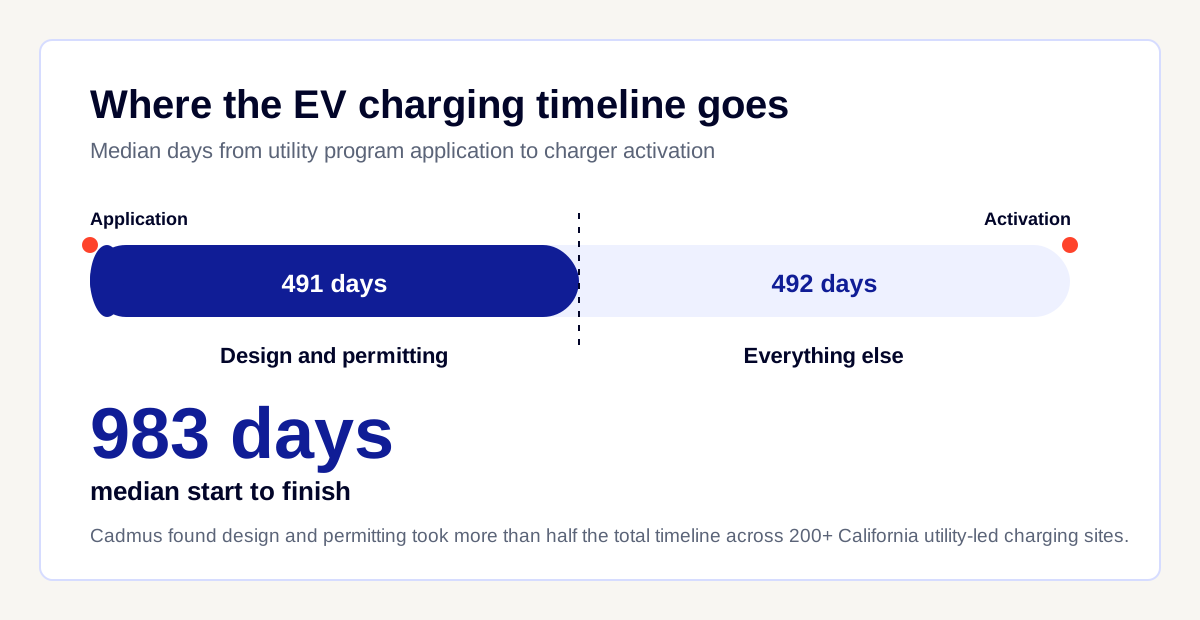
A third-party evaluation of California’s utility-run EV charging programs, conducted by Cadmus Group across more than 200 sites, found the median time from program application to a charger being turned on was 983 days. The original estimated timeline when those programs launched was 11 to 19 months.
The design and permitting phase alone accounted for a median of 491 days, more than half the total.6
Data from Electrify America, cited in a Stanford SIEPR policy brief, found that in 2019, permits in California took 75 business days on average, compared with a national average of 44. Extended zoning review and multiple comment rounds were the top two sources of delay. Costs were 24% higher than Electrify America’s national average, attributed in part to the permitting timeline.7
These numbers predate the NEVI freeze by years. They reflect the standard operating environment for EV charging development in the United States, where the capital can be available, the equipment can be ready, and the project can still be stuck waiting on a local building department, often one with little to no experience permitting EV charging sites.
What this means for developers right now
Until energization timelines improve across the U.S., the thing companies can control is how prepared they are for local permitting.
The correction cycle, the back-and-forth between a developer’s engineering team and a local reviewer who may have limited experience with this equipment type, is where months disappear. It is also where the gap between the best-run development teams and the rest of the industry shows up most clearly.
A jurisdiction in Hidalgo County, Texas has reviewed far fewer utility-scale charging installations than one in Clark County, Nevada. A developer entering a new market does not have the benefit of knowing the local interpretation of NEC 625, the unwritten preferences of the plan reviewer, or the specific civil and electrical details that most commonly come back as corrections in that jurisdiction.
They find out after they submit.
The companies building national EV charging networks at speed are the ones treating permitting as a variable they can manage, not an obstacle they have to wait through — which is the problem Rhonda’s EV charging plan checking exists to solve.
The NEVI story is still being written. More money may eventually flow, and reforms that make building faster may eventually land. None of that changes the fundamental physics of building a charging station in 2026: the capital can be ready, the site can be acquired, the equipment can be on order, and the project can still be sitting in a permit queue.
The gap between $4.4 billion available and $94 million reimbursed is a federal story. The gap between a submitted plan set and a building permit is a local one. For developers building now, the second gap is the one that determines their timeline.
Rhonda checks EV charging plan sets against local jurisdiction requirements before submission, catching the issues that typically come back as correction letters before they do. See what a Rhonda review looks like.
Footnotes
-
E&E News by Politico, “Congress green-lighted billions for EV chargers. Four years later, only 2% is spent.” (David Ferris, Jan. 21, 2026). ↩ ↩2
-
Congressional Research Service, “Implementation of Electric Vehicle Charging Infrastructure Programs: CFI and NEVI” (R48996). ↩ ↩2
-
Congressional Research Service, “Status of Federal Implementation of EV Charging Infrastructure” (IN12556). ↩
-
Paren, “US EV Fast Charging: Full Year 2025” (Jan. 28, 2026). ↩
-
NRDC, “Cut the Wait, Cut the Cost: Faster Grid Connections for EV Charging” (Beth Hammon, John Bailey, and Jordan Brinn, Mar. 20, 2026), summarizing Atlas Public Policy’s Energize Solutions analysis. ↩
-
Cadmus Group, “Key findings from 2024 California transportation electrification programs report”. ↩
-
Stanford SIEPR, “Overcoming roadblocks to California’s public EV charging infrastructure” (Feb. 2024). ↩