EV Charging Permit Requirements in Florida
Florida preempted local EV charging regulation entirely in 2024, moving authority to the state. The building permit, electrical permit, and utility coordination process didn't go anywhere, and Florida's utility landscape is the most fragmented in this series.

Florida made a significant regulatory move in 2024: the state preempted local government authority over EV charging station regulation entirely. Under Section 366.94, Florida Statutes (amended by Senate Bill 1084, effective July 1, 2024), local governments may not enact or enforce any ordinance or regulation related to EV charging stations. Regulation now rests exclusively with the Florida Department of Agriculture and Consumer Services (FDACS). The practical effect for developers: local EV-ready mandates that existed before July 2024, including Orlando’s requirement for 10% of commercial parking spaces to be EV-ready, are no longer enforceable.
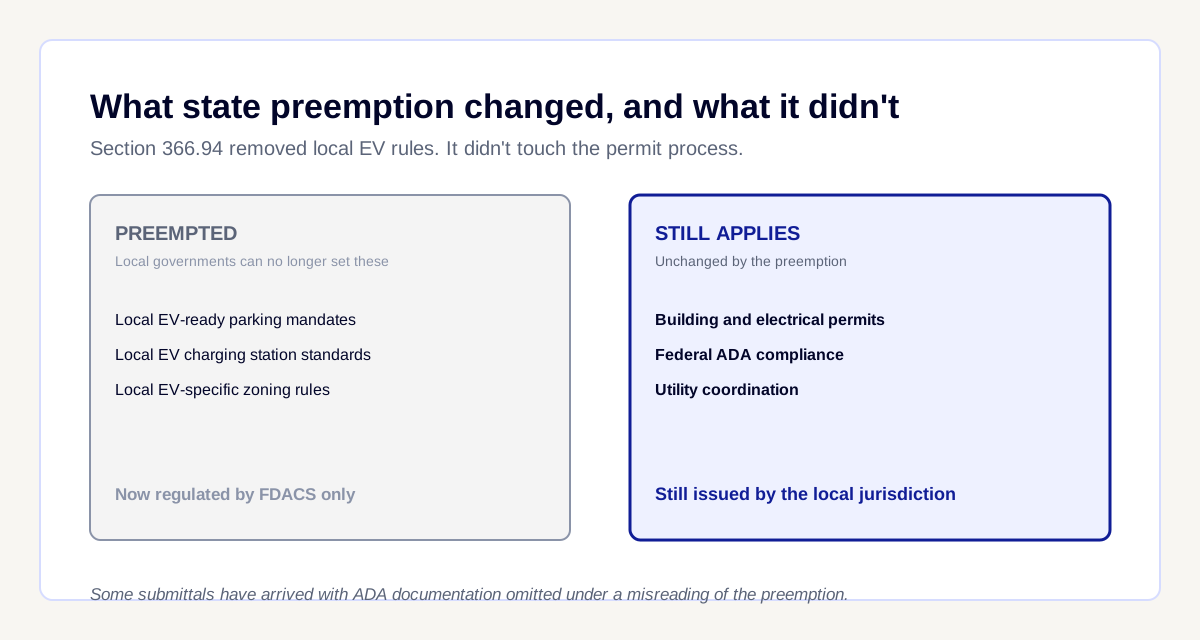
What the preemption does not change: the Florida Building Code still governs the construction work, electrical permits are still issued and inspected by local jurisdictions, and utility coordination still runs through the serving utility. The preemption removes local regulatory requirements around EV charging station standards and zoning. It does not eliminate the building permit process.
Florida also has a statewide EVSE registration requirement for public commercial chargers through FDACS under Rule 5J-28, effective May 1, 2025, with enforcement of signage, registration, and prohibition sections beginning December 1, 2025. Operators who had existing chargers were required to register by December 1, 2025. New installations must register annually.
The utility picture in Florida is the most fragmented of any state in this series, a contrast to Nevada’s single-utility footprint. Florida Power and Light (FPL), Duke Energy Florida, Tampa Electric (TECO), Gulf Power (now integrated into FPL/NextEra), JEA, OUC, Gainesville Regional Utilities, Lakeland Electric, and numerous rural electric cooperatives each operate separately, with separate interconnection processes, rebate programs, and timeline expectations. Utility territory in Florida is not intuitive from city or county alone. Confirm the serving utility by project address before design.
Do you need a permit to install an EV charger in Florida?
Yes. The Florida Building Code requires permits for any new electrical circuit installation, including EV charger wiring. An electrical permit is required for all commercial EV charging installations statewide. A building permit is also required under Florida Statute § 553 where structural work accompanies the installation: trenching, canopy installation, pedestal anchoring, or any site modification. For DCFC installations at 50 kW or above, an electrical permit under the commercial construction track applies, which carries additional plan review requirements.
The contractor performing the work must hold a Certified Electrical Contractor (EC) license issued by the Florida Department of Business and Professional Regulation (DBPR). As of July 1, 2025, House Bill 735 eliminated the old local registered license pathway. All contractors now must hold a state Certified license, valid statewide, through DBPR examination and application.
How EV Charger Permitting Works in Florida
Florida’s permit structure has three distinct tracks operating independently: the electrical and building permit through the local jurisdiction, the FDACS statewide registration for public commercial chargers, and utility coordination through the serving utility.
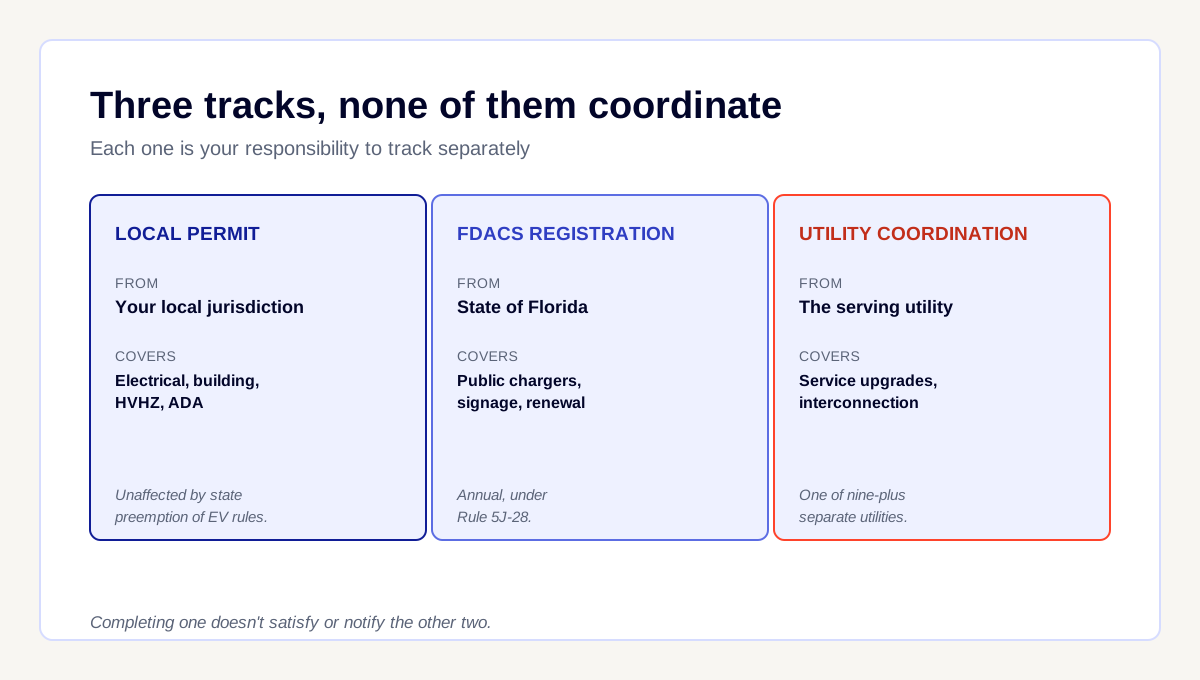
Electrical permits are issued and inspected by the local jurisdiction under the Florida Building Code and NEC 2023. The contractor must hold an active DBPR Certified Electrical Contractor (EC) license. Florida’s exam is administered by Pearson VUE and as of September 2025 references the 2023 NEC. All certified electrical contractor licenses renew on August 31 of even-numbered years; an expired license is grounds for rejection at permit intake.
The Florida Building Code (FBC) is the statewide baseline for commercial construction, including EV charging installations. The FBC adopts the NEC and the International Building Code with Florida-specific amendments. Florida’s hurricane exposure and flood zone requirements are built into the FBC and affect conduit burial depth, equipment enclosure ratings, and, in some coastal and flood-zone areas, may trigger additional review from the Florida Building Commission. High-velocity hurricane zone (HVHZ) requirements apply in Miami-Dade and Broward counties and add a layer of wind resistance documentation not required in other Florida counties.
The state preemption under Section 366.94 means local governments cannot impose EV-specific zoning requirements or local EV charging standards on top of state requirements. This does not exempt projects from standard building code review, ADA compliance, or utility coordination. The local jurisdiction still issues the electrical and building permit. The preemption simply removes local regulatory authority over EV-specific rules, not over construction permitting generally.
FDACS registration is required annually for all public commercial EV charging stations under Rule 5J-28, Florida Administrative Code. Registration requires the operator’s contact information, equipment specifications, EVSE type, and location data. Signage requirements under the FDACS rule include labeling per NIST Handbook 44 and NIST Handbook 130, plus charging safety information. Operators who don’t register are subject to administrative fines, and in cases involving a threat to public health, safety, or welfare, FDACS may issue an immediate final order prohibiting use of the station.
Florida’s utility structure requires confirming the serving utility before design. The investor-owned utilities, FPL, Duke Energy Florida, and Tampa Electric, are regulated by the Florida Public Service Commission and collectively account for approximately 77.7% of statewide retail energy sales. Municipal utilities including JEA (Jacksonville), OUC (Orlando), Gainesville Regional Utilities, and Lakeland Electric operate independently with their own interconnection processes and rate structures. Rural electric cooperatives including Clay Electric and Suwannee Valley Electric serve other areas under different regulatory structures under Florida Statutes Chapter 425. None of these utilities’ processes are interchangeable.
Active Jurisdictions in Florida
Florida has 67 counties and 411 incorporated municipalities. These are the jurisdictions with the most commercial EV charging permit activity:
| Jurisdiction | Authority | Notes |
|---|---|---|
| Miami-Dade County | Miami-Dade Building Department | High-velocity hurricane zone (HVHZ) requirements apply; wind resistance documentation required beyond standard FBC. FPL territory. High density of fleet and commercial charging development. Separate permitting from City of Miami. |
| City of Miami | Miami Building Department | Separate from Miami-Dade County. FPL territory. HVHZ requirements apply. DCFC installations require FPL New Business service work order before energization. |
| Broward County | Broward County Building Division | HVHZ requirements apply. FPL territory for most of the county. Separate from incorporated municipalities including Fort Lauderdale and Hollywood, which have their own building departments. |
| Palm Beach County | Palm Beach County Building Division | FPL territory. Covers unincorporated areas; incorporated cities including West Palm Beach have separate building departments. |
| Orlando / Orange County | Orange County Building Division | OUC (Orlando Utilities Commission) serves most of Orlando proper; Duke Energy Florida serves surrounding Orange County areas. Confirm utility before design; OUC and Duke have separate interconnection processes. OUC offers a commercial EV charging service where OUC owns and maintains the equipment. |
| Tampa / Hillsborough County | Hillsborough County Development Services | Tampa Electric (TECO) territory for most of Hillsborough County. City of Tampa has a separate building department from the county. TECO commercial EV program runs separately from city permitting. |
| Jacksonville | Jacksonville Building Inspection | JEA is the municipal utility serving Jacksonville. JEA offers rebates of $850 per Level 2 port and $3,000 per DCFC port (50 kW or above). JEA interconnection runs separately from city permitting. |
| Pinellas County | Pinellas County Building Department | Duke Energy Florida territory for most of the county. Covers unincorporated areas; St. Petersburg and Clearwater have separate building departments. |
Don’t see your jurisdiction? Florida has 411 incorporated municipalities. Contact us at hello@rhonda.build if you need requirements for a specific Florida jurisdiction.
Relevant Code References
NEC Article 625, Electric Vehicle Power Transfer System (NEC 2023)
Florida’s electrical code baseline for EVSE installation, adopted through the Florida Building Code. Article 625 governs circuit sizing, disconnecting means, continuous load calculations, GFCI requirements, and grounding. DCFC installations at 50 kW or above also require consideration of NFPA 70E (2024 edition) for arc flash hazard analysis at the service entrance.
Florida Building Code (FBC), Florida Statute § 553
The statutory basis for construction permitting in Florida. Both an electrical permit and, where structural work accompanies the EVSE installation, a building permit are required under § 553. The FBC incorporates the IBC with Florida-specific amendments, including hurricane and flood zone requirements that affect equipment enclosure ratings, conduit burial depth, and site work specifications.
Florida Statute § 366.94, Electric Vehicle Charging (as amended by SB 1084, 2024)
Preempts local government authority over EV charging station regulation. Local governments may not enact or enforce ordinances or regulations related to EV charging stations. Regulation is vested exclusively in FDACS. Does not affect the local jurisdiction’s authority over building and electrical permits.
Rule 5J-28, Florida Administrative Code, EV Charging Station Standards
FDACS final rules implementing § 366.94, effective May 1, 2025. Covers safety, design, signage, permitting, zoning, registration, and enforcement. Requires annual registration of all public commercial EV charging stations. Signage must comply with NIST Handbook 44 and NIST Handbook 130. Enforcement provisions effective December 1, 2025.
Florida Statute § 339.287, State Highway Electrification Plan
Requires FDOT to maintain a master plan for EV charger development along the State Highway System, including emergency evacuation staging areas. Relevant for projects sited along state highway corridors that may intersect with FDOT right-of-way requirements.
ADA Standards for Accessible Design (2010)
Federal accessibility requirements apply to all public-facing commercial EV charging installations regardless of the state preemption. The preemption removes local EV-specific zoning requirements; it does not affect ADA compliance obligations.
FPSC Rule 25-6.065, Net Metering and Distributed Energy Resource Interconnection
Governs interconnection for solar-paired EV charging installations through Florida’s investor-owned utilities. Relevant for projects combining solar generation, battery storage, and EV charging, where the DER interconnection process applies on top of the standard service upgrade process.
Common Permit Corrections and Rejections for EV Charging Projects in Florida
Florida’s corrections are consistent with the national pattern at the electrical and ADA level, with two Florida-specific layers: the HVHZ requirements in Miami-Dade and Broward, and the multi-utility confusion that comes from Florida’s fragmented utility landscape.
Electrical
Missing or incorrect load calculations
The branch circuit must be sized at 125% of the EVSE nameplate amperage per NEC 625.41. A full load calculation under NEC Article 220 is required before sizing any EV charger circuit. Projects that omit the continuous load multiplier, or that calculate against panel rating rather than actual connected load, receive a correction before plan review advances.
Expired or incorrect DBPR license
All commercial EV charging electrical work requires an active DBPR Certified Electrical Contractor (EC) license. As of July 1, 2025, the old local registered license pathway has been eliminated; only statewide Certified licenses are valid for commercial work. Licenses renew August 31 of even-numbered years. Applications with an expired or locally registered (rather than certified) license are rejected at intake.
HVHZ documentation missing in Miami-Dade and Broward
Projects in the high-velocity hurricane zone must document compliance with wind resistance requirements under the Florida Building Code’s HVHZ provisions. Plans submitted without HVHZ documentation in Miami-Dade and Broward counties are flagged at plan review. This applies to equipment enclosures, canopy structures, and conduit installation specifications.
DCFC commercial track not triggered at 50 kW threshold
Commercial EVSE at 50 kW or above requires permitting under the commercial construction track with additional plan review requirements. Projects that submit a 50 kW+ DCFC installation under the residential or light commercial track receive a correction requiring resubmission under the correct track.
Wiring method not specified
Plans must specify conduit type, burial depth, support intervals, and routing. Florida’s wet climate and flood zone exposure affect conduit material selection; PVC conduit in below-grade runs must be specified to appropriate schedules for burial in high-moisture environments. Plans that omit wiring method specifications are flagged at plan review.
Site / ADA
No accessible route shown
Plans must show a continuous accessible route from accessible parking spaces to the charger controls. This is the most frequent ADA correction on commercial EV submittals across all Florida markets.
Clear floor space not documented
The U.S. Access Board requires a minimum clear ground space of 30 inches by 48 inches at each accessible charger, not sloped more than 1:48, and unobstructed by curbs, wheel stops, bollards, or landscaping. Plans that don’t document this receive a correction.
Flood zone grading conflicts with ADA slope requirements
In Florida’s flood-prone areas, site grading requirements for stormwater management frequently conflict with ADA maximum slope requirements at accessible EV stalls. Grading to meet FEMA flood zone elevation requirements can push surface slopes beyond the 1:48 ADA limit. This requires careful civil engineering coordination at the design stage; it is not resolvable at plan review without redesign.
Preemption misapplied to ADA compliance
The Section 366.94 preemption removes local regulatory authority over EV charging station standards. It does not remove ADA compliance requirements, which are federal. Some submittals have arrived with ADA documentation omitted under a misreading of the preemption scope. ADA compliance is still required.
Signage not compliant with FDACS Rule 5J-28
FDACS Rule 5J-28 requires signage including NIST Handbook 44 and NIST Handbook 130 labeling and charging safety information. Plans that don’t address FDACS signage requirements for public commercial installations are flagged; this is a new correction category that did not exist before the rule’s December 1, 2025 enforcement date.
Utility Coordination
Not confirming the serving utility before design
Florida’s utility territory is the most fragmented of any state in this series. FPL, Duke Energy Florida, Tampa Electric, JEA, OUC, Gainesville Regional Utilities, Lakeland Electric, Gulf Power (now FPL), and multiple rural cooperatives each serve distinct territories with separate interconnection processes. Designing to FPL’s service upgrade process for a project in OUC or Duke territory produces incorrect results. Confirm the serving utility by project address before electrical design begins.
FPL New Business process not initiated before construction
For service upgrades, FPL requires a service work order request through its contractor portal before work begins. Failure to notify FPL before construction results in delayed meter reconnection after inspection. FPL’s New Business process, governing transformer sizing review and distribution infrastructure cost responsibility, can include extended engineering review for DCFC installations requiring significant service upgrades. Timelines for commercial fleet charging applications at scale range from 60 to 180 days depending on grid constraints at the point of interconnection.
Duke Energy Florida and TECO interconnection not treated as separate from FPL
Duke Energy Florida serves the central Florida corridor including parts of Orange County, the Tampa Bay area, and the western Panhandle. Tampa Electric (TECO) serves Hillsborough County. Both have interconnection processes separate from FPL. Projects in Duke or TECO territory that apply FPL process assumptions will encounter gaps at the utility coordination stage.
JEA and OUC municipal utility processes not initiated separately
JEA (Jacksonville) and OUC (Orlando) are municipal utilities operating independently of the Florida PSC-regulated IOUs. Their interconnection processes, rebate programs, and timeline expectations differ from FPL, Duke, and TECO. OUC offers a commercial EV charging service model where OUC owns and maintains equipment; this is a separate program track from standard utility interconnection and requires early coordination with OUC to determine which path applies.
Solar + storage + EV combined load not disclosed at DER interconnection
Projects combining solar generation, battery storage, and EV charging trigger the DER interconnection process under FPSC Rule 25-6.065 at Florida’s investor-owned utilities. Projects that don’t disclose the full system configuration, particularly BESS systems capable of grid export, at the outset of utility coordination frequently encounter late-stage interconnection requirements.
Permitting shouldn’t be the bottleneck on your next charging site.
Rhonda makes permitting for commercial solar, battery storage, and EV charging infrastructure predictable. Pre-check your plan set against Florida’s state requirements and the specific jurisdiction and utility requirements for your project before you submit. See what Rhonda catches before your jurisdiction does.
← Back to the State and City Requirement Guide Library
Footnotes
- Florida Department of Agriculture and Consumer Services, EV Charging Stations
- Florida Statute § 366.94, Electric Vehicle Charging (2025)
- Rule 5J-28, Florida Administrative Code, Drive Electric Florida Summary
- Florida Statute § 553, Florida Building Act
- House Bill 735 (2025), Elimination of local registered contractor license pathway
- DBPR Electrical Contractors Licensing Board
- NEC Article 625, Electric Vehicle Power Transfer System (NEC 2023, NFPA 70)
- NEC Article 220, Branch Circuit, Feeder, and Service Load Calculations
- Florida PSC, 2025 Ten Year Site Plans Review
- Florida Utility Interconnection for EV Charging
- FPL Commercial EV Charging
- Duke Energy Florida Commercial EV
- JEA Electrification Rebates
- OUC Commercial EV Charging Service
- FPSC Rule 25-6.065, Net Metering and DER Interconnection
- U.S. Access Board, EV Charging Station Accessibility
- AFDC, Florida Laws and Incentives