EV Charging Permit Requirements in Colorado
Colorado has more legislative activity around EV charging permitting than any other state in this series, with two major 2023 to 2024 laws, a new state EVSE registration program, and electrical permit authority split between DORA and authorized local jurisdictions.

Colorado has more legislative activity around EV charging permitting than any other state in this series. In 2023 and 2024 alone, the legislature passed two significant laws, HB23-1233 and HB24-1173, that restructured how local governments handle EV charging permits and what multifamily and commercial buildings must provide. A new retail EVSE registration program through the Division of Oil and Public Safety took effect July 1, 2026. And the Colorado State Electrical Board adopted revised licensing and permit rules in January 2026.
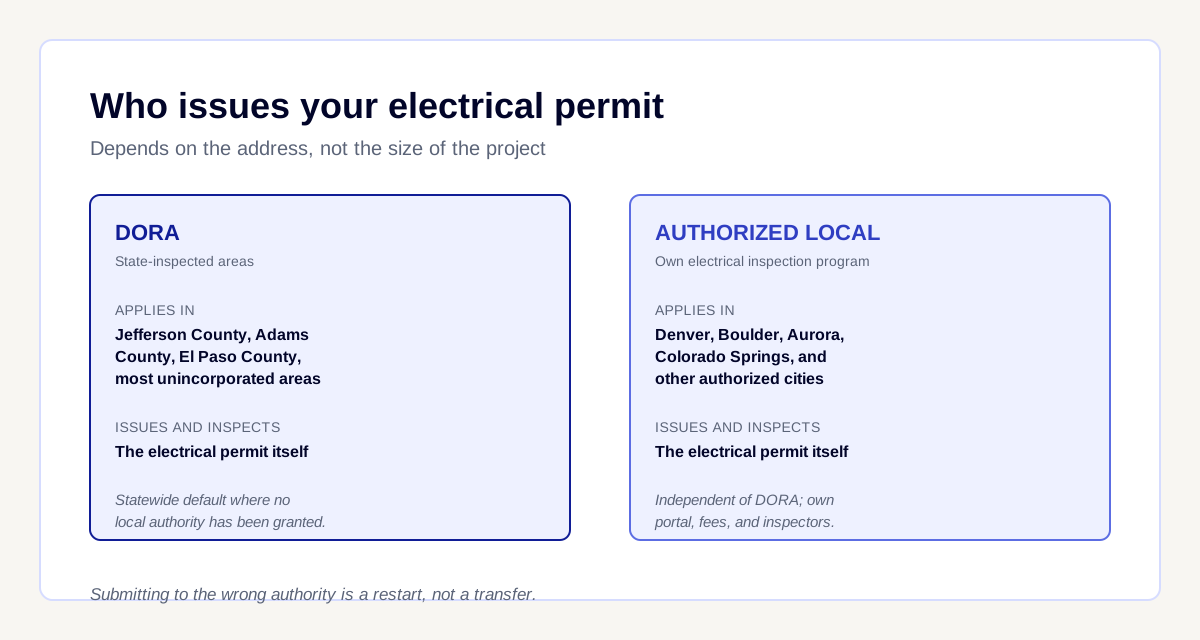
The result is a permitting environment that is more standardized than Texas or Arizona but more jurisdictionally fragmented than Nevada. Electrical permit authority in Colorado is split between DORA (the Department of Regulatory Agencies) for state-inspected areas and authorized local inspection jurisdictions for cities and counties that have been granted their own electrical inspection authority. Denver, Boulder, Aurora, Colorado Springs, and several other jurisdictions operate their own electrical inspection programs. The utility picture is similarly complex: Xcel Energy serves the Front Range but Colorado Springs Utilities, Black Hills Energy, and numerous rural electric cooperatives serve other parts of the state under different rules.
Do you need a permit to install an EV charger in Colorado?
Yes. All Level 2 EVSE installations require an electrical permit in Colorado. DCFC installations require an electrical permit and typically a building permit as well, given the service upgrade and site work involved. The permit requirement is statewide: it applies in Denver, in smaller Front Range cities, and in rural counties.
Contractors cannot work under another company’s permit in Colorado. Work started before a permit is issued may be subject to double fees. The Colorado State Electrical Board enforces these requirements through DORA, and stop work orders must be followed immediately.
Public commercial EV chargers installed after July 1, 2026 must also be registered with the Colorado Division of Oil and Public Safety (OPS) within 30 calendar days of being placed into service, under the state’s new Retail EV Charger Program. This is a separate operational registration requirement that sits on top of the local building permit, not a replacement for it.
How EV Charger Permitting Works in Colorado
Colorado’s permit structure has three separate tracks that run independently: the electrical permit, the building permit, and, for public commercial chargers, the DORA retail EVSE registration. Utility coordination runs in parallel with all three.
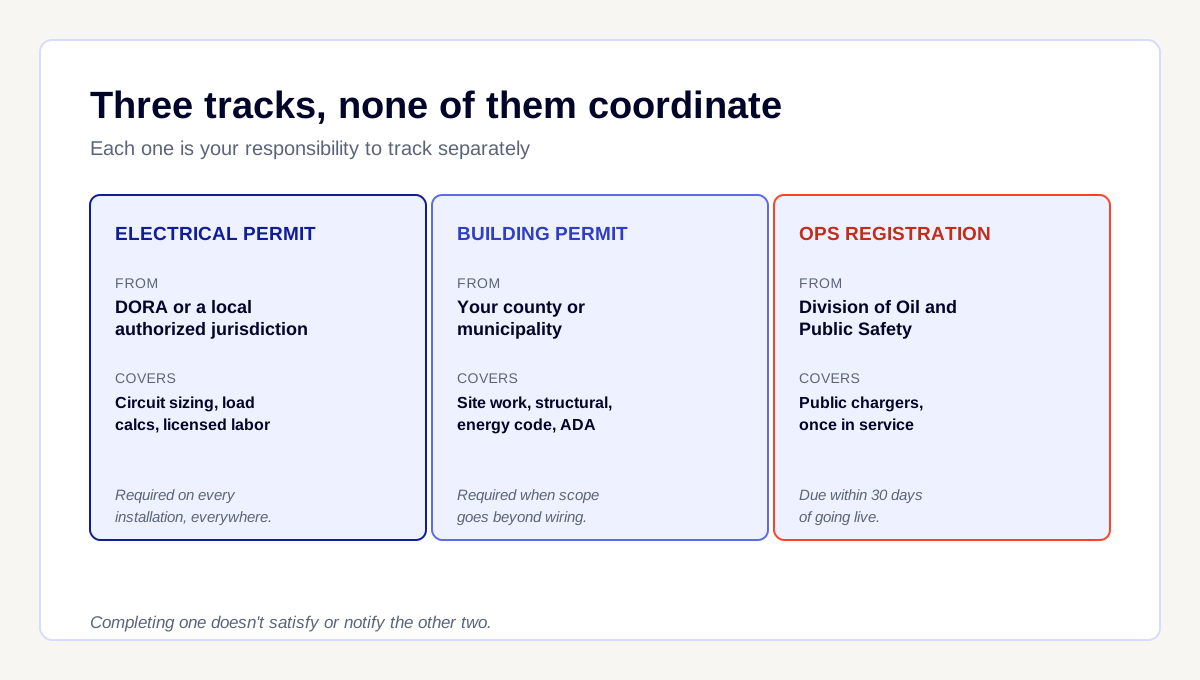
Electrical permit authority is split between state and local. DORA issues and inspects electrical permits in state-inspected areas. Denver, Boulder, Aurora, Colorado Springs, and other jurisdictions that have been granted local electrical inspection authority issue and inspect electrical permits independently. Verify which authority applies to your project address before submitting; submitting to the wrong authority is a restart.
The building permit is issued by the county or municipality. Colorado counties and municipalities adopt and enforce their own building codes and local amendments. State law establishes minimum energy code requirements when covered jurisdictions update their codes, but the adopted building code, permit forms, and review process vary by jurisdiction. Some projects may also require separate fire, zoning, structural, or energy storage review depending on the jurisdiction.
The state NEC baseline is the 2023 edition. Colorado enforces NFPA 70: National Electrical Code 2023 as the statewide minimum. Local jurisdictions may adopt amendments or more recent editions. The Colorado State Electrical Board confirmed the 2023 NEC as the enforced standard in its January 2026 rule revision. NEC Article 625 governs EVSE installation: circuit sizing, disconnecting means, continuous load calculations, GFCI requirements, and grounding.
HB24-1173 restructured local EV charging permitting as of December 31, 2025. Every county with a population of 20,000 or more and every municipality with a population of 10,000 or more was required to take one of three actions by December 31, 2025: adopt the Colorado Energy Office’s EV Charger Permitting Model Code, establish its own objective standards and administrative review process, or formally affirm its existing permitting review process. Covered jurisdictions that established their own process must provide applicants a checklist of all requirements and submit a compliance report to the CEO by March 1, 2026. The practical effect: developers should request the current permit checklist from any Colorado jurisdiction before submitting, since that checklist is now a legal requirement, not optional guidance.
Denver has its own EV code requirements on top of the state baseline. Section C405.13 of the 2022 Denver Energy Code governs the quantity of EV spaces required in commercial projects. Section 1107 of the 2022 Denver Commercial Building Code governs accessible and universal spaces for installed EV charging stations. These requirements are specific to Denver and must be addressed during the Site Development Plan process, not just at building permit stage.
The retail EVSE registration program is new and applies to public commercial chargers. The Colorado Division of Oil and Public Safety’s Retail EV Charger Program took effect July 1, 2026. Public commercial chargers installed after July 1, 2026 must be registered with OPS within 30 calendar days of being placed into service. Chargers installed before that date must be registered by January 1, 2027. The program requires registration of manufacturer, model, serial number, EVSE type, voltage, current, power rating, and connector types. Chargers used for free charging where no retail transaction occurs, and those owned or operated by public utilities, are exempt.
Colorado Springs operates under a different utility structure. Colorado Springs Utilities (CSU) is a municipal utility that operates outside direct PUC jurisdiction and runs its own net metering and interconnection rules. Applying Xcel Energy assumptions to a Colorado Springs project will produce incorrect results.
Active Jurisdictions in Colorado
Colorado has 64 counties and 271 incorporated cities and towns. The Front Range, the Denver-Boulder-Colorado Springs corridor, accounts for the majority of commercial EV charging activity. These are the jurisdictions with the most active commercial EV charging permit activity:
| Jurisdiction | Authority | Notes |
|---|---|---|
| Denver | Denver Community Planning and Development | Authorized local electrical inspection jurisdiction, separate from DORA. 2022 Denver Energy Code (DEC) and 2022 Denver Commercial Building Code (DCBC) impose EV space requirements that must be addressed at Site Development Plan stage. Xcel Energy territory for most of the city. |
| Boulder | Boulder Community Planning and Sustainability | Authorized local electrical inspection jurisdiction. Uses traditional plan review rather than SolarAPP+; Boulder County processes separately. Xcel Energy territory. Active reach code development; verify local amendments before design. |
| Aurora | Aurora Building Inspection | Authorized local electrical inspection jurisdiction. Xcel Energy territory. Part of the Denver metro commercial market. |
| Colorado Springs | Colorado Springs Building and Development Review | Authorized local electrical inspection jurisdiction. Colorado Springs Utilities (CSU) is the serving utility; CSU operates independently of Xcel and PUC jurisdiction. Do not apply Xcel interconnection assumptions to Colorado Springs projects. |
| Fort Collins | Fort Collins Building Services | Fort Collins Utilities serves the city, a municipal utility. Separate interconnection process from Xcel. Fort Collins has been active in EV-ready building policy. |
| Jefferson County (unincorporated) | Jefferson County Planning and Zoning | State-inspected area; DORA issues electrical permits. Building permits through Jefferson County. Xcel Energy territory. |
| Adams County (unincorporated) | Adams County Building | State-inspected area in most jurisdictions within the county. Heavy logistics and industrial corridor north of Denver. Xcel Energy territory. |
| El Paso County (unincorporated) | El Paso County Development Services | State-inspected area. Colorado Springs Utilities or Black Hills Energy depending on location; verify utility before design. |
Don’t see your jurisdiction? Colorado has 271 incorporated cities and towns. Contact us at hello@rhonda.build if you need requirements for a specific Colorado jurisdiction.
Relevant Code References
NEC Article 625, Electric Vehicle Power Transfer System (NEC 2023)
Colorado’s statewide electrical code baseline for EVSE installation, confirmed as the enforced standard by the Colorado State Electrical Board in January 2026. Article 625 governs circuit sizing, disconnecting means, continuous load calculations, GFCI requirements, and grounding. Local jurisdictions may adopt amendments on top of the state baseline.
Colorado Revised Statutes Title 12, Article 115, Electrical Practice Act
The statutory basis for electrical contractor licensing in Colorado, administered by the Colorado State Electrical Board through DORA. All electrical work on commercial EV charging installations must be performed by a Board-licensed electrical contractor. Colorado does not maintain blanket reciprocity agreements with all states; out-of-state electricians must satisfy Board examination or experience equivalency requirements before working in Colorado.
HB24-1173, Electric Vehicle Charging System Permits (effective August 7, 2024)
Establishes permitting procedures for EV charging systems for covered counties (population 20,000+) and covered municipalities (population 10,000+). Required covered jurisdictions to take compliance action by December 31, 2025. Requires jurisdictions that establish their own process to provide applicants a checklist of all permit requirements and to provide written findings for any permit denial. Establishes an appeal process for denied permits.
HB23-1233, Electric Vehicle Charging and Parking Requirements (effective 2023)
Required the Colorado State Electrical Board to adopt rules mandating compliance with EV power transfer infrastructure requirements in the Model Electric Ready and Solar Ready Code for multifamily buildings, effective March 1, 2024. Expanded prohibitions on landlords and HOAs from unreasonably blocking EV charging installation.
2022 Denver Energy Code (DEC), Section C405.13
Denver-specific: governs the quantity of EV spaces required in commercial projects. Applies on top of state baseline requirements and must be addressed during the Site Development Plan process.
Colorado Division of Oil and Public Safety, Retail EV Charger Program (effective July 1, 2026)
Requires registration of all retail EVSE placed in service after July 1, 2026 within 30 calendar days. Existing equipment must be registered by January 1, 2027. Incorporates NIST Handbook 44 (2025 edition), Section 3.40, which governs Electric Vehicle Fueling Systems for metrological accuracy. New installations after July 1, 2026 must have an active NTEP Certificate of Conformance.
ADA Standards for Accessible Design (2010)
Federal accessibility requirements apply to all public-facing commercial EV charging installations. Denver’s 2022 Commercial Building Code Section 1107 governs accessible and universal EV charging spaces within the city and county, with specific requirements beyond the federal floor.
Common Permit Corrections and Rejections for EV Charging Projects in Colorado
Colorado’s split electrical permit authority, DORA versus authorized local jurisdictions, is the most common source of submittal confusion. The NEC-based corrections are consistent across jurisdictions. Denver’s local code requirements add an additional layer.
Electrical
Missing or incorrect load calculations
The branch circuit must be sized at 125% of the EVSE nameplate amperage per NEC 625.41. A full load calculation under NEC Article 220 is required before sizing any EV charger circuit. Projects that omit the continuous load multiplier, or that calculate against panel rating rather than actual connected load, receive a correction before plan review advances.
Wrong electrical permit authority
In state-inspected areas, electrical permits go through DORA. In Denver, Boulder, Aurora, Colorado Springs, and other authorized local jurisdictions, electrical permits go through the local authority. Submitting to the wrong authority requires resubmission. Verify which authority applies before submitting.
Unlicensed or out-of-state contractor
All commercial EV charging electrical work requires a Board-licensed contractor under CRS Title 12, Article 115. Colorado does not have blanket reciprocity with other states for electrical trades. Out-of-state contractors working in Colorado without satisfying Board requirements are subject to stop-work orders and disciplinary proceedings.
Working before permit issuance
The Colorado State Electrical Board’s January 2026 rule revision explicitly addressed this: work started before a permit is issued may be subject to double fees. Stop work orders must be followed immediately. Reinspection fees apply when a site is not ready, inaccessible, or unsafe.
Denver EV space requirements not addressed at SDP stage
For projects in Denver, EV space requirements under Section C405.13 of the Denver Energy Code must be addressed during the Site Development Plan process, not at the building permit stage. Projects that reach building permit review without having addressed EV space requirements in the SDP receive a correction requiring plan revision and re-review.
NEC Article 625 energy management system provisions not addressed
The 2023 NEC includes updated requirements in Article 625 for EV charging systems, including provisions for energy management systems and bidirectional charging equipment. Projects that cite earlier NEC editions or that don’t address the energy management system provisions for larger multi-port installations receive corrections from plan reviewers enforcing the 2023 code.
Site / ADA
No accessible route shown
Plans must show a continuous accessible route from accessible parking spaces to the charger controls. This is the most frequent ADA correction on commercial EV submittals across all Colorado markets.
Clear floor space not documented
The U.S. Access Board requires a minimum clear ground space of 30 inches by 48 inches at each accessible charger, not sloped more than 1:48, and unobstructed by curbs, wheel stops, bollards, or landscaping. Plans that don’t document this receive a correction.
Denver Section 1107 accessible and universal space requirements not addressed
Denver’s 2022 Commercial Building Code Section 1107 governs accessible and universal EV charging spaces with requirements beyond the federal ADA floor. Projects in Denver that only address federal ADA standards without addressing Section 1107 receive a correction.
Signage omitted
Accessible EV stalls require specific marking and signage under federal ADA standards and Denver’s local code. Consistently missing from civil and site sheets on first submittal.
High-altitude equipment and conduit derating not addressed
Colorado’s elevation, Denver sits at 5,280 feet and mountain communities can be at 8,000 to 10,000 feet, affects electrical equipment ratings and conduit fill calculations. Equipment rated at sea level may require derating at elevation. Plans that don’t address altitude derating for equipment installed at high elevation may receive a correction from technically thorough reviewers, particularly in mountain resort markets.
Utility Coordination
Applying Xcel Energy assumptions to non-Xcel territory
Xcel Energy (Public Service Company of Colorado) serves the Front Range including Denver and Boulder, but Colorado Springs Utilities, Black Hills Energy, Fort Collins Utilities, and numerous rural electric cooperatives serve other parts of the state under different rules and processes. Colorado Springs Utilities operates outside direct PUC jurisdiction. Fort Collins Utilities is a municipal utility. Projects that apply Xcel interconnection assumptions, rebate structures, or timeline expectations to a project in Colorado Springs, Fort Collins, or rural cooperative territory will encounter gaps at the utility coordination stage.
Starting utility coordination after permit approval
Xcel Energy’s commercial EV charging infrastructure process, covering service design from the customer’s meter to the charging port, runs on Xcel’s schedule, not the jurisdiction’s. DCFC installations requiring transformer sizing or service upgrades trigger Xcel engineering review. Initiating Xcel coordination at the same time as the jurisdiction permit application is the most reliable way to prevent utility coordination from extending the overall project timeline.
Xcel rebate program requirements not confirmed before design
Xcel’s commercial EV charging rebates have specific equipment eligibility requirements: ENERGY STAR certification, networked EVSE capable of supporting managed charging programs, and compliance with Xcel’s grid-integration requirements. Projects that select equipment before confirming Xcel rebate eligibility may find their chosen equipment doesn’t qualify. For income-qualified projects or those in high-emissions communities, rebate amounts differ from standard commercial rates. Confirm current program requirements with Xcel before finalizing equipment selection.
DORA retail EVSE registration not planned into project closeout
Public commercial chargers installed after July 1, 2026 must be registered with the Colorado Division of Oil and Public Safety within 30 calendar days of being placed in service. This is the operator’s responsibility, not the contractor’s, and it is separate from the local building permit closeout. Projects that commission chargers without completing OPS registration are out of compliance under the Retail EV Charger Program.
Colorado Energy Office incentive programs not coordinated with project timeline
The CEO’s Charge Ahead Colorado program provides grant funding for community-based Level 2 and DCFC installations, up to $4,500 per Level 2 port and up to $70,000 per DCFC. These grants have application cycles and funding caps. Projects that don’t apply for CEO funding early in the development process frequently miss application windows.
Permitting shouldn’t be the bottleneck on your next charging site.
Rhonda makes permitting for commercial solar, battery storage, and EV charging infrastructure predictable. Pre-check your plan set against the specific jurisdiction and utility requirements for your Colorado project before you submit. See what Rhonda catches before your jurisdiction does.
← Back to the State and City Requirement Guide Library
Footnotes
- Colorado State Electrical Board / DORA, Electrical Licensing
- Colorado Revised Statutes Title 12, Article 115, Electrical Practice Act
- HB24-1173, Electric Vehicle Charging System Permits (effective August 7, 2024)
- HB23-1233, Electric Vehicle Charging and Parking Requirements
- Colorado Energy Office, Local Government EV Charging Permitting
- Colorado Division of Oil and Public Safety, Retail EV Charger Program
- OPS Retail EV Charger Program Guidance
- NEC Article 625, Electric Vehicle Power Transfer System (NEC 2023, NFPA 70)
- NEC Article 220, Branch Circuit, Feeder, and Service Load Calculations
- Denver EV Charging Spaces Requirements
- Denver Commercial EV Requirements
- Xcel Energy Colorado EV Solutions
- Colorado Energy Office, Charge Ahead Colorado Program
- AFDC, Colorado Laws and Incentives
- Colorado State Electrical Board January 2026 Rule Revisions
- U.S. Access Board, EV Charging Station Accessibility