Solar Permit Requirements in Texas
Texas has no statewide building code that applies uniformly to commercial construction, so solar permitting runs through whatever code edition your jurisdiction has adopted. Layer on a wind-load structural stamp, TDLR electrical licensing, and interconnection through a TDU or municipal utility, and the process looks nothing like a state with a single codebook.


Do you need a permit to install solar in Texas?
Yes. A building permit is required for the racking, structural attachment, and any site work, and an electrical permit is required for the PV system wiring, inverters, and interconnection equipment. Every major Texas city enforces this through its own permitting process, and for commercial installations, ground-mount arrays, and any system on new construction, both permits typically require full plan review with structural calculations and fire department coordination.
The complication is the same one that shows up across Texas’s EV charging permitting: there is no statewide building code that applies uniformly to commercial construction. Texas sets minimum standards, but each jurisdiction adopts its own edition of the International Building Code, the National Electrical Code, and any local amendments, on its own timeline. Two commercial solar projects thirty miles apart can be reviewed under different code editions with different requirements. Texas also passed streamlined permitting laws in 2025, SB 1202 and SB 1252, but both apply only to residential backup power systems on one- or two-family dwellings at 600 volts or less. Commercial solar doesn’t qualify for either one and goes through standard local plan review.
How Solar Permitting Works in Texas
Commercial solar in Texas runs through three tracks that don’t automatically coordinate: TDLR electrical licensing, a local jurisdiction permit where the code edition varies by city, and utility interconnection through whichever entity owns the wires at your site.
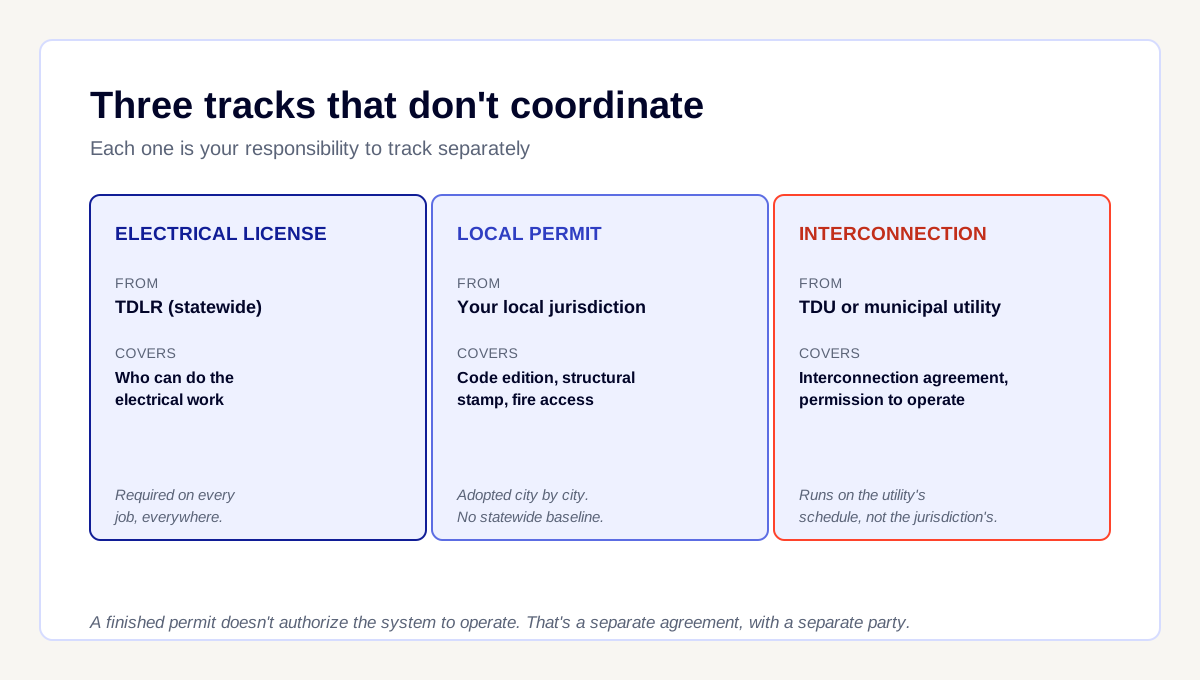
TDLR electrical licensing is the statewide baseline, the same as it is for EV charging. All electrical work performed under a permit requires a licensed electrician working under a Texas Electrical Contractor License. TDLR sets this floor everywhere in the state; it doesn’t touch what a local jurisdiction requires beyond the electrical scope. One place solar diverges from EV charging: TDLR’s newer registration layer for EV charging, the EVSE registration required under Senate Bill 1001, applies to public commercial chargers. Solar’s equivalent statewide registration, created by the Residential Solar Retailer Regulatory Act (effective for registration on September 1, 2026), explicitly exempts nonresidential property and multifamily buildings of four units or more. For commercial solar, that third statewide layer simply doesn’t exist. Commercial projects have two tracks to satisfy before interconnection, not three.
The local permit is where the code itself gets decided, jurisdiction by jurisdiction. Most Texas cities that enforce a commercial building code do so through the International Building Code and the National Electrical Code, but which edition, and which local amendments layer on top, is a city-by-city decision. Houston, Dallas, Austin, and San Antonio are all currently working from the 2020 NEC, which means rapid shutdown compliance under NEC 690.12 and its labeling requirements sit in NEC 690.56(C) rather than the newer 690.12(D) numbering used once a jurisdiction adopts the 2023 edition. Submitting a plan set citing the wrong edition’s section numbers is a real source of confusion on Texas solar projects, more so than in states with a single statewide code cycle.
Structural review carries more regional variation in Texas than in most states, because wind exposure varies so much across the state. Gulf Coast jurisdictions, Houston included, require structural calculations that account for hurricane-force wind uplift, commonly built around 110+ mph design wind speeds depending on exposure category. Inland jurisdictions still require wind and hail load calculations, just against different design values. Almost every commercial rooftop or ground-mount array needs a PE-stamped structural package regardless of location; what changes is the load case the engineer has to design against.
Utility interconnection is a separate track entirely, governed by the Public Utility Commission of Texas (PUCT) under Substantive Rule 25.211, not by the jurisdiction issuing the permit. This is where Texas looks structurally different from almost every other state in this series. Most of Texas sits on the ERCOT grid, a power system with limited interconnection to the rest of the country, which is why Texas answers to the PUCT and the Texas Legislature on interconnection policy rather than FERC. Within that structure, who you actually interconnect with depends on the site: an investor-owned Transmission and Distribution Utility (Oncor, CenterPoint Energy, or AEP Texas) regulated under PUCT Rule 25.211, or a municipal utility like Austin Energy or CPS Energy that runs its own interconnection program largely outside that rule. Either way, the interconnection agreement and permission-to-operate are separate from, and run on a different clock than, the local building and electrical permit.
Active Jurisdictions in Texas
These are the jurisdictions with the most commercial solar permit activity, using the same footprint as our EV charging guide:
| Jurisdiction | Authority | Notes |
|---|---|---|
| Houston | Houston Permitting Center | No zoning ordinance; the building permit is the primary land-use instrument. CenterPoint Energy handles interconnection separately from the city permit. Structural stamps must account for Gulf Coast hurricane wind loads. Working from the 2020 NEC. |
| Austin | Austin Development Services | Building and electrical permits both required for commercial solar. Austin Energy is a municipal utility and runs its own Value of Solar interconnection program, separate from Development Services review and outside PUCT Rule 25.211. |
| Dallas | Dallas Building Inspection | Commercial electrical and building permits required. Oncor serves Dallas; interconnection runs through Oncor’s DG portal, separate from the city permit timeline. PE stamp required on commercial structural packages. |
| San Antonio | San Antonio Development Services | Commercial permits required. CPS Energy, a municipal utility, handles interconnection and credits exports at its own avoided-cost rate rather than following PUCT Rule 25.211. |
| Fort Worth | Fort Worth Development Services | Oncor territory. Maintains its own permit checklist and code edition separate from Dallas despite proximity; confirm the adopted edition before submitting. |
| Austin Energy territory | Austin Energy (municipal utility) | Commercial systems between 50 kW-AC and 10 MW-AC route through the Solar Standard Offer Program, interconnected on the utility side of the meter, with its own application and Letter of Approval process ahead of construction. |
| Unincorporated areas | Varies by county / TDLR | Some counties have no commercial building code enforcement at all. TDLR electrical licensing still applies to the electrical work regardless. Utility interconnection still runs through whichever TDU or co-op serves the site. |
Don’t see your jurisdiction? Texas has over 1,200 incorporated municipalities. Contact us at hello@rhonda.build if you need requirements for a specific Texas city or county.
Relevant Code References
NEC Article 690, Solar Photovoltaic (PV) Systems (adopted locally)
Governs PV system installation: circuit sizing, disconnecting means, rapid shutdown, and grounding and bonding. Texas has no statewide code adoption authority, so which NEC edition applies, and therefore which section numbers govern rapid shutdown labeling, depends entirely on what your specific jurisdiction has adopted.
NEC 690.12, Rapid Shutdown of PV Systems on Buildings
The most frequently cited item at Texas solar plan review, same as everywhere else. Under the 2020 NEC, still current in Houston, Dallas, Austin, and San Antonio, labeling requirements sit in 690.56(C). Jurisdictions on the 2023 edition move that labeling requirement to 690.12(D) and add an explicit rapid-shutdown exemption for non-enclosed detached structures like solar carports.
PUC Substantive Rule 25.211, Interconnection of On-Site Distributed Generation
The statewide framework governing how distributed generation, including commercial solar, interconnects with a utility’s distribution system in Texas. Sets the terms for both investor-owned Transmission and Distribution Utilities and, in part, cooperative and municipal systems.
PUC Substantive Rule 25.212, Technical Requirements for Interconnection
Companion rule to 25.211, setting the technical standards for parallel operation, including inverter certification. IEEE 1547-2018 compliance, typically demonstrated through UL 1741 SA listing, is the baseline every TDU requires.
Residential Solar Retailer Regulatory Act (2025)
Grants TDLR authority over residential solar sales and leasing contracts, cancellation rights, and, starting September 1, 2026, registration of solar retailers and salespeople. Explicitly exempts systems on nonresidential property and multifamily buildings of four units or more, so it doesn’t reach commercial solar installers.
SB 1202 (2025), Third-Party Review for Home Backup Power
Lets homeowners use qualified third-party reviewers, licensed PEs, NABCEP-certified professionals, master electricians, in place of municipal plan review for backup power systems on one- or two-family dwellings at 600 volts or less. Commercial solar projects don’t qualify.
International Building Code / International Energy Conservation Code (locally adopted)
Governs structural requirements for racking attachment, wind and hail load design, and, in cities that have moved to the 2024 IECC, on-site renewable energy or renewable energy credit requirements for new commercial construction. Adoption, and the specific edition in force, is a city-by-city decision with no statewide floor.
TDLR Electrical Contractor Licensing
All electrical work performed under a Texas permit, including solar PV installation, must be performed by a licensed electrician under a valid Texas Electrical Contractor License. This is the one piece of the process TDLR sets statewide.
Common Permit Corrections and Rejections for Commercial Solar Projects in Texas
Texas’s jurisdiction-by-jurisdiction fragmentation means correction patterns vary more city to city here than in states with a single statewide code. The corrections below are the ones that show up consistently across the major markets.
Structural / Fire
Missing or unstamped structural calculations
Commercial rooftop and ground-mount arrays need PE-stamped calculations showing dead load, wind uplift, and, on the Gulf Coast, hurricane-exposure design values, plus attachment details tied to the specific roof or foundation structure. This is close to universal across Texas jurisdictions and is the most common reason a commercial submittal stalls before review even starts.
Wind and hail rating not documented for the region
A structural package built to inland wind values on a Houston-area project, or vice versa, comes back as a correction. Design wind speed and exposure category have to match the actual site, not a generic regional assumption.
Fire and roof access requirements missing or mismatched to the local amendment
Roof access pathway and setback requirements come from whatever fire code edition and local amendments the jurisdiction has adopted, and that adoption isn’t uniform across Texas. Plans built against one city’s roof access standard and submitted to a different jurisdiction get flagged for not matching the applicable local amendment.
Electrical
Incomplete rapid shutdown documentation
NEC 690.12 rapid shutdown is the most-cited electrical correction on Texas solar submittals, same as it is everywhere else. Whether the labeling requirement lives under 690.56(C) or 690.12(D) depends on the jurisdiction’s adopted NEC edition, and reviewers hold plans to whichever one their city enforces.
Wrong NEC edition assumed
Houston, Dallas, Austin, and San Antonio are all currently on the 2020 NEC. A plan set drafted against 2023 NEC requirements and submitted to a jurisdiction still enforcing 2020 creates section-number mismatches that force a resubmittal. Confirm the adopted edition before finalizing drawings, not after intake.
Inverter one-line diagram doesn’t match cut sheets
Same failure mode as everywhere: the inverter model on the one-line diagram has to match the manufacturer spec sheet submitted with the application, and reviewers check them directly against each other.
Missing or invalid TDLR license number
All commercial electrical work requires a TDLR-licensed electrical contractor, and the license number has to appear on the application. Applications without a valid license number are rejected at intake, not flagged for correction later.
Utility Coordination
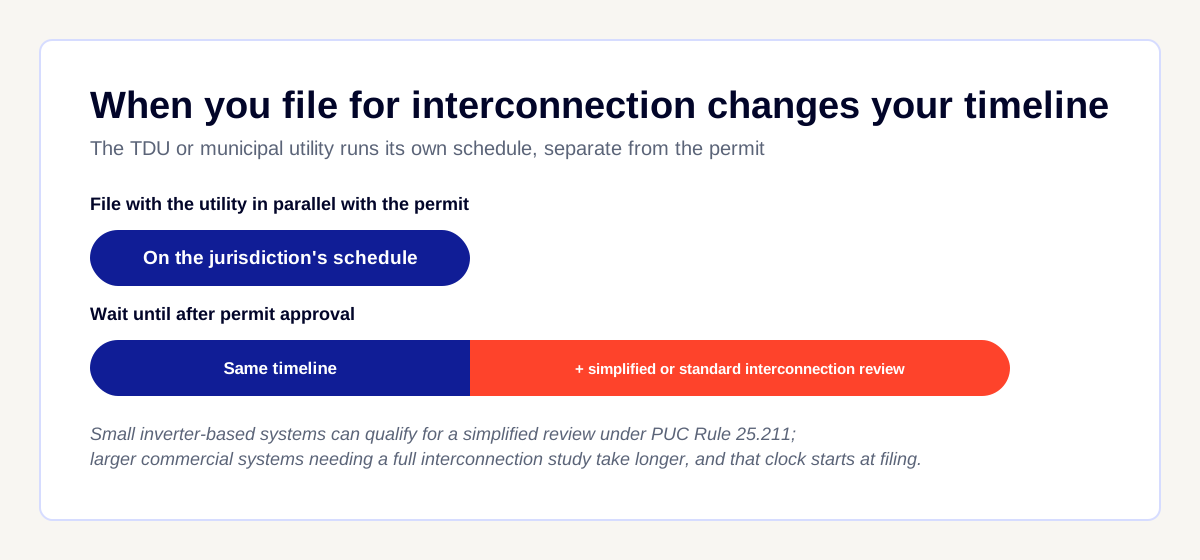
Starting interconnection after permit approval
Interconnection with the TDU or municipal utility runs on its own schedule, independent of the jurisdiction’s permit process. Filing that application in parallel with the building permit is the biggest schedule lever available on a Texas commercial solar project.
Assuming ERCOT or a Retail Electric Provider handles interconnection
Neither one does. ERCOT balances supply and demand on the grid; a Retail Electric Provider sells electricity and bills the customer. Interconnection, service upgrades, and the agreement that lets a system operate all run through the TDU serving the site, or the municipal utility if the project sits in Austin Energy or CPS Energy territory.
Municipal utility assumptions applied to TDU territory, or vice versa
Austin Energy and CPS Energy aren’t part of ERCOT’s competitive retail market and don’t follow PUCT Rule 25.211 the way Oncor, CenterPoint, and AEP Texas do. Austin Energy commercial systems between 50 kW-AC and 10 MW-AC go through its Solar Standard Offer Program with its own Letter of Approval step before construction can start. A project team that applies Oncor’s process to an Austin Energy site, or the reverse, loses time reworking the interconnection application.
Simplified review threshold miscalculated
Smaller, inverter-based systems that meet IEEE 1547 and UL 1741 SA certification can qualify for a simplified interconnection review with limited engineering study. Larger commercial systems, or anything requiring a full interconnection study, take considerably longer, and that clock starts when the utility receives the application, not when the permit is approved.
Permitting shouldn’t be the bottleneck on your next solar site.
Rhonda makes permitting for commercial solar, battery storage, and EV charging infrastructure predictable. Pre-check your plan set against Texas’s state code and the specific local amendments for your jurisdiction before you submit, so corrections don’t cost you weeks. See how Rhonda can help.
← Back to the State and City Requirement Guide Library
Footnotes
- TDLR, Electrical Contractors and Electricians
- TDLR, Residential Solar Retail Sales Now Regulated by TDLR
- SB 1202 (89th Legislature, 2025), Texas Legislature Online
- NEC Article 690, Solar Photovoltaic (PV) Systems (adopted locally by jurisdiction)
- PUC Substantive Rule 25.211, Interconnection of On-Site Distributed Generation
- PUC Substantive Rule 25.212, Technical Requirements for Interconnection and Parallel Operation of On-Site Distributed Generation
- ERCOT, Distributed Generation Resources
- Oncor, Energy System Developers / DG Interconnection
- CenterPoint Energy, Distributed Generation Application Process FAQs
- Austin Energy, Distribution System Interconnection Guide for Customer-Owned Generation
- Austin Energy, Solar Standard Offer Program
- Texas Municipal League, Building Codes (home-rule adoption authority)
- Houston Permitting Center, Solar PV Permit Checklist (Go Solar Texas)
- Austin Development Services
- Dallas Building Inspection
- San Antonio Development Services
- PUCT, Texas TDU and ERCOT Market Overview