Solar Permit Requirements in Nevada
NV Energy dominates utility coordination in Nevada, so that part of the process runs through one entity. Local permitting is another story: Clark County's own solar rulebook pulls nearly every commercial project into PE-stamped structural and electrical review well before it reaches NV Energy's interconnection queue.

Do you need a permit to install solar in Nevada?
Yes. Nevada requires a building permit for the racking, structural attachment, and any site work, and an electrical permit for the PV system wiring, inverters, and interconnection equipment, on every commercial solar installation. Ground-mount arrays add fire-clearance and foundation review; roof-mounted arrays add fire department access-pathway review under the state’s adopted fire code. There’s no commercial-scale exemption. Clark County’s own solar guidance waives detailed structural submittals only for small residential systems that meet a narrow prescriptive checklist, and almost no commercial project qualifies.
Nevada’s EV charging guide found a state where a single dominant utility, NV Energy, keeps utility coordination simple while local permitting fragments into four separate Las Vegas-metro jurisdictions. Solar permitting in Nevada runs through that same jurisdictional skeleton, but no Nevada jurisdiction has adopted SolarAPP+ automated permitting, and the code stack layered on top of local review is different. Instead of NEC Article 625 and ADA accessible-route review, commercial solar has to clear NEC Article 690 rapid shutdown, IFC Chapter 12 rooftop access geometry, and PE-stamped structural calculations before a project ever reaches NV Energy’s interconnection queue.
How Solar Permitting Works in Nevada
Nevada’s permitting authority structure for solar is the same one our EV charging guide found: local jurisdictions, not any single state agency, issue the permit and run plan review. Electrical contractor licensing is statewide through the Nevada State Contractors Board (NSCB). Everything else, adopted code edition, plan review timeline, structural submittal requirements, varies by jurisdiction, and the Las Vegas metro alone is split across four of them: Clark County (unincorporated), the City of Las Vegas, Henderson, and North Las Vegas.
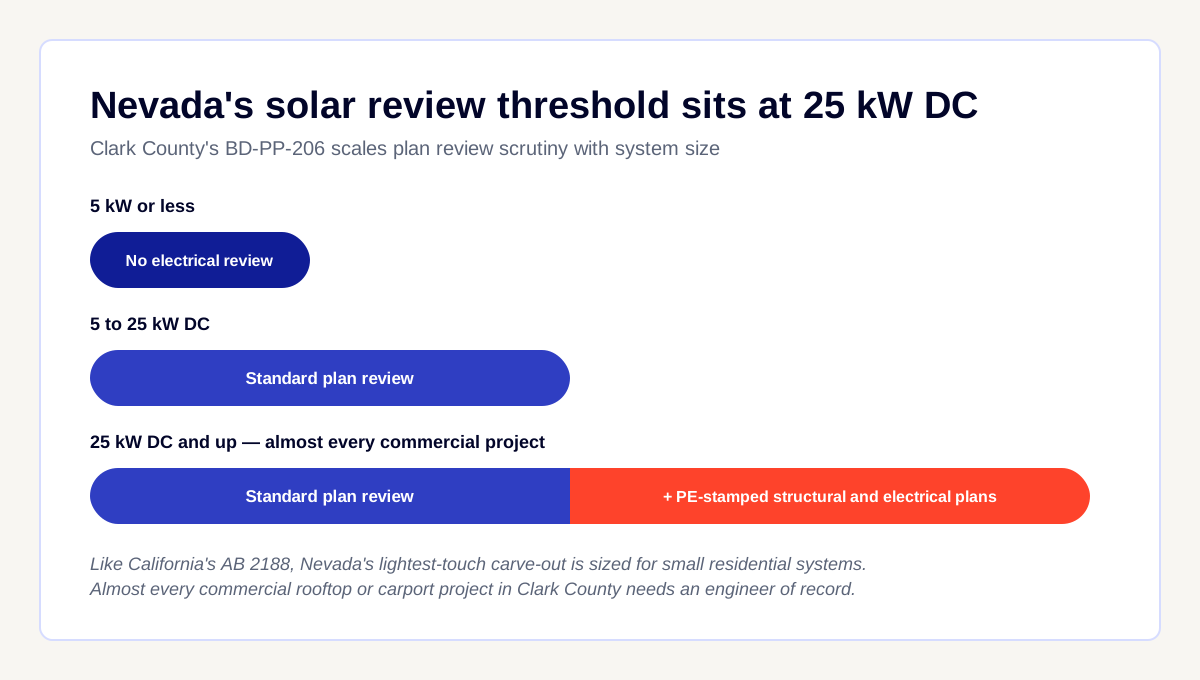
Clark County’s Building Department publishes the most detailed solar-specific guidance in the state, policy BD-PP-206, revised April 2026 against the 2024 IFC, 2024 IBC, 2024 IRC, ASCE 7-22, and 2023 NFPA 70 (Nevada’s NEC edition). It sets a size ladder that determines how much scrutiny a project gets: no electrical plan review required at or under 5 kW, standard review through 25 kW DC, and PE-stamped structural and electrical plans required at 25 kW DC and above. Almost every commercial rooftop or carport project clears that 25 kW line by a wide margin, so in practice, commercial solar in Clark County always needs an engineer of record.
The electrical permit is filed against NEC Article 690, the governing article for PV system installation, adopted through the 2023 edition of NFPA 70. NEC 690.12 rapid shutdown compliance carries the same labeling weight it does in every other state, but Nevada’s fire code, IFC Section 1205.4, actually specifies the label design: a yellow background and black text for a label indicating full-array shutdown, a red background and white text where only the conductors leaving the array are shut down, mounted within 3 feet of the service disconnect. Reviewers check the label spec, not just whether a label exists.
The building permit covers structural attachment and roof access. IFC Section 1205 requires a 6-foot clear perimeter around roof edges, reducible to 4 feet on buildings where either axis is 250 feet or less, two 36-inch pathways from the lowest roof edge to the ridge, and a ridge setback that steps from 18 inches to 36 inches once the array covers more than 33% of the roof, not the 66% coverage line used elsewhere. Ground-mounted arrays get a different fire clearance entirely: a 10-foot brush-free perimeter, with fire apparatus access lanes kept clear of racking. That’s a desert-terrain concern that doesn’t come up the same way in denser coastal markets.
Structural review scales with how the system is mounted. Freestanding, ground-mounted arrays need a Nevada Registered Design Professional’s stamp on foundation, anchorage, and structural frame calculations under the IBC and ASCE 7-22, unless the array is under 10 feet tall with less than 100 square feet of net wind area. Roof-attached commercial systems need the same PE stamp addressing wind, seismic, snow, and dead load, plus a Risk Category determination and an existing-structure evaluation under the International Existing Building Code. There’s no prescriptive waiver path for commercial work the way there is for small residential installs.
Contractor licensing has a wrinkle that doesn’t show up in EV charging. The NSCB’s C-2g subclassification (NAC 624.200) authorizes installation, alteration, and repair of PV cells, batteries, and inverters for residential and commercial installations, but it explicitly excludes wiring beyond the service panel and any system “scaled or intended solely for the commercial production and sale of electricity.” That carve-out matters at true commercial scale: large ground-mount projects built to sell power back rather than serve the host building’s own load fall outside C-2g and need the broader C-2 electrical classification instead. Reviewers check the license class against the project’s declared intent, not just its size.
Active Jurisdictions in Nevada
These are the jurisdictions seeing the most commercial solar permit activity, with the same profile as our EV charging guide:
| Jurisdiction | Authority | Notes |
|---|---|---|
| Clark County (unincorporated) | Clark County Building Department | Publishes policy BD-PP-206 with detailed solar-specific requirements against the 2024 IFC, IBC, and IRC, ASCE 7-22, and 2023 NFPA 70. Engineer-stamped plans required at 25 kW DC and above. Covers unincorporated areas including the Strip. |
| City of Las Vegas | Las Vegas Building and Safety | Separate permitting authority from Clark County. Publishes its own solar information bulletin. Commercial systems require full plan review, including separate structural and electrical sub-permits. |
| Henderson | Henderson Building Division | Separate from Clark County. Building division fees are based on actual plan review and inspection cost recovery. NV Energy territory. |
| North Las Vegas | North Las Vegas Building Safety | Separate from Clark County. Fast-growing logistics and industrial market driving large rooftop and carport solar demand. NV Energy territory. |
| Reno | Reno Building and Safety | Washoe County seat. Adopted 2024 building codes July 2025. Commercial submittals require NEC 690.8 overcurrent protection documentation, IRC Chapter 3 structural load calculations, and IFC Section 605 fire safety compliance. |
| Sparks | Sparks Community Services, Building Safety | Separate from Reno and Washoe County. NV Energy territory. |
| Washoe County (unincorporated) | Washoe County Community Services | Covers unincorporated areas around Reno and Sparks. Commercial and non-residential solar routes to Building, Fire Prevention, and Planning together. First review targeted within 10 business days; permits expire 18 months after issuance. |
Don’t see your jurisdiction? Nevada has 17 counties and 19 incorporated cities. Contact us at hello@rhonda.build if you need requirements for a specific Nevada jurisdiction.
Relevant Code References
NEC Article 690, Solar Photovoltaic (PV) Systems (2023 NFPA 70)
Governs PV system installation: circuit sizing, disconnecting means, rapid shutdown, and grounding and bonding. NEC 690.12 rapid shutdown compliance is the electrical baseline every Nevada jurisdiction checks against, with Nevada’s fire code layering on specific label design requirements.
International Fire Code, 2024 Edition, Section 1205
Sets roof access pathway, ridge setback, perimeter clearance, and rapid shutdown label requirements for solar PV systems, as adopted by Clark County and other Nevada jurisdictions. Ridge setbacks step from 18 to 36 inches at 33% roof coverage rather than the 66% line used in some other states’ amended fire codes. Ground-mounted systems get a separate 10-foot brush-free perimeter requirement.
2024 International Building Code and ASCE 7-22
Sets the structural load basis, wind, seismic, snow, and dead load, for both roof-attached and freestanding commercial solar. Freestanding, ground-mounted arrays require a Nevada Registered Design Professional’s stamp unless they fall under a narrow small-system exception.
Nevada Administrative Code 624.200, Classification C-2, Subclassification (g) Photovoltaics
Defines the C-2g scope: installation, alteration, and repair of PV cells, batteries, and inverters for residential and commercial installations. Explicitly excludes wiring beyond the service panel and any system scaled or intended solely for commercial production and sale of electricity, which requires the broader C-2 classification instead.
NRS 704.771 and NRS 704.773, Net Metering
Caps net metering system eligibility at 1 megawatt, or 150% of the customer’s peak demand if lower, and guarantees a net metering customer-generator the right to continue net metering for 20 years. Systems above the 1 MW cap fall outside net metering entirely and interconnect as generating facilities instead.
NV Energy Electric Rule No. 15, Generating Facility Interconnections
The Public Utilities Commission of Nevada (PUCN) adopted these interconnection standards in December 2003, modeled on IEEE 1547, NARUC’s model interconnection agreement, and California’s own interconnection rule. Rule 15 covers on-site generation up to 20 megawatts, with applications submitted through NV Energy’s PowerClerk portal.
Common Permit Corrections and Rejections for Commercial Solar Projects in Nevada
Commercial solar permitting in Nevada touches the local jurisdiction, the fire authority, and NV Energy, each with its own review and its own way to send a project back. The corrections that show up most often fall into three categories.
Structural / Fire
Missing PE stamp on a ground-mount design
Freestanding, ground-mounted arrays need a Nevada Registered Design Professional’s stamp on foundation, anchorage, and structural frame calculations under the IBC and ASCE 7-22. Submittals that rely on manufacturer installation instructions alone, without confirming the project qualifies for the narrow small-system exception, get bounced back for a stamped package.
Roof access pathway or ridge setback geometry doesn’t match the coverage percentage
IFC 1205 ties ridge setback directly to how much of the roof the array covers, 18 inches up to 33% coverage, 36 inches above it, plus the 6-foot perimeter and two 36-inch pathways to the ridge. Site plans that don’t show the actual coverage calculation next to the setback dimension are a common correction.
Ground-mount fire clearance not shown
The 10-foot brush-free perimeter around ground-mounted arrays, and keeping racking clear of fire apparatus access lanes, is easy to miss on civil sheets built from a generic template. This is a distinctly Nevada correction tied to the state’s desert terrain and wildfire exposure in outlying areas.
Existing-structure evaluation missing on retrofit projects
Roof-attached systems on existing buildings need an evaluation under the International Existing Building Code’s alteration provisions, on top of the new load calculations. Submittals that only show the new PV load without addressing the existing structure’s capacity come back as incomplete.
Electrical
Rapid shutdown label doesn’t match the IFC spec
Nevada’s fire code specifies exact label colors and text for rapid shutdown: yellow background and black text for full-array shutdown, red background and white text where only the conductors outside the array are shut down. Plans that show a generic rapid shutdown label without matching the correct color scheme to the actual shutdown type get flagged.
Engineer-stamped plans missing above 25 kW DC
Clark County’s electrical plan review threshold sits at 25 kW DC. Submittals sized for that threshold but designed as if the residential prescriptive waiver applied, no engineer stamp, no detailed calculations, are rejected at intake rather than corrected in review.
Wrong NSCB classification for the project’s intent
A C-2g license covers PV installation for a building’s own use. A project designed to sell power back rather than serve host-building load needs the broader C-2 classification. Reviewers check the license against the interconnection purpose stated in the application, not just the system size.
Utility Coordination
Starting Rule 15 interconnection after permit approval
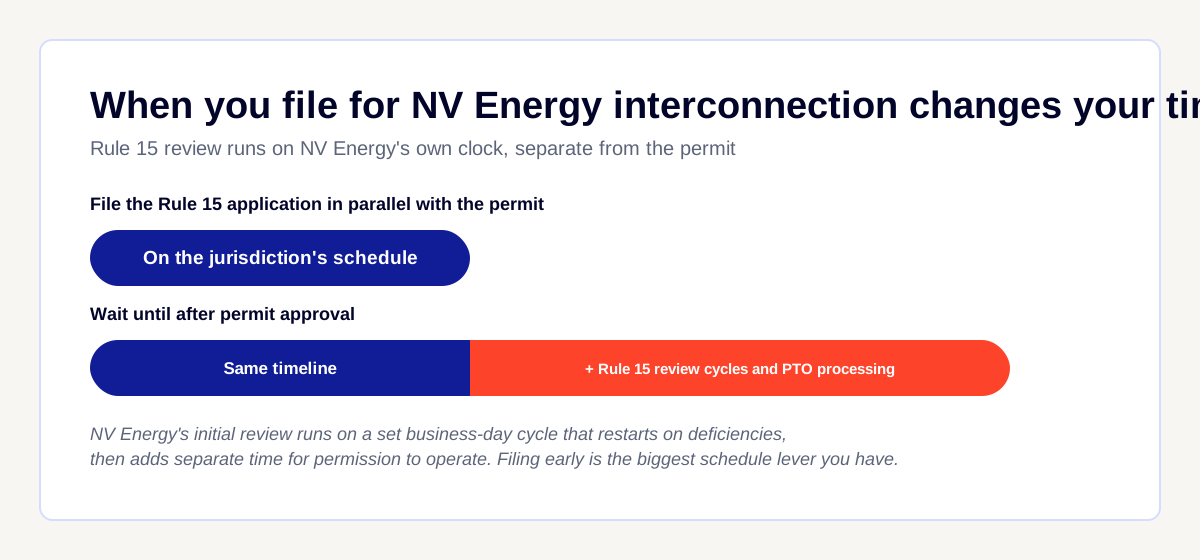
NV Energy’s interconnection review runs on its own schedule, separate from the jurisdiction’s permit process. Filing the Rule 15 application through PowerClerk in parallel with the permit is the biggest lever available to keep a project on schedule.
Assuming net metering applies above the 1 MW cap
NRS 704.771 caps net metering eligibility at 1 megawatt, or 150% of the customer’s peak demand if that’s lower. Projects sized above that cap don’t get net metering treatment at all. They interconnect as generating facilities under Rule 15’s standard process, a different track with different economics than teams sometimes assume going in.
Net metering tariff status not confirmed before design
NV Energy moved to netting solar exports and consumption every 15 minutes instead of monthly, and added a new demand charge, for net metering customers applying after October 1, 2025. Both changes were still working through legal challenges as of mid-2026. Projects designing around a specific net metering tariff should confirm current status with NV Energy and the PUCN before finalizing project economics, not assume the rules will hold still.
Interconnection review corrections restarting the clock
NV Energy’s initial application review runs on a set business-day cycle, and if the application comes back with deficiencies, that cycle restarts from zero on resubmission rather than picking up where it left off. Incomplete PowerClerk submittals are a common, and avoidable, source of added weeks.
Permitting shouldn’t be the bottleneck on your next solar site.
Rhonda makes permitting for commercial solar, battery storage, and EV charging infrastructure predictable. Pre-check your plan set against Nevada’s state code and the specific local amendments for your jurisdiction before you submit, so corrections don’t cost you weeks. See how Rhonda can help.
← Back to the State and City Requirement Guide Library
Footnotes
- Clark County Building Department, BD-PP-206, Solar Photovoltaic Requirements (revised April 2026)
- NEC Article 690, Solar Photovoltaic (PV) Systems, and NEC 690.12, Rapid Shutdown (NFPA 70, 2023 edition)
- International Fire Code, 2024 Edition, Section 1205, Solar Photovoltaic Power Systems
- Nevada Administrative Code 624.200, Classification C-2, Subclassification (g) Photovoltaics
- NRS 704.771, “Net metering system” defined
- NRS 704.773, Net metering requirements (Nevada Revised Statutes, Chapter 704)
- NV Energy Electric Rule No. 15, Generating Facility Interconnections (South)
- Solar United Neighbors / SolarUSA, Nevada Interconnection Standards
- Las Vegas Review-Journal, “NV Energy’s new demand charge likely to stay in place despite objections”
- Nevada Current, “NV Energy peak demand charge, tweak to net metering, violate state law, say experts”
- Washoe County, Solar Photovoltaic (PV) System Permitting Checklist
- Clark County Building Department
- City of Las Vegas Building and Safety, Solar Information
- Reno Building and Safety
- Henderson Building Division
- NAC 624.200, Classification C-2, full text