Solar Permit Requirements in Florida
Florida requires a building permit and an electrical permit for commercial solar, reviewed by the local jurisdiction, but the state's real differentiator is structural. Miami-Dade and Broward's High-Velocity Hurricane Zone requires wind uplift documentation and product approval that most other states never ask for. Here's how the process works, and where projects most often get stuck.

Do you need a permit to install solar in Florida?
Yes. A building permit is required for the racking, structural attachment, and any site work, and an electrical permit is required for the PV system wiring, inverters, and interconnection equipment. Both are issued locally. Unlike Florida’s 2024 preemption of local EV charging regulation, there’s no equivalent statewide preemption for solar. Local jurisdictions still set zoning, still run plan review, and still issue the permit, across all 67 counties and 411 incorporated municipalities.
Florida does have a state-level permitting reform aimed at solar, but it’s narrower than it sounds. CS/CS/CS/HB 683 (2025) added solar energy and energy storage installations to the list of “single-trade” work eligible for an accelerated, privately reviewed permitting track with a 5-business-day deemed-approval deadline. That track applies only to single-family and two-family dwellings. Commercial solar projects don’t qualify and run on the general 20-business-day track instead, the same one that applies to any other commercial building permit.
How Solar Permitting Works in Florida
As with EV charging, the local jurisdiction is the point of contact for both the building and electrical permit, and each of Florida’s 67 counties and 411 municipalities runs its own process. What sets Florida apart from other states in this series isn’t the permitting authority structure. It’s the structural engineering layer sitting on top of it.
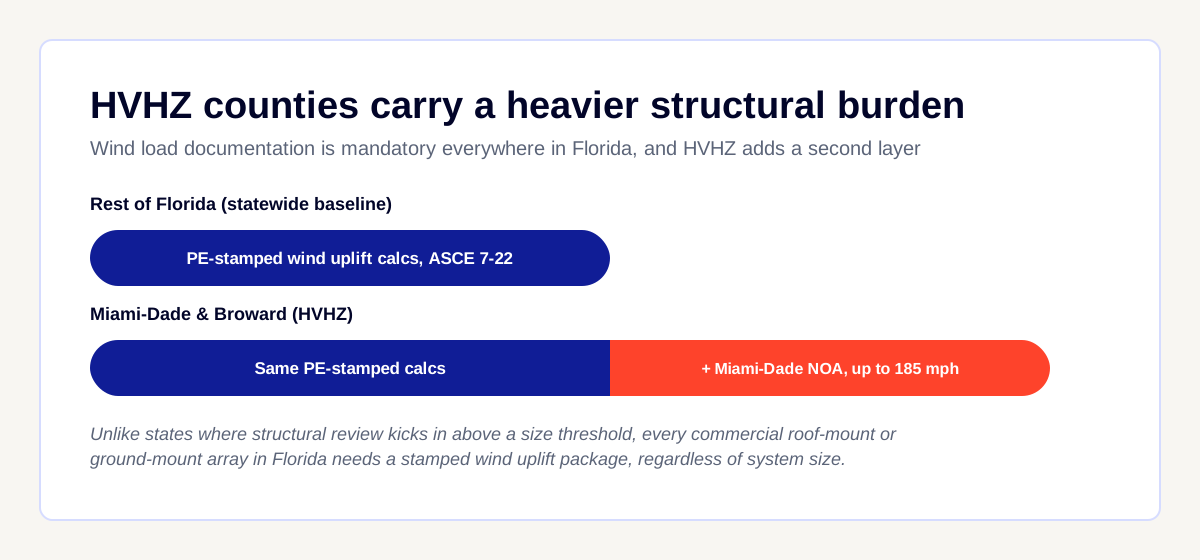
Wind load governs the building permit everywhere in the state. The Florida Building Code (FBC), 8th Edition (2023), effective December 31, 2023, references ASCE 7-22 for structural wind design under Chapter 16. Every commercial roof-mount or ground-mount array needs PE-stamped wind uplift calculations showing the racking and attachment method can handle the site’s design wind speed, tied to its risk category and exposure classification. There’s no size threshold that gets a project out of this. A small commercial rooftop system gets the same structural scrutiny as a large one, which is a different posture than states where structural review is triggered by project size.
Miami-Dade and Broward counties add a second layer. Together they make up Florida’s High-Velocity Hurricane Zone (HVHZ), where design wind speeds for Risk Category II structures run well above what the rest of the state requires, commonly cited in the 170 to 185 mph range depending on risk category and location. Racking and roof attachment products used in HVHZ need product approval through the Miami-Dade Notice of Acceptance (NOA) process, on top of the statewide Florida Product Approval that most other counties accept on its own. A racking system with statewide approval but no Miami-Dade NOA gets rejected in HVHZ, even if the wind uplift math otherwise checks out.
The electrical permit runs under the FBC’s electrical chapter, which adopts the National Electrical Code by reference. The 8th Edition FBC currently references the 2020 NEC. NEC Article 690 governs PV system installation, and rapid shutdown compliance under 690.12 is checked closely at plan review, the same as it is everywhere else in this series: labeled disconnects, initiation devices, and rapid shutdown zones all need to match the equipment list shown on the site plan.
Contractor licensing runs through the state, not the jurisdiction. Florida requires a state-issued license through the Department of Business and Professional Regulation (DBPR), not a local registration. Solar work qualifies under the Certified Solar Contractor (CV) classification, which covers PV, solar thermal, and solar pool heating for both residential and commercial scope, or under a Certified Electrical Contractor (EC) license, since the underlying work is electrical. Both are state-level certifications valid statewide, the same model the EV charging guide found for electrical contractors after House Bill 735 eliminated Florida’s old local registration pathway.
The Florida Solar Rights Act (Fla. Stat. § 163.04) prohibits local ordinances, deed restrictions, and HOA covenants from banning solar installations outright. An HOA or a recorded covenant governing a deed-restricted commercial park can still set reasonable placement rules, generally limited to south-facing orientation within 45 degrees, but can’t refuse solar approval altogether. For projects sited inside a deed-restricted business park or planned development, that protection matters at the design review stage, before the project ever reaches the jurisdiction’s building department.
Active Jurisdictions in Florida
These are the jurisdictions seeing the most commercial solar permit activity, with the same profile as our EV charging guide:
| Jurisdiction | Authority | Notes |
|---|---|---|
| Miami-Dade County | Miami-Dade Building Department | HVHZ. Racking and attachment products need a Miami-Dade NOA, not just statewide Florida Product Approval. FPL territory. |
| City of Miami | Miami Building Department | Separate permitting from Miami-Dade County. HVHZ applies. FPL territory; Tier 3 commercial systems need FPL interconnection coordination before energization. |
| Broward County | Broward County Building Division | HVHZ applies countywide. FPL territory for most of the county. Fort Lauderdale and Hollywood run their own building departments, separate from the county. |
| Palm Beach County | Palm Beach County Building Division | Outside HVHZ, but still a high-wind coastal county under ASCE 7-22. FPL territory. West Palm Beach and other incorporated cities have separate building departments. |
| Orlando / Orange County | Orange County Building Division | OUC serves Orlando proper; Duke Energy Florida serves surrounding Orange County. Confirm the serving utility before sizing the interconnection application; OUC and Duke run separate review processes. |
| Tampa / Hillsborough County | Hillsborough County Development Services | TECO territory for most of the county. City of Tampa runs a separate building department from the county. |
| Jacksonville | Jacksonville Building Inspection | JEA is the municipal utility serving Jacksonville. Interconnection and any solar rebate program run outside city permitting entirely. |
| Pinellas County | Pinellas County Building Department | Duke Energy Florida territory for most of the county. St. Petersburg and Clearwater run separate building departments. |
Don’t see your jurisdiction? Florida has 411 incorporated municipalities. Contact us at hello@rhonda.build if you need requirements for a jurisdiction not listed here.
Relevant Code References
Florida Building Code (FBC), 8th Edition (2023)
Statewide baseline for commercial construction, effective December 31, 2023. Chapter 16 references ASCE 7-22 for structural wind design. Chapter 27 adopts the National Electrical Code by reference for electrical work.
NEC Article 690 (adopted via FBC Chapter 27, 2020 NEC edition)
Governs PV system installation: circuit sizing, disconnecting means, rapid shutdown, and grounding and bonding. NEC 690.12 rapid shutdown compliance and its labeling requirements are the most frequently cited electrical item at Florida plan review, the same pattern seen nationally.
HVHZ provisions, FBC Chapter 16 (Miami-Dade & Broward counties)
Sets elevated design wind speeds for Risk Category II and higher structures and requires racking and roof attachment products to carry Miami-Dade Notice of Acceptance (NOA) approval, on top of statewide Florida Product Approval.
CS/CS/CS/HB 683 (2025), amending Fla. Stat. § 553.791
Effective July 1, 2025. Defines solar energy and energy storage installations as “single-trade” work eligible for private-provider plans review, including automated or software-based review. The accelerated 5-business-day deemed-approval track applies only to single-trade permits for single-family and two-family dwellings. Other permit applications, including commercial solar, fall under the general 20-business-day deemed-approval track set by the same bill.
Florida Solar Rights Act, Fla. Stat. § 163.04
Prohibits local ordinances, deed restrictions, and HOA covenants from prohibiting solar collectors or other renewable energy devices. Permits reasonable placement restrictions tied to orientation, provided they don’t impair the system’s effective operation.
DBPR License Classifications: CV (Certified Solar Contractor), EC (Certified Electrical Contractor)
Both are state-issued licenses valid statewide, not local registrations. Solar PV, thermal, and pool heating work qualifies under CV; the underlying electrical scope also qualifies under EC. Reviewers check the license class against the submitted scope of work.
Fla. Admin. Code R. 25-6.065, Interconnection and Metering of Customer-Owned Renewable Generation
The Florida Public Service Commission’s interconnection and net metering rule for investor-owned utilities. Sets three size tiers, up to 10 kW, above 10 kW up to 100 kW, and above 100 kW up to 2 MW, each with its own application and technical review requirements, and requires compliance with IEEE 1547.
Common Permit Corrections and Rejections for Commercial Solar Projects in Florida
Commercial solar permitting in Florida touches the local jurisdiction, the structural review tied to wind load, and the serving utility, each with its own review and its own way to send a project back. The corrections that show up most often fall into three categories.
Structural / Wind Load
Missing or unstamped wind uplift calculations
Every commercial roof-mount or ground-mount array needs PE-stamped calculations covering wind uplift under ASCE 7-22, tied to the site’s risk category and exposure classification, plus attachment details specific to the roof or foundation structure. Submittals without a stamped structural package are the most common reason a Florida commercial solar plan check stalls before it starts, and unlike some states, this isn’t optional based on system size.
Missing Miami-Dade NOA in HVHZ
In Miami-Dade and Broward, racking and attachment products need Miami-Dade Notice of Acceptance approval specifically, not just statewide Florida Product Approval. Plans citing only the statewide approval number get flagged the moment the reviewer checks the product against the county’s approved products list.
Roof dead load not verified against the existing structure
Added dead load from racking and modules needs to be checked against the existing roof framing’s live and dead load capacity, especially on retrofit projects where original structural drawings are incomplete or don’t exist. This shows up often on older commercial buildings where the roof structure predates current code.
Electrical
Incomplete rapid shutdown documentation
NEC 690.12 rapid shutdown compliance is the most-cited electrical correction on Florida solar submittals, consistent with the national pattern. Plans need the initiation device location shown on the site plan, plus labeling for the PV disconnect, back-fed breaker, and arc-fault protection that matches the equipment list.
Wrong or expired contractor license on the application
Solar work needs a state-issued DBPR Certified Solar Contractor (CV) or Certified Electrical Contractor (EC) license listed on the application. Submittals listing an expired license, or one not currently active with DBPR, get rejected at intake, the same problem our EV charging guide found with expired Certified Electrical Contractor licenses on charger installations.
Inverter one-line diagram doesn’t match cut sheets
Mismatches between the inverter model shown on the one-line diagram and the manufacturer spec sheet are checked against each other directly and come back as a correction every time.
Utility Coordination
Starting Tier 3 interconnection after permit approval
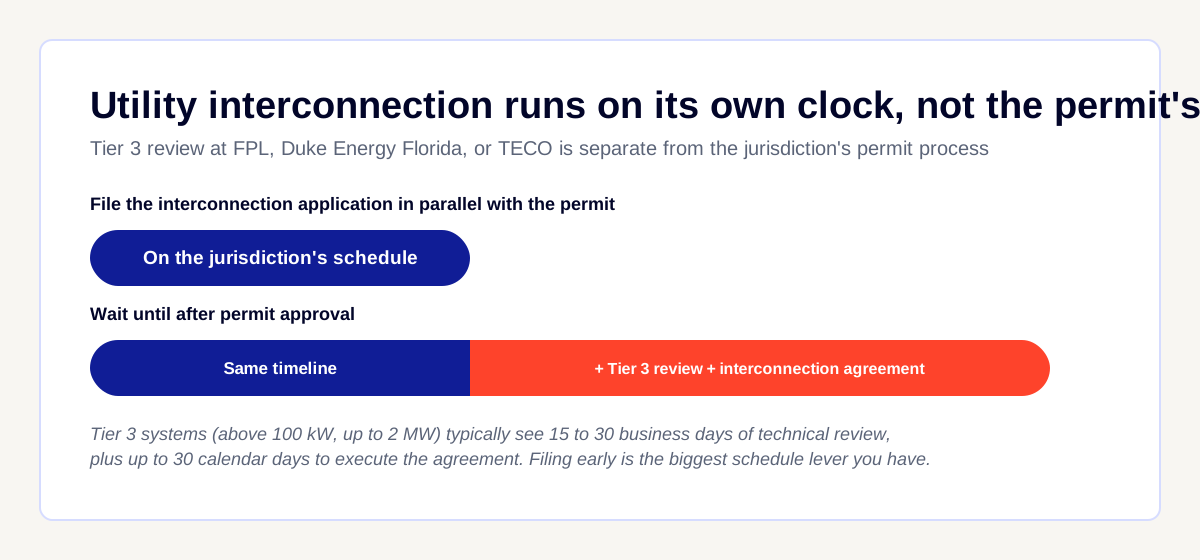
Interconnection review under Rule 25-6.065 runs on the serving utility’s own schedule, separate from the jurisdiction’s permit process entirely. Filing the interconnection application in parallel with the permit, rather than waiting for permit approval first, is the biggest lever available to keep a commercial project on schedule.
Wrong utility assumed for the project address
Florida’s utility landscape is as fragmented for solar as it is for EV charging. FPL, Duke Energy Florida, and TECO each run separate Tier review processes as the state’s investor-owned utilities, while JEA, OUC, and other municipal utilities and rural cooperatives run their own interconnection processes entirely outside Public Service Commission jurisdiction. Confirm the serving utility by project address before sizing the interconnection application.
Tier 3 insurance requirement not budgeted
Systems in the Tier 3 range, above 100 kW up to 2 MW, typically require proof of liability insurance as part of the interconnection application. Projects that don’t budget for this find out at the utility application stage, well after the permit is already moving, which can stall energization even after the building department has signed off.
Permitting shouldn’t be the bottleneck on your next solar site.
Rhonda makes permitting for commercial solar, battery storage, and EV charging infrastructure predictable. Pre-check your plan set against Florida’s state code and the specific local amendments for your jurisdiction before you submit, so corrections don’t cost you weeks. See how Rhonda can help.
← Back to the State and City Requirement Guide Library
Footnotes
- Florida Building Code, 8th Edition (2023), Chapter 16, Structural Design (International Code Council / Florida Building Commission)
- Florida Building Code, 8th Edition (2023), Chapter 27, Electrical (International Code Council)
- ASCE 7-22 Wind Loads Fact Sheet (Florida Building Commission, floridabuilding.org)
- Solar Photovoltaic (PV) Permitting and Plan Submittal Requirements (Miami-Dade County Building Department)
- Florida Statute § 163.04, Florida Solar Rights Act (The Florida Senate)
- CS/CS/CS/HB 683 (2025), Construction Regulations, enrolled bill text (The Florida Senate)
- Florida Statute § 553.791, Alternative Plans Review and Inspection (The Florida Senate)
- Florida Statute § 553.792, Local Government Permit Application Review Timelines (The Florida Senate)
- Fla. Admin. Code R. 25-6.065, Interconnection and Metering of Customer-Owned Renewable Generation (Florida Public Service Commission)
- NEC Article 690, Solar Photovoltaic (PV) Systems (NFPA 70, 2020 edition)
- DBPR Electrical Contractors Licensing Board (Florida Department of Business and Professional Regulation)
- FPL Net Metering Guidelines (Florida Power & Light)
- Duke Energy, Interconnection for Renewable Generation (Duke Energy Florida)
- Tampa Electric (TECO), Connecting Your Solar / Net Metering Application (Tampa Electric Company)
- pv magazine USA, “Florida ushers in a new era of permit reforms for faster, cheaper rooftop solar” (pv magazine USA, July 2025)