Solar Permit Requirements in Colorado
Colorado splits solar electrical permit authority between DORA and authorized local jurisdictions, requires solar-ready roof zones on new commercial construction under a 2023 model code, and funds SolarAPP+ adoption for residential systems only. There's no equivalent fast track for commercial-scale solar. Here's how the process works, and where projects most often get stuck.

Do you need a permit to install solar in Colorado?
Yes. A building permit is required for racking, structural attachment, and any site work, issued by your county or municipality. An electrical permit is required for the PV wiring, inverters, and interconnection equipment, and that permit comes from either DORA (the Department of Regulatory Agencies) or an authorized local jurisdiction, depending on your project address. For commercial installations, ground-mount arrays, and anything tied to new construction, both permits typically require full plan review, including structural calculations, fire department coordination, and utility interconnection paperwork.
Colorado’s EV charging permitting landscape has seen a wave of legislative activity: two major state laws in 2023 and 2024 that standardized local review timelines and a new state registration program. Solar hasn’t gotten the same treatment. The state has funded optional software adoption for residential systems and set solar-ready construction standards for new buildings, but there’s no statute requiring jurisdictions to offer commercial-scale solar an expedited track. Every commercial solar project in Colorado runs the full discretionary building and electrical review, the same as any other commercial construction submittal.
How Solar Permitting Works in Colorado
Solar permitting in Colorado runs on two tracks that don’t automatically coordinate: the electrical permit and the building permit. Utility interconnection runs in parallel with both, on the utility’s own schedule.
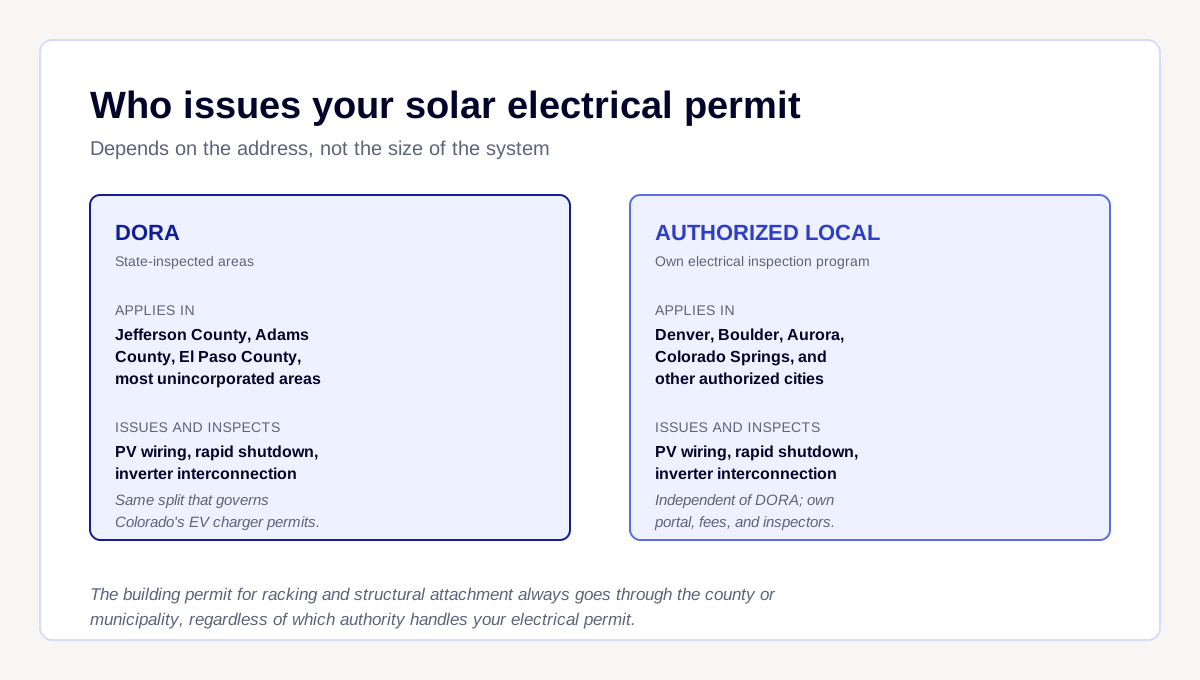
The electrical permit follows the same split that governs Colorado’s EV charging installations. DORA issues and inspects electrical permits, including the Colorado State Electrical (Photovoltaic) permit, in state-inspected areas. Denver, Boulder, Aurora, Colorado Springs, and other jurisdictions granted local electrical inspection authority issue and inspect their own. Verify which authority applies to your project address before submitting; sending a solar electrical permit to the wrong authority means starting over, not transferring the application.
The statewide electrical baseline is the 2023 NEC. The Colorado State Electrical Board confirmed NFPA 70: National Electrical Code 2023 as the enforced standard in its January 2026 rule revision. NEC Article 690 governs PV system installation: circuit sizing, disconnecting means, grounding and bonding. NEC 690.12 rapid shutdown compliance is the item reviewers flag most: the initiation device location, PV system disconnect, and back-fed breaker all need clear labeling and site plan callouts.
The building permit is issued by the county or municipality, and Colorado’s home-rule landscape means the adopted code edition and local amendments vary by jurisdiction, the same fragmentation that shapes EV charger permitting in the state. On top of whatever local building code applies, new commercial construction has an additional layer: the Colorado Model Electric Ready and Solar Ready Code, established by HB23-1233, requires a designated solar-ready zone on the roof of new commercial buildings with a low-sloped roof or an orientation between 110 and 270 degrees of true north, plus documented structural capacity and conduit pathways to the electrical panel, unless the building already includes on-site renewable generation covering 40% of net roof area. Jurisdictions that adopt or update their building code between July 1, 2023 and June 30, 2026 are required to adopt this alongside the 2021 IECC. That’s a meaningfully different approach than California’s, which mandates solar installation itself on qualifying new nonresidential buildings; Colorado’s model code reserves the space and structural capacity for solar but doesn’t require the panels.
Fire code review runs through the Division of Fire Prevention and Control’s adopted 2021 IFC, Chapter 12, Energy Systems. Section 1205.2 sets roof access pathway and spacing requirements for rooftop PV: pathways need to run over areas that can support firefighters and stay clear of vents, conduit, and mechanical equipment, and arrays covering 33% or less of the roof’s plan-view area need an 18-inch setback on both sides of the ridge. In wildland-urban interface jurisdictions, particularly mountain resort communities, fire authorities also weigh defensible space and access requirements into PV layout review, adding a coordination step that flatland Front Range projects don’t face.
Structural review is where Colorado’s terrain shows up most. Ground snow loads vary enormously across the state, and jurisdictions increasingly require PE-stamped, project-specific calculations rather than generic manufacturer racking tables. Mountain community jurisdictions, Summit, Eagle, and Pitkin counties among them, typically require a stamped snow drift analysis under ASCE 7 in addition to the base ground snow load, since drift near parapets, dormers, or roof-level changes can add significant localized load beyond the flat-roof number.
Contractor licensing works differently than in states with a dedicated solar contractor class. Colorado has no C-46 equivalent. Solar installation work falls under electrical contractor licensing through the State Electrical Board, and a licensed electrical contracting business needs a master electrician overseeing the work. Colorado also created a new photovoltaic installer registration under CRS 12-115-110: contractors performing PV installation work as of September 1, 2025, with at least one NABCEP-certified employee, must register as a photovoltaic installer with the board by December 31, 2026. It’s a registration requirement layered on top of standard electrical licensing, not a replacement for it.
Active Jurisdictions in Colorado
These are the jurisdictions seeing the most commercial solar permit activity, with the same profile as our EV charging guide:
| Jurisdiction | Authority | Notes |
|---|---|---|
| Denver | Denver Community Planning and Development | Authorized local electrical inspection jurisdiction. SolarAPP+ is available for residential rooftop solar; commercial and ground-mount projects go through standard plan review. New commercial buildings must address solar-ready zone requirements under the Model Electric and Solar Ready Code. Xcel Energy territory for most of the city. |
| Boulder | Boulder Community Planning and Sustainability | Authorized local electrical inspection jurisdiction. Traditional plan review; local structural review is thorough on snow and wind load. Xcel Energy territory. Verify local amendments before design. |
| Aurora | Aurora Building Inspection | Authorized local electrical inspection jurisdiction. Xcel Energy territory. Part of the Denver metro commercial solar market. |
| Colorado Springs | Colorado Springs Building and Development Review | Authorized local electrical inspection jurisdiction. Colorado Springs Utilities (CSU) is the serving utility and operates independently of Xcel and PUC interconnection rules; don’t apply 4 CCR 723-3 assumptions here. |
| Fort Collins | Fort Collins Building Services | Fort Collins Utilities serves the city, a municipal utility with its own interconnection process separate from Xcel and the PUC. |
| Jefferson County (unincorporated) | Jefferson County Planning and Zoning | State-inspected area; DORA issues the solar electrical permit. Building permit through the county. Xcel Energy territory. Foothills terrain can push ground snow loads higher than Front Range flatland. |
| Adams County (unincorporated) | Adams County Building | State-inspected area in most of the county. Heavy logistics and industrial corridor north of Denver with significant commercial rooftop and ground-mount activity. Xcel Energy territory. |
| El Paso County (unincorporated) | El Paso County Development Services | State-inspected area. CSU or Black Hills Energy depending on location; verify utility before design. Mountain portions of the county carry high ground snow loads requiring stamped drift analysis. |
Don’t see your jurisdiction? Colorado has 271 incorporated cities and towns. Contact us at hello@rhonda.build if you need requirements for a specific Colorado jurisdiction.
Relevant Code References
NEC Article 690, Solar Photovoltaic (PV) Systems (NEC 2023)
Colorado’s statewide electrical code baseline for PV installation, confirmed as the enforced standard by the Colorado State Electrical Board in its January 2026 rule revision. Governs circuit sizing, disconnecting means, grounding and bonding. NEC 690.12 rapid shutdown compliance and its labeling requirements are the most frequently cited item at plan review.
Colorado Revised Statutes Title 12, Article 115, Electrical Practice Act, including § 12-115-110
The statutory basis for electrical contractor licensing in Colorado, administered by the State Electrical Board through DORA. Section 12-115-110 establishes the new photovoltaic installer registration: contractors performing PV work as of September 1, 2025 with at least one NABCEP-certified employee must register by December 31, 2026.
Division of Fire Prevention and Control (DFPC) Fire Code 2021, based on IFC 2021, Chapter 12
Colorado’s statewide fire code baseline. Section 1205.2 sets roof access, pathway, and setback requirements for rooftop PV: an 18-inch ridge setback on both sides for arrays covering 33% or less of the roof’s plan-view area, with pathways clear of obstructions and capable of supporting firefighter operations.
Colorado Model Electric Ready and Solar Ready Code (HB23-1233)
Requires a solar-ready roof zone, with documented structural capacity and conduit pathway to the electrical panel, on new commercial buildings meeting roof orientation or slope criteria. Applies alongside the 2021 IECC in jurisdictions that adopt or update their building code between July 1, 2023 and June 30, 2026. Reserves space and capacity for solar; doesn’t mandate installation.
HB23-1234, Streamlined Solar Permitting and Inspection Grant Program
Funds local jurisdiction adoption of SolarAPP+, an automated permitting tool built for residential rooftop solar. No equivalent state-funded fast track exists for commercial-scale or ground-mount solar; those projects run standard discretionary review in every jurisdiction.
ASCE 7-22, Chapter 7, Snow Loads
Governs ground snow load and snow drift calculations for racking design, incorporated by reference through the adopted building code. Mountain community jurisdictions frequently require PE-stamped drift analysis in addition to the base ground snow load figure.
Colorado PUC Interconnection Procedures and Standards, 4 CCR 723-3, Rules 3850-3859
Governs interconnection for Xcel Energy and other investor-owned utility territory in Colorado, with a Level 1 Simplified Interconnection Process for smaller certified inverter-based systems and Standard review tracks for larger commercial projects. Rural electric cooperatives and municipal utilities aren’t directly bound by PUC jurisdiction but generally mirror the framework.
Common Permit Corrections and Rejections for Commercial Solar Projects in Colorado
Commercial solar permitting in Colorado touches the local jurisdiction, the fire authority, and the serving utility, each with its own review and its own way to send a project back. The corrections that show up most often fall into three categories.
Structural / Fire
Missing or unstamped snow load and drift calculations
Generic manufacturer racking load tables aren’t accepted as a substitute for project-specific structural calculations in most Colorado jurisdictions. Roof-mounted commercial arrays need PE-stamped calculations reflecting the site’s ground snow load under ASCE 7, and mountain community jurisdictions often require a separate stamped snow drift analysis for arrays near parapets, dormers, or roof-level changes. Submittals without a stamped, site-specific structural package are the most common reason a commercial solar plan check stalls before it starts.
Roof access pathway or ridge setback violations
DFPC Fire Code Chapter 12 sets specific geometry: pathways clear of obstructions capable of supporting firefighter operations, and an 18-inch ridge setback on each side for arrays covering 33% or less of the roof. Layouts that don’t reflect these numbers on the site plan get flagged by the fire authority, sometimes after the building department has already cleared its own review.
Solar-ready zone not addressed on new commercial construction
On new commercial buildings subject to the Colorado Model Electric Ready and Solar Ready Code, construction documents need to show the solar-ready zone location and size, roof structural design loads, and conduit routing pathway, whether or not solar is being installed as part of the current scope. Projects that skip this documentation on new builds in jurisdictions that have adopted the model code receive a correction requiring plan revision.
Electrical
Incomplete rapid shutdown documentation
NEC 690.12 rapid shutdown compliance is the single most-cited electrical correction on Colorado solar submittals. Plans need the initiation device location on the site plan and clear labeling for the PV system disconnect and back-fed breaker. Ambiguous or missing labeling gets treated the same as missing compliance.
Wrong electrical permit authority
In state-inspected areas, the solar electrical permit goes through DORA. In Denver, Boulder, Aurora, Colorado Springs, and other authorized local jurisdictions, it goes through the local authority. Submitting to the wrong authority means resubmitting from scratch. Verify which authority applies before submitting.
Contractor licensing and registration mismatch
All solar electrical work needs a licensed electrical contractor with master electrician oversight. Contractors performing PV work who employ a NABCEP-certified installer also need to be registered under the new CRS 12-115-110 photovoltaic installer registration by the December 31, 2026 deadline. A contractor listed on the application without the correct licensing or registration on file is a common intake-stage rejection.
Utility Coordination
Starting interconnection after permit approval
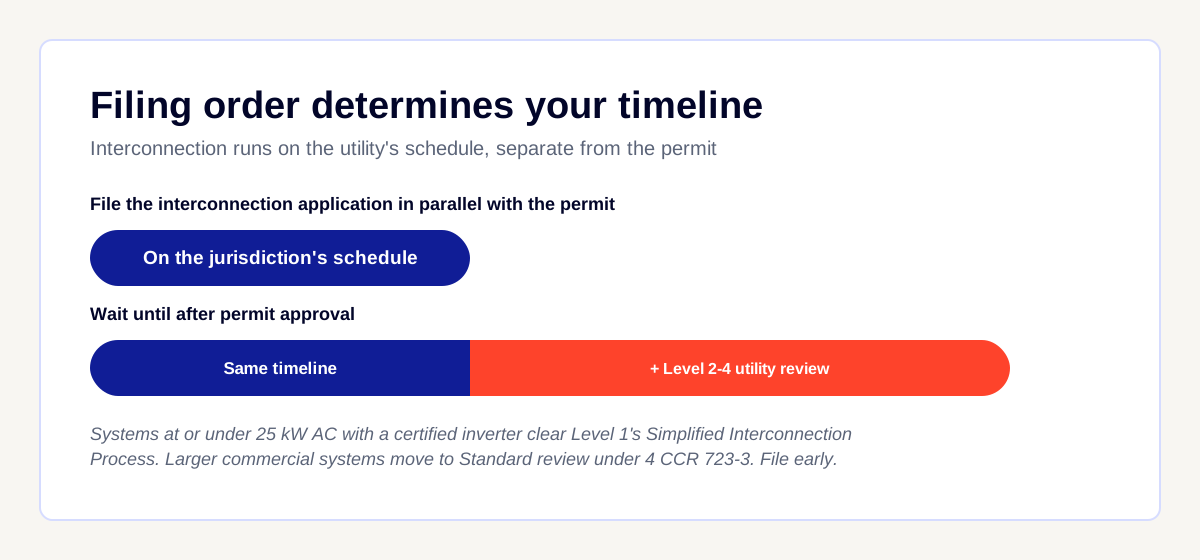
Interconnection runs on the utility’s own schedule under 4 CCR 723-3, separate from the jurisdiction’s building and electrical permit process. Filing the interconnection application in parallel with the permit is the biggest lever available to keep a commercial project on schedule.
Project size pushing past Level 1 into Standard review
Colorado’s Level 1 Simplified Interconnection Process covers smaller certified inverter-based systems, up to 25 kW AC. Most commercial-scale projects exceed that threshold and land in Standard review instead, which brings engineering study and, if the initial screen finds grid impact, a supplemental distribution system impact study at the developer’s expense. That timeline doesn’t start until the application is filed.
Applying Xcel assumptions to co-op or municipal utility territory
Xcel Energy serves the Front Range, but Colorado Springs Utilities, Fort Collins Utilities, Black Hills Energy, and Colorado’s rural electric cooperatives serve other parts of the state under their own interconnection rules, outside direct PUC jurisdiction. Projects that apply Xcel’s process and timeline assumptions to a Colorado Springs or Fort Collins project will run into gaps at the utility coordination stage.
Permission to operate held up by final electrical inspection
Interconnection approval and the local electrical permit run on separate tracks, but permission to operate typically can’t be issued until the jurisdiction’s final electrical inspection is complete. Projects that treat these as fully independent sometimes find utility sign-off waiting on a permit closeout step they hadn’t scheduled yet.
Permitting shouldn’t be the bottleneck on your next solar site.
Rhonda makes permitting for commercial solar, battery storage, and EV charging infrastructure predictable. Pre-check your plan set against Colorado’s state code and the specific local amendments for your jurisdiction before you submit, so corrections don’t cost you weeks. See how Rhonda can help.
← Back to the State and City Requirement Guide Library
Footnotes
- Colorado State Electrical Board / DORA, Electrical Licensing
- Colorado State Electrical Board January 2026 Rule Revisions, confirming NEC 2023 as enforced standard
- NEC Article 690, Solar Photovoltaic (PV) Systems (NFPA 70, 2023 edition)
- Colorado Revised Statutes Title 12, Article 115, Electrical Practice Act
- CRS § 12-115-110, License Requirements, Photovoltaic Installer Registration
- Division of Fire Prevention and Control, FLS Adopted Codes
- Colorado DFPC Fire Code 2021, based on IFC 2021, Chapter 12, Energy Systems
- HB23-1233, Colorado Model Electric Ready and Solar Ready Code
- Colorado Model Electric Ready and Solar Ready Code, full text
- HB23-1234, Streamlined Solar Permitting and Inspection Grant Program
- pv magazine USA, Colorado passes bill to speed up solar permitting, inspection
- SolarAPP+ Colorado program page
- ASCE 7-22, Chapter 7, Snow Loads
- Colorado PUC Interconnection Procedures and Standards, 4 CCR 723-3, Rules 3850-3859
- Xcel Energy Colorado, DER Interconnection Portal Process Guide
- Colorado Solar Authority, Utility Interconnection Process for Colorado Solar Systems
- Colorado Solar Authority, Snow Load, Hail, and Weather Resilience for Colorado Solar