Solar Permit Requirements in California
California requires both a building permit and an electrical permit for most commercial solar projects, reviewed by the same local jurisdiction. The state's streamlined permitting law only covers small systems, so almost every commercial project runs the full discretionary track. Here's how the process works, and where projects most often get stuck.

Do you need a permit to install solar in California?
Yes. A building permit is required for the racking, structural attachment, and any site work, and an electrical permit is required for the PV system wiring, inverters, and interconnection equipment. For commercial installations, ground-mount arrays, and any system tied to new construction, both permits typically require full plan review, including structural calculations, fire department coordination, and utility interconnection paperwork.
California does have a statutory fast track for solar permitting, but it’s narrower than most developers expect. AB 1236 gives commercial EV chargers streamlined timelines regardless of project size. California’s solar equivalent, AB 2188, only streamlines systems at or under 10 kW PV or 30 kW thermal, small residential scale. Almost every commercial solar project is too large to qualify and goes through the same discretionary plan check as any other commercial building project.
How Solar Permitting Works in California
As with EV charging, the local jurisdiction, not a separate statewide authority, is the point of contact for both the building and electrical permit. Every city and county administers its own process, and the size of your system determines which track you’re on.
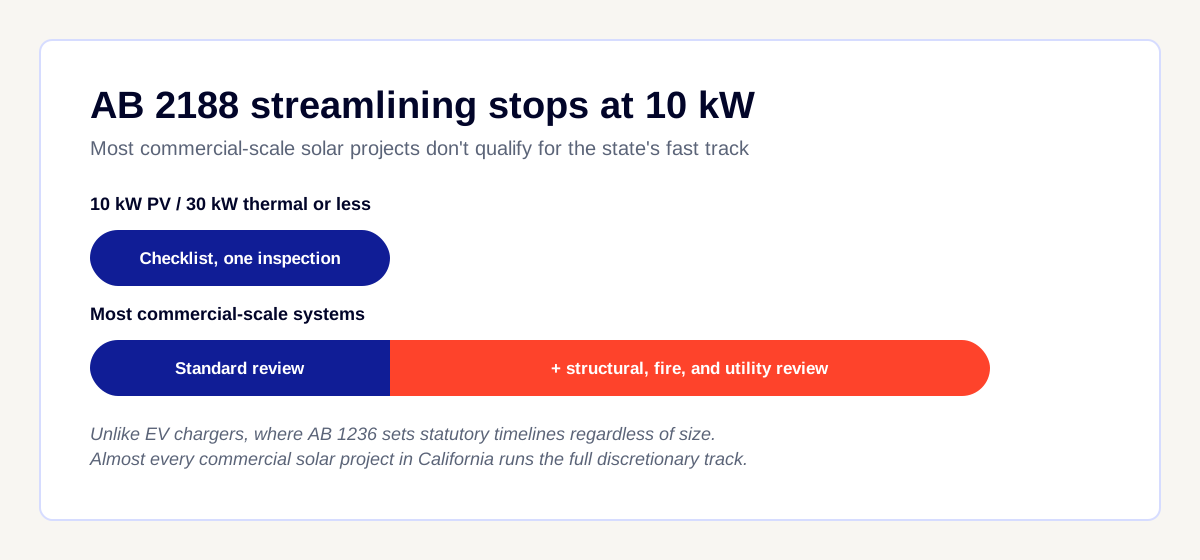
AB 2188 (2014) requires every city and county to offer an expedited, checklist-based process, one inspection, electronic submission, no discretionary design review, for small residential-scale systems. The California Solar Permitting Guidebook sets the model jurisdictions are expected to substantially conform to. Above the 10 kW PV / 30 kW thermal threshold, none of that applies. Your project is reviewed like any other commercial building submittal.
The electrical permit is filed under the California Electrical Code (CEC), Title 24, Part 3, which adopts NEC Article 690, the governing article for PV system installation. Rapid shutdown compliance under NEC 690.12 is the single most-cited item at California plan review: the initiation device, PV system disconnect, back-fed breaker, and arc-fault protection all need to be labeled and shown on the site plan, per CEC 690.56(C).
The building permit covers structural attachment and, for most commercial projects, roof access requirements under the California Fire Code (CFC), Title 24, Part 9, Chapter 12. Nonresidential roofs need a 6-foot access perimeter, and arrays need dedicated pathways: at least two 36-inch pathways from the lowest roof edge to the ridge, plus a ridge setback of 18 inches on each side for arrays covering 66% or less of the roof, and 36 inches for arrays covering more. Get the array layout wrong against these numbers and the fire department kicks it back before the building department even finishes its review.
The 2025 California Energy Code (Title 24, Part 6), effective January 1, 2026, adds another layer for new construction. New nonresidential buildings, offices, retail, warehouses, and specified other types, are now required to include solar PV, and in some cases battery storage, as part of the base building design. If your commercial solar project is being installed as part of new construction rather than retrofitted onto an existing building, it’s not really optional scope. It’s baked into the Energy Code compliance path the building has to hit anyway.
Contractor licensing has more flexibility than EV charging. Solar work can be performed under a C-46 Solar Contractor license, a C-10 Electrical Contractor license (PV-endorsed), or a Class B General Building Contractor license, depending on scope. Reviewers check the license class against the work scope on the application, so a mismatch, a C-46 contractor listed on a submittal that includes structural roof modifications beyond racking attachment, for example, is a common source of intake rejection.
Active Jurisdictions in California
These are the jurisdictions seeing the most commercial solar permit activity, with the same profile as our EV charging guide:
| Jurisdiction | Authority | Notes |
|---|---|---|
| Los Angeles (City) | LADBS (LA Dept. of Building and Safety) | Small systems (under 10 kW, no service upgrade beyond 225A) route through PermitLA for same-day express permits. Commercial and ground-mount systems require ePlanLA plan check, typically 4-8 weeks for initial review. |
| Los Angeles County (unincorporated) | LA County Public Works Building and Safety | Separate authority from the City of LA. Some areas are served by LADWP rather than SCE; confirm utility jurisdiction before design. |
| San Francisco | SF DBI (Dept. of Building Inspection) | Local CFC amendments apply on top of the state baseline. Projects near the wildland-urban interface trigger additional SFFD review on the roof access plan. |
| San Diego (City) | San Diego Development Services Dept. (DSD) | Information Bulletin 301 covers the PV permitting process. Projects in designated high fire-risk areas require fire department sign-off, adding several days to review. |
| San Diego County (unincorporated) | San Diego County Planning & Development | Large unincorporated area with significant ground-mount and community solar activity. Fire authority varies by district. |
| San Jose | San Jose Planning, Building and Code Enforcement | Instant online permitting is available for standard small systems; commercial-scale and battery storage projects go through traditional plan review. The San Jose Fire Department publishes its own PV installation guideline. |
| Sacramento (City) | Sacramento Community Development | SMUD, not a CPUC-regulated investor-owned utility, serves this area and runs its own interconnection process outside Rule 21. |
| Oakland | Oakland Planning & Building Dept. | Same-day in-person permitting available for eligible small systems. Served by PG&E for utility coordination on larger commercial projects. |
| Riverside / San Bernardino | Varies by city/county | Significant ground-mount and utility-scale solar activity in the Inland Empire. SCE territory. |
Don’t see your jurisdiction? California has over 480 incorporated cities. Contact us at hello@rhonda.build if you need requirements for a jurisdiction not listed here.
Relevant Code References
California Electrical Code (CEC), Title 24, Part 3, Article 690
Governs PV system installation: circuit sizing, disconnecting means, rapid shutdown, and grounding and bonding. NEC 690.12 rapid shutdown compliance, and its labeling requirements under CEC 690.56(C), is the most frequently cited item at plan review.
California Energy Code, Title 24, Part 6
The 2025 edition, effective January 1, 2026, requires solar PV, and in some building types battery storage, as part of the base design for new nonresidential construction. Coordinates with CALGreen (Title 24, Part 11) on broader green building standards.
California Fire Code, Title 24, Part 9, Chapter 12
Sets roof access, pathway, and ridge setback requirements for rooftop PV arrays on commercial buildings: a 6-foot access perimeter, at least two 36-inch pathways to the ridge, and ridge setbacks of 18 to 36 inches depending on array coverage.
AB 2188 (2014), California Solar Permitting Guidebook
Requires every California city and county to offer an expedited, checklist-based permitting process for small residential-scale solar (10 kW PV / 30 kW thermal or less). Commercial-scale projects above that threshold don’t qualify and go through standard discretionary plan review.
SB 379 (2022), Residential Solar Permit Reporting Program
Requires jurisdictions above 50,000 residents to run automated permitting software (SolarAPP+ or an equivalent) for qualifying small systems by September 30, 2023, and smaller jurisdictions by September 30, 2024. The California Energy Commission tracks jurisdiction-by-jurisdiction compliance on a public dashboard. This program covers the same small-system scope as AB 2188 and doesn’t extend to commercial-scale projects.
CSLB License Classifications: C-46, C-10, B
Solar installation work can be performed under a C-46 Solar Contractor license, a C-10 Electrical Contractor license, or a Class B General Building Contractor license, depending on project scope. Reviewers check the license class against the submitted scope of work.
Electric Rule 21, Generating Facility Interconnections
The CPUC-regulated process for interconnecting a solar system to the grid through PG&E, SCE, or SDG&E. Includes a Fast Track review for smaller, lower-impact systems and Detailed Study tracks, Independent Study, Distribution Group Study, and Transmission Cluster Study, for larger projects.
Net Billing Tariff (NEM 3.0), CPUC Decision D.22-12-056
Applies to interconnection applications submitted after April 15, 2023. Which tariff applies is locked in at the date the interconnection application is submitted, not the date the system is energized.
Common Permit Corrections and Rejections for Commercial Solar Projects in California
Commercial solar permitting in California touches the local jurisdiction, the fire authority, and the serving utility, each with its own review and its own way to send a project back. The corrections that show up most often fall into three categories.
Structural / Fire
Missing or unstamped structural calculations
Roof-mounted commercial arrays need PE-stamped calculations showing added dead load from racking and modules, wind uplift, and, where applicable, snow load, plus attachment details tied to the specific roof structure. Submittals without a stamped structural package are the most common reason a commercial solar plan check stalls before it starts.
Roof access pathway or ridge setback violations
CFC Chapter 12 sets specific geometry: a 6-foot perimeter access zone, two 36-inch pathways to the ridge, and ridge setbacks of 18 to 36 inches depending on how much of the roof the array covers. Layouts that don’t reflect these numbers on the site plan get flagged by the fire authority, sometimes after the building department has already cleared its own review.
Roof material and attachment mismatch
Attachment details that don’t match the roof material and manufacturer cut sheets, or racking specified for a different roof type than what’s actually on the building, come back as a correction. This shows up often on retrofit projects where the original roof documentation is incomplete.
Electrical
Incomplete rapid shutdown documentation
NEC 690.12 rapid shutdown compliance is the single most-cited electrical correction on California solar submittals. Plans need the initiation device location on the site plan, and labeling for the PV system disconnect, back-fed breaker, and arc-fault protection per CEC 690.56(C). Ambiguous or missing labeling is treated the same as missing compliance.
Inverter one-line diagram doesn’t match cut sheets
Mismatches between the inverter model shown on the one-line diagram and the manufacturer spec sheet trigger a correction every time. Reviewers check these against each other directly.
Wrong contractor license class on the application
Solar work qualifies under a C-46, C-10, or Class B license depending on scope, but the license on the application has to match the actual scope of work. A C-46 contractor listed on a project that includes structural roof alterations beyond racking attachment is a common intake-stage rejection.
Utility Coordination
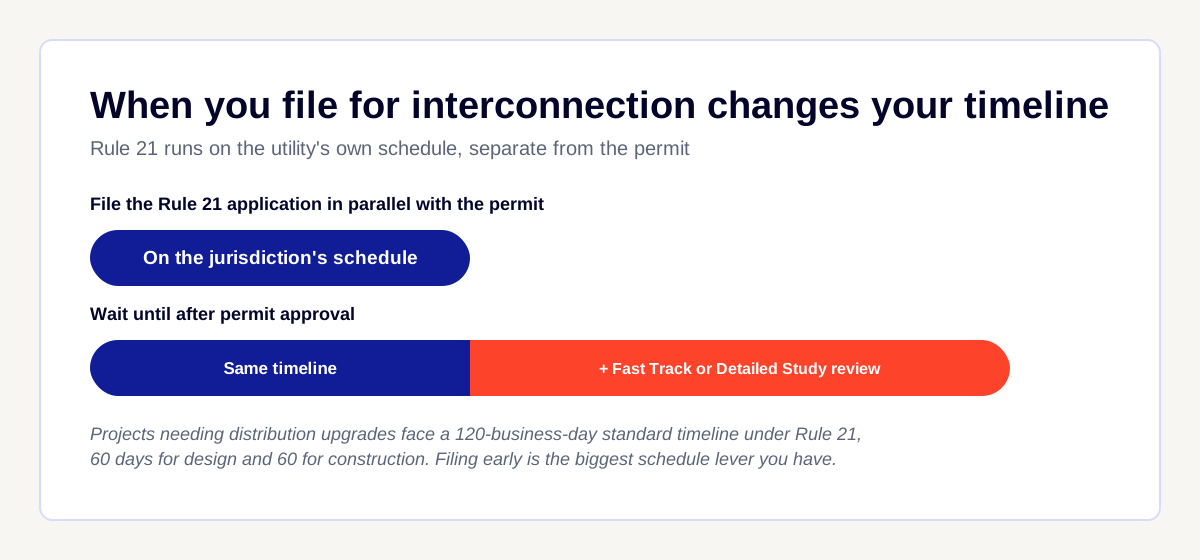
Starting Rule 21 interconnection after permit approval
Interconnection runs on the utility’s own schedule, separate from the jurisdiction’s permit process. Filing the Rule 21 application in parallel with the permit is the biggest lever available to keep a project on schedule.
Project size pushing past Fast Track into Detailed Study
Rule 21 Fast Track works for smaller, lower-impact systems. Larger commercial and utility-scale projects often land in an Independent Study, Distribution Group Study, or Transmission Cluster Study instead, each with its own queue and timeline. Projects that need new distribution upgrades face a standard timeline of 120 business days, 60 for design and 60 for construction, and that clock doesn’t start until the application is in.
NEM 3.0 eligibility date confusion
Which tariff applies, the legacy NEM structure or the current Net Billing Tariff, is determined by the date the interconnection application was submitted, not the date the system is energized or even the date the permit is issued. Teams that assume the tariff will match their permit timeline sometimes find out otherwise.
SMUD and LADWP territory: different rules
PG&E, SCE, and SDG&E are investor-owned utilities regulated by the CPUC under Rule 21. Sacramento Municipal Utility District (SMUD) and Los Angeles Department of Water and Power (LADWP) are municipal utilities with their own interconnection processes, outside CPUC jurisdiction. Projects in Sacramento or LADWP territory that apply Rule 21 assumptions to their interconnection planning will run into gaps.
Permitting shouldn’t be the bottleneck on your next solar site.
Rhonda makes permitting for commercial solar, battery storage, and EV charging infrastructure predictable. Pre-check your plan set against California’s state code and the specific local amendments for your jurisdiction before you submit, so corrections don’t cost you weeks. See how Rhonda can help.
← Back to the State and City Requirement Guide Library
Footnotes
- California Electrical Code (CEC), Title 24 Part 3, Article 690 (California Building Standards Commission)
- California Energy Code, Title 24 Part 6, 2025 edition, effective January 1, 2026 (California Energy Commission)
- California Fire Code, Title 24 Part 9, Chapter 12, Energy Systems (California Building Standards Commission)
- AB 2188 (2014), California Government Code, Solar Rights Act implementation
- California Solar Permitting Guidebook (California Energy Commission / Governor’s Office of Planning and Research)
- SB 379 (2022), Residential Solar Permit Reporting Program (California Energy Commission, energy.ca.gov)
- CSLB License Classifications: C-46 Solar Contractor, C-10 Electrical Contractor, Class B General Building Contractor (cslb.ca.gov)
- Electric Rule 21, Generating Facility Interconnections (CPUC, cpuc.ca.gov/Rule21)
- CPUC Decision D.22-12-056, Net Billing Tariff (NEM 3.0)
- LADBS PermitLA / ePlanLA solar permitting process (ladbs.org, dbs.lacity.gov)
- San Diego Development Services Information Bulletin 301 (sandiego.gov)
- San Jose Fire Department Photovoltaic Systems guideline (sanjoseca.gov)