Solar Permit Requirements in Arizona
Arizona is a home rule state, so solar permit review varies by city, but state law actually limits when a jurisdiction can require a structural engineer's stamp at all. Add the APS/SRP utility split and Arizona's commercial solar permitting has its own shape. Here's how it works, and where projects get stuck.

Do you need a permit to install solar in Arizona?
Yes. A building permit is required for racking, structural attachment, and any site work, and an electrical permit is required for the PV system wiring, inverters, and interconnection equipment. Both are issued by the local jurisdiction, not a state agency. For commercial installations, ground-mount arrays, and anything tied to new construction, expect full plan review: structural documentation, fire department coordination, and utility interconnection paperwork running alongside the permit.
Arizona’s home rule structure works the same way for solar as it does for EV charging: each municipality is its own permitting authority, and the statewide constant is contractor licensing, not the building code. Where solar diverges from EV charging is Arizona’s rare statutory limit on when a jurisdiction can even demand a structural engineer’s stamp, and the fact that a PV system is a generating source tied into the grid, not just a load, which pulls a second regulatory track into the process before you can turn it on.
How Solar Permitting Works in Arizona
Arizona has no mandatory statewide building code. The Arizona Department of Fire, Building and Life Safety oversees code adoption at the state level, but individual cities and counties choose their own edition of the International Building Code, International Fire Code, and NEC, each with its own local amendments. A jurisdiction’s adopted code edition, not a state baseline, determines what your plan set has to show.
Arizona Revised Statutes § 9-468 (municipalities) and § 11-323 (counties) set the state’s baseline standards for solar permitting, and they contain a provision most states don’t have: a jurisdiction shall not require a stamp from a professional engineer for a solar photovoltaic system unless an engineering stamp is deemed necessary. In practice, that discretion narrows fast for commercial work. A jurisdiction is well within its rights to deem a stamp necessary any time a rooftop array involves structural modification beyond simple attachment, which describes most commercial retrofits, and ground-mount and larger rooftop systems routinely get flagged for full structural review regardless of the statute’s default. Treat the “no stamp required” language as a floor for simple prescriptive residential work, not a rule you can lean on for a commercial submittal.
HB 2301 (2025), amending § 9-468, requires every Arizona municipality and county to offer an instant, checklist-based permitting process, most commonly through the SolarAPP+ platform, by January 1, 2026. Phoenix, Tucson, Maricopa County, Mesa, Chandler, Gilbert, and Scottsdale have all adopted it. The statute is explicit that this mandate covers residential solar energy systems and residential energy storage systems only. Commercial-scale projects don’t qualify and go through the jurisdiction’s standard plan review, the same track as before the mandate.
The electrical permit is filed against whatever NEC edition the jurisdiction has adopted, which incorporates Article 690, the governing article for PV system installation. As with EV charging, adopted editions vary by city: Maricopa County references the 2017 NEC through its SolarAPP+ integration, while Phoenix and Mesa have moved to more recent editions. NEC 690.12 rapid shutdown compliance, the initiation device, PV disconnect, and labeling for the back-fed breaker and arc-fault protection, is the most consistently cited electrical item at plan review, same as it is everywhere else this code applies.
The building permit covers structural attachment and, where the jurisdiction has adopted it, International Fire Code roof access requirements. Commercial rooftop arrays need a pathway at least 4 feet wide, with venting cutouts on alternating sides every 20 feet, and a ridge setback of at least 36 inches where the array covers more than 66% of the roof’s plan-view area. Ground-mounted arrays are exempt from the setback geometry but need a clear, brush-free perimeter of at least 10 feet, a real consideration for desert sites with native vegetation close to the array.
Arizona’s desert wind and monsoon exposure shows up in structural review even where a stamp isn’t statutorily mandated. Jurisdictions that have adopted the 2024 IBC reference ASCE 7-22 for wind, seismic, and snow load methodology, and Maricopa and Pima county jurisdictions in particular tend to specify design wind speeds above the ASCE base map to account for monsoon conditions. Racking and attachment details that don’t reflect local wind speed requirements are a common source of correction independent of whether a PE stamp was technically required at intake.
Active Jurisdictions in Arizona
Arizona has 15 counties and 91 incorporated cities and towns. The Phoenix metro accounts for the largest share of commercial solar permit activity, followed by Tucson. These are the jurisdictions with the most active commercial solar permitting:
| Jurisdiction | Authority | Notes |
|---|---|---|
| Phoenix | Phoenix Planning and Development Department | Residential systems route through SolarAPP+ for instant permitting. Commercial and ground-mount systems require full plan review through the standard commercial track. APS and SRP territory boundary runs through the city; confirm utility before design. |
| Scottsdale | Scottsdale Building Safety | Separate portal and checklist from Phoenix. Primarily APS territory in north Scottsdale; SRP serves some eastern areas. Older central Scottsdale commercial stock frequently needs structural review for added roof load. |
| Tempe | Tempe Community Development | Mixed APS/SRP territory. Commercial building and electrical permits required for any rooftop or ground-mount array. Verify current local IFC and IBC amendments before design. |
| Mesa | Mesa Development Services | Primarily SRP territory. Offers Expedited (10 working days, 100% fee premium) and Super Expedited (5 working days, 200% fee premium) commercial plan review on top of standard review. Has adopted SolarAPP+ for qualifying residential systems. |
| Chandler | Chandler Building Safety | SRP territory. Chandler plan reviewers check racking and attachment details against their adopted IBC edition and local wind load amendments. Has adopted SolarAPP+ for residential systems. |
| Gilbert | Gilbert Building Safety | SRP territory. Commercial building and electrical permits required. Active commercial and industrial rooftop solar pipeline alongside residential growth. |
| Tucson | Tucson Planning and Development Services | TEP territory. PE stamp commonly required in practice above roughly 15 kW. Ground-mount arrays require building permit, electrical permit, and zoning review. Has adopted SolarAPP+ for residential systems. |
| Pima County (unincorporated) | Pima County Development Services | Covers unincorporated areas around Tucson. TEP and UniSource territory depending on location. Significant ground-mount and utility-scale solar activity given available desert land. |
Don’t see your jurisdiction? Arizona has 91 incorporated cities and towns. Contact us at hello@rhonda.build if you need requirements for a specific Arizona jurisdiction.
Relevant Code References
NEC Article 690, Solar Photovoltaic (PV) Systems
Governs PV system installation: circuit sizing, disconnecting means, rapid shutdown, and grounding and bonding. NEC 690.12 rapid shutdown compliance is the most frequently cited item at electrical plan review, and the adopted NEC edition varies by jurisdiction.
Arizona Revised Statutes § 9-468 (municipalities) and § 11-323 (counties)
Sets statewide baseline standards for solar permitting, including the requirement that a jurisdiction not require a PE stamp for a PV system unless deemed necessary, and that permit fees not exceed the actual cost of issuing the permit. Amended by HB 2301 (2025) to add the instant permitting mandate.
HB 2301 (2025), Instant Permitting Mandate
Requires every Arizona municipality and county to offer an instant, checklist-based permitting process for residential solar energy systems and residential energy storage systems, typically through SolarAPP+, by January 1, 2026. Does not extend to commercial-scale projects.
International Fire Code, adopted with local amendments
Sets rooftop access, pathway, and ridge setback requirements for commercial PV arrays where adopted: a minimum 4-foot pathway with alternating venting cutouts, and ridge setbacks of at least 36 inches for arrays covering more than 66% of the roof. Ground-mounted arrays are exempt from setback geometry but need a 10-foot brush-free perimeter.
Arizona Registrar of Contractors (ROC), A.R.S. Title 32, Chapter 10; Arizona Administrative Code R4-9-104
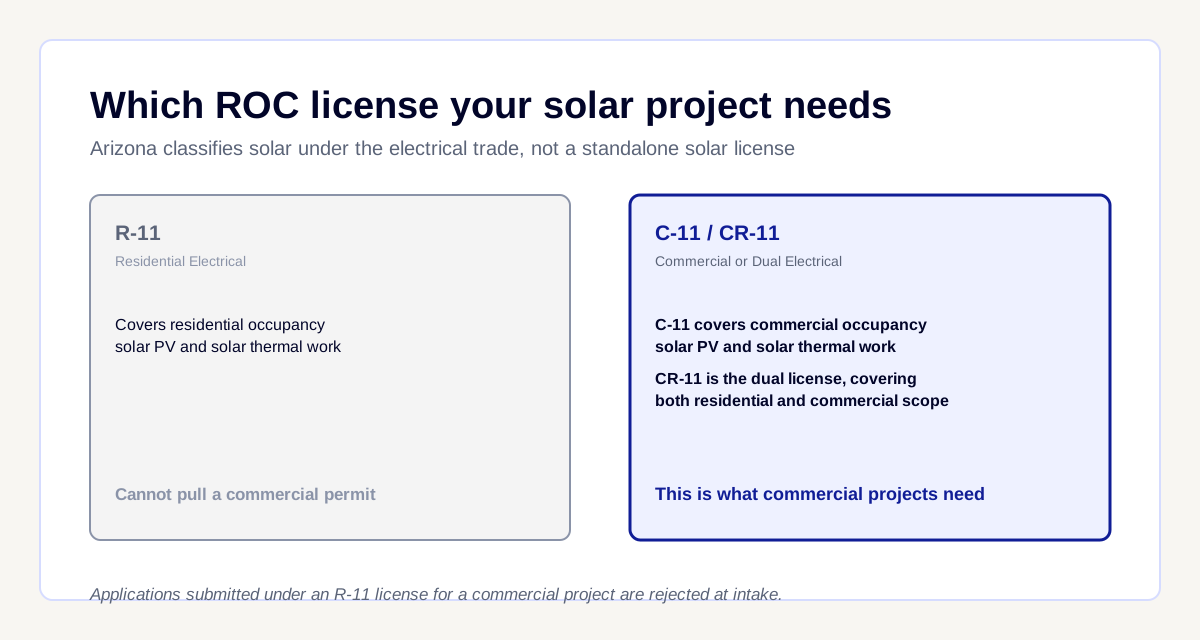
Arizona classifies solar under the electrical trade specialty rather than a standalone solar license. Commercial and dual-scope work requires a C-11 or CR-11 license; a residential-only R-11 license cannot pull a commercial permit.
Arizona Corporation Commission Distributed Generation Interconnection Rules
Governs APS interconnection review timelines: 15 business days for Track 1, 45 business days for Track 2, depending on system size and grid impact. APS is regulated by the ACC; SRP, a political subdivision, is not and sets its own interconnection process.
APS Resource Comparison Proxy, Decision No. 79293
The current export rate methodology for APS customers under net billing, which replaced full-retail net metering statewide following the ACC’s 2017 Value-of-Solar decision (Decision No. 75859). Which rate applies depends on the interconnection application date, not the energization date.
Common Permit Corrections and Rejections for Commercial Solar Projects in Arizona
Commercial solar permitting in Arizona touches the local jurisdiction, the fire authority where adopted, and the serving utility, each with its own review and its own way to send a project back. The corrections that show up most often fall into three categories.
Structural / Fire
Assuming no PE stamp means no structural review
ARS § 9-468 limits when a jurisdiction can require an engineering stamp by default, but that discretion doesn’t disappear for commercial work. Most jurisdictions deem a stamp necessary for anything beyond simple prescriptive attachment, which covers nearly every commercial rooftop retrofit. Submittals that skip structural documentation on the assumption that the statute exempts them come back with a correction, and sometimes a stalled review, before the building department even reaches the rest of the plan set.
Roof access pathway or ridge setback violations
Where a jurisdiction has adopted IFC rooftop PV requirements, the geometry is specific: a minimum 4-foot pathway with alternating venting cutouts every 20 feet, and ridge setbacks of at least 36 inches for arrays covering more than 66% of the roof. Layouts that don’t reflect these numbers on the site plan get flagged, sometimes after the building department has already cleared its own review.
Wind load calculations not matched to local amendments
Jurisdictions on the 2024 IBC reference ASCE 7-22 for wind load methodology, and Maricopa and Pima county jurisdictions in particular often specify design wind speeds above the ASCE base map to account for monsoon conditions. Racking and attachment calculations built to a generic wind speed instead of the local amendment are a common correction.
Electrical
Incomplete rapid shutdown documentation
NEC 690.12 rapid shutdown compliance is the most-cited electrical correction on Arizona commercial solar submittals. Plans need the initiation device location on the site plan and clear labeling for the PV disconnect, back-fed breaker, and arc-fault protection. Ambiguous or missing labeling gets treated the same as missing compliance.
Wrong ROC license classification on the application
Commercial and dual-scope solar work requires a C-11 or CR-11 license. A residential-only R-11 license cannot pull a commercial permit, and applications submitted under the wrong classification are rejected at intake, before plan review starts.
NEC edition mismatch across jurisdictions
Because Arizona leaves NEC adoption to the local jurisdiction, the enforced edition varies by city, and sometimes lags the current published edition by several cycles. Plans citing the latest Article 690 requirements for a jurisdiction still enforcing an older edition create mismatches that require resubmittal.
Utility Coordination
Starting interconnection after permit approval
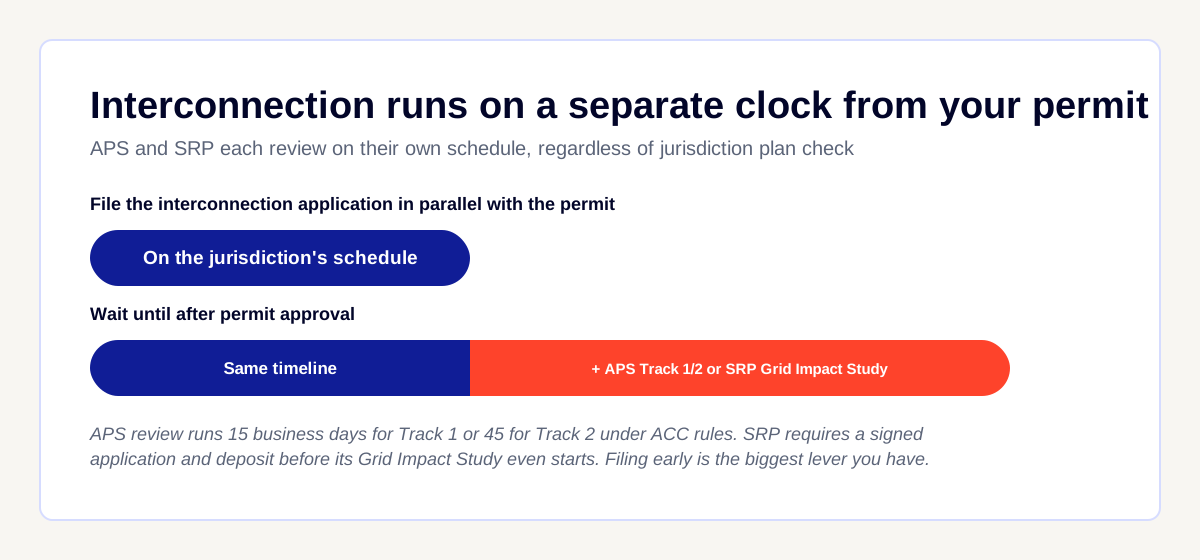
APS and SRP interconnection review runs on the utility’s own schedule, separate from the jurisdiction’s permit process. Filing the interconnection application in parallel with the permit is the biggest lever available to keep a project on schedule.
Not confirming APS vs. SRP territory before design
The APS/SRP boundary runs through the Phoenix metro and isn’t always obvious from a street address. APS, regulated by the ACC, runs a Track 1 (15 business day) or Track 2 (45 business day) review depending on system size and grid impact. SRP, a political subdivision not regulated by the ACC, requires a signed PowerClerk application and a study deposit before its Grid Impact Study even begins, and systems 1 MW-AC and larger need a relay schematic on top of the standard interconnection agreement. Designing to the wrong utility’s assumptions creates rework late in the process.
Net billing rate assumptions not matched to application date
Which export rate applies, and whether a project is grandfathered into legacy net metering terms, is set by the date the interconnection application was submitted, not the date the system is energized. Projects assuming a rate that doesn’t match their actual filing date find out during utility review, not before.
Permitting shouldn’t be the bottleneck on your next solar site.
Rhonda makes permitting for commercial solar, battery storage, and EV charging infrastructure predictable. Pre-check your plan set against Arizona’s state code and the specific local amendments for your jurisdiction before you submit, so corrections don’t cost you weeks. See how Rhonda can help.
← Back to the State and City Requirement Guide Library
Footnotes
- Arizona Revised Statutes § 9-468, Solar construction permits; standards; definition (Arizona State Legislature)
- Arizona Revised Statutes § 11-323, Solar construction permits; standards; definition (Justia)
- HB 2301 (2025), 57th Legislature, 1st Regular Session (Arizona State Legislature)
- NEC Article 690, Solar Photovoltaic (PV) Systems (NFPA 70), as adopted by individual Arizona jurisdictions
- Arizona Department of Fire, Building and Life Safety
- International Fire Code, Chapter 12 / Section 605.11, Rooftop Solar Photovoltaic Systems, as adopted by individual Arizona jurisdictions
- Arizona Registrar of Contractors (ROC), License Classifications
- Arizona Administrative Code R4-9-104, Dual Contractor License Classifications and Scopes of Work
- APS Interconnection Requirements for Distributed Generation (aps.com)
- APS Resource Comparison Proxy, Plan of Administration, Decision No. 79293 (aps.com)
- Arizona Corporation Commission, Value-of-Solar Decision No. 75859 (2017), Net Billing (azcc.gov)
- SRP Commercial Distributed Energy Program Process Checklist (srpnet.com)
- Mesa Development Services, Commercial Construction (mesaaz.gov)
- Phoenix Planning and Development Department, SolarApp / Photovoltaic Projects (phoenix.gov)