Battery Energy Storage (BESS) Permit Requirements in New York
New York requires a building permit, an electrical permit, and a separate fire department review for commercial battery energy storage (BESS) projects, and which code applies to all three depends on whether you're inside New York City or anywhere else in the state. NYC runs its own construction, electrical, and fire code, FDNY included, completely separate from the state Uniform Code. Here's how BESS permitting actually works across New York.

Do you need a permit to install battery energy storage in New York?
Yes. Commercial battery energy storage (BESS) projects in New York need a building permit for the pad, foundation, and enclosure, and an electrical permit for the wiring, disconnects, and interconnection equipment. Almost every commercial-scale project also triggers a separate fire department review, and in New York, that reviewer isn’t the same statewide.
New York City is legally exempt from the state’s Uniform Fire Prevention and Building Code and runs its own construction and electrical code entirely separately, a split that already complicates EV charger permitting. For BESS, that same city line now cuts through fire review too. FDNY administers its own Fire Code and reviews battery storage installations under it directly. Everywhere else, a local or state fire marshal reviews the same kind of project against the Fire Code of New York State, part of the Uniform Code. Get the jurisdiction wrong on a multi-site portfolio and you’re citing the wrong fire code to the wrong reviewer, not just the wrong electrical code.
How BESS Permitting Works in New York
As with EV charging, the split between New York City and the rest of the state runs through every layer of review, not just electrical. What’s new for battery storage is a third authority, fire and hazmat, that solar and EV charging projects in New York don’t deal with in the same way.
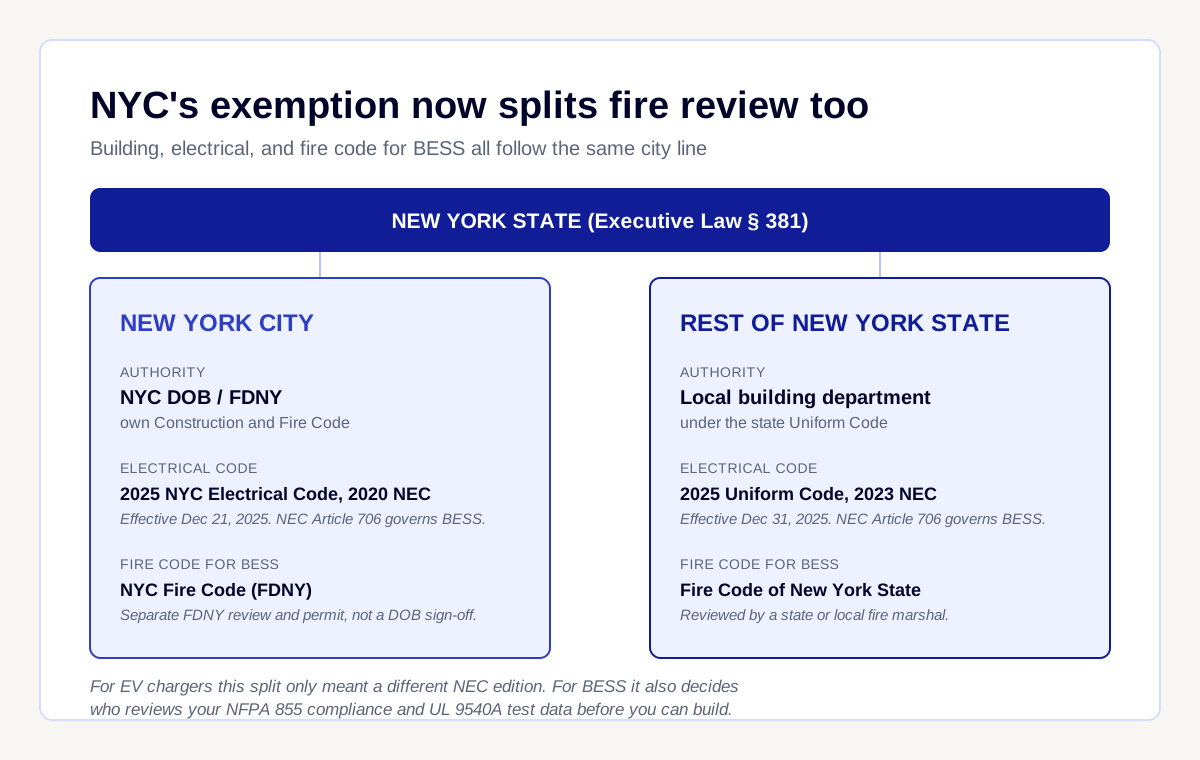
In New York City, DOB handles building and electrical plan review under the 2025 NYC Electrical Code, adopted by Local Law 128 of 2024 and effective December 21, 2025, which references the 2020 NEC. NEC Article 706, the article governing energy storage system installation, applies on that code cycle. FDNY reviews fire and life safety separately, under the city’s own Fire Code rather than a DOB sign-off, and that review typically includes its own hazmat or energy storage system permit tied to battery chemistry and quantity.
Everywhere else in New York, the 2025 Uniform Code took effect for applications filed on or after December 31, 2025, referencing the newer 2023 NEC. Article 706 governs BESS installation there too, just under a different edition than NYC. The Fire Code of New York State, the fire-side component of the same Uniform Code, was also updated for stationary energy storage systems around that cycle. According to local reporting on the update, New York tightened its fire code requirements for battery storage effective around January 2026, on top of what was already in place.¹ That fire review runs through the local or county fire marshal, separate from the building department’s electrical sign-off.
NFPA 855, the Standard for the Installation of Stationary Energy Storage Systems, is the model standard both code paths point reviewers toward for spacing, suppression, and installation detail beyond what the base fire code chapter spells out. Underneath it sit two UL standards that do most of the practical work at plan review: UL 9540 lists the system as a product, and UL 9540A is the large-scale fire test measuring thermal runaway propagation between units, now on its sixth edition.² Whether it’s FDNY or a fire marshal upstate, reviewers use UL 9540A data to decide whether a proposed unit spacing or enclosure configuration is safe, and a report that doesn’t match the actual installation, wrong chemistry, wrong enclosure, wrong suppression system, gets sent back regardless of which side of the city line you’re on.
Licensing follows the same municipal pattern as EV charging. New York has no statewide electrical license. NYC requires a DOB-issued Licensed Master Electrician or a Registered General Contractor with an electrical endorsement. Every other municipality issues and enforces its own electrician licensing, and a license valid in one town doesn’t transfer to the next one over.
New York has real reasons to be building this fast. The Public Service Commission approved an expanded statewide energy storage target of 6,000 megawatts by 2030 in June 2024, building on the state’s Energy Storage Roadmap and the broader CLCPA climate targets.³ That build-out is also why fire safety at battery sites is a live, contested issue rather than a theoretical one: a 2023 fire at a battery storage facility in East Hampton later turned into a groundwater contamination investigation, and by mid-2026 it had triggered lawsuits, a demand from the Suffolk County Executive that the facility close, and moratoria in multiple Suffolk County towns.⁴ Reviewers on both sides of the NYC line are operating in that environment, and it shows in how closely fire and hazmat submittals get checked.
Active Jurisdictions in New York
These are the jurisdictions seeing the most commercial BESS permit activity, with the same profile as our EV charging guide, but with fire and hazmat authority now doing real work in the review:
| Jurisdiction | Authority | Notes |
|---|---|---|
| New York City (all five boroughs) | NYC DOB / FDNY | Exempt from the state Uniform Code and Fire Code of New York State entirely. DOB reviews building and electrical under the 2025 NYC Electrical Code (2020 NEC); FDNY separately reviews fire and hazmat under the NYC Fire Code, with its own energy storage system permit. |
| Buffalo | Buffalo Permit & Inspection Services | National Grid territory. Follows the Uniform Code (2025 edition, 2023 NEC) and the Fire Code of New York State for BESS fire review. |
| Rochester | Rochester Bureau of Buildings & Zoning | RG&E (Avangrid) territory, a distinct interconnection process from most of upstate. |
| Syracuse | Syracuse Codes Enforcement | National Grid territory. Uniform Code jurisdiction. |
| Albany | Albany Buildings & Regulatory Compliance | National Grid territory. Nearby New Scotland saw organized opposition to a proposed community-scale battery storage project in 2026, a preview of the local scrutiny to expect in the Capital Region. |
| Yonkers | Yonkers Building Department | Westchester County. Con Edison territory, but outside NYC and under the state Uniform Code and Fire Code of New York State, not FDNY. |
| Westchester County (other towns) | Varies by municipality | Con Edison territory throughout. Each town’s fire marshal handles BESS fire review independently. |
| Nassau County | Varies by town/village | PSEG Long Island territory. |
| Suffolk County | Varies by town/village | PSEG Long Island territory. Several towns, including Southold, Southampton, and Babylon, adopted BESS moratoria after PFAS groundwater contamination was discovered near the site of a 2023 battery fire in East Hampton; Riverhead is amending containment and zoning rules instead of pausing review outright. Confirm current moratorium status before committing site control. |
Don’t see your jurisdiction? New York has hundreds of towns, cities, and villages outside NYC. Contact us at hello@rhonda.build if you need requirements for a jurisdiction not listed here.
Relevant Code References
2025 NYC Electrical Code / NYC Fire Code (NYC only)
Adopted by Local Law 128 of 2024, effective December 21, 2025, referencing the 2020 NEC for DOB’s electrical review. FDNY administers the NYC Fire Code separately for fire and hazmat review, including energy storage systems, independent of DOB and the state Uniform Code.
2025 New York State Uniform Fire Prevention and Building Code, including the Fire Code of New York State (everywhere except NYC)
References the 2023 NEC for permit applications filed on or after December 31, 2025. The fire code component was tightened for stationary energy storage systems around the same cycle. Applies statewide by default; NYC is exempt under Executive Law § 381 and runs its own codes instead.
New York Executive Law § 381
The statutory basis for NYC’s exemption from the state Uniform Code, extending to the fire code as well as the construction and electrical code.
NEC Article 706, Energy Storage Systems
Added to the National Electrical Code in 2017 to govern energy storage system installation: disconnecting means, system ratings, and installation clearances. In force in New York under two different editions depending on jurisdiction, 2020 in NYC and 2023 elsewhere.
NFPA 855, Standard for the Installation of Stationary Energy Storage Systems
The model installation standard both New York fire code paths point reviewers toward for spacing, suppression, and installation detail beyond the base fire code chapter.
UL 9540 and UL 9540A
UL 9540 is the product listing standard for the energy storage system as a unit. UL 9540A is the large-scale fire test measuring thermal runaway propagation between units, now in its sixth edition. Fire reviewers on both sides of the NYC line use UL 9540A data to evaluate proposed unit spacing and enclosure configurations.
NYSERDA Energy Storage Roadmap and the 6,000 MW by 2030 target
The New York Public Service Commission approved an expanded statewide energy storage deployment target of 6,000 megawatts by 2030 in June 2024, building on NYSERDA’s Energy Storage Roadmap and the state’s CLCPA climate targets, and context for why commercial BESS review volume is significant statewide.
Master Electrician Licensing (municipal, not statewide)
New York has no statewide electrical license. NYC requires a DOB-issued Licensed Master Electrician or a Registered General Contractor with electrical endorsement. Every other municipality issues and enforces its own licensing independently.
Common Permit Corrections and Rejections for Commercial BESS Projects in New York
Commercial BESS permitting in New York touches the local jurisdiction, the fire or hazmat authority, and the serving utility, and in New York the first two split along the same NYC line. The corrections that show up most often fall into three categories.
Fire & Life Safety
Citing the wrong fire code entirely
NYC projects fall under the NYC Fire Code, reviewed by FDNY. Everywhere else, it’s the Fire Code of New York State, reviewed by a local or state fire marshal. These are separate documents maintained by separate agencies, not different amendments to a shared baseline. Plan sets that reference the wrong one, easy to do on a multi-site portfolio spanning both, get flagged immediately.
UL 9540A test report doesn’t match the proposed installation
A test report covering a different battery chemistry, enclosure configuration, or separation distance than what’s on the site plan doesn’t support the design. Reviewers check the report’s installation type, edition currency, and suppression system against the actual proposal, and a mismatch on any of those is a correction, whether it’s FDNY or an upstate fire marshal doing the checking.
Missing FDNY energy storage system permit, or local fire marshal sign-off
In NYC, fire and hazmat review runs through FDNY as its own permit process, separate from the DOB electrical and construction permits. Upstate, the equivalent is a local or county fire marshal sign-off on top of the building department’s review. Teams used to solar or EV charging permitting, where fire involvement is narrower, often miss that this is a distinct submission with its own timeline and reviewer.
Electrical
Citing the wrong NEC edition for Article 706
NYC’s 2025 Electrical Code runs on the 2020 NEC. The 2025 Uniform Code, everywhere else, runs on the 2023 NEC. Article 706 disconnect, rating, and clearance requirements differ enough between editions that a submittal built against the wrong one gets sent back at first review.
License not valid for the jurisdiction
An electrician’s license issued by one municipality doesn’t transfer to another, and NYC’s DOB-issued Licensed Master Electrician is its own separate credential. Applications filed under a license not valid in that jurisdiction are rejected at intake.
Electrical one-line and fire/hazmat layout plan don’t reconcile
Unit counts, spacing, and enclosure locations on the electrical one-line sometimes don’t match the fire and hazmat layout plan submitted separately. Since fire review checks separation distances against its own layout plan, not the electrical drawing, this discrepancy tends to surface during cross-review rather than at intake.
Utility Coordination
Assuming the EV Make-Ready Program covers storage too
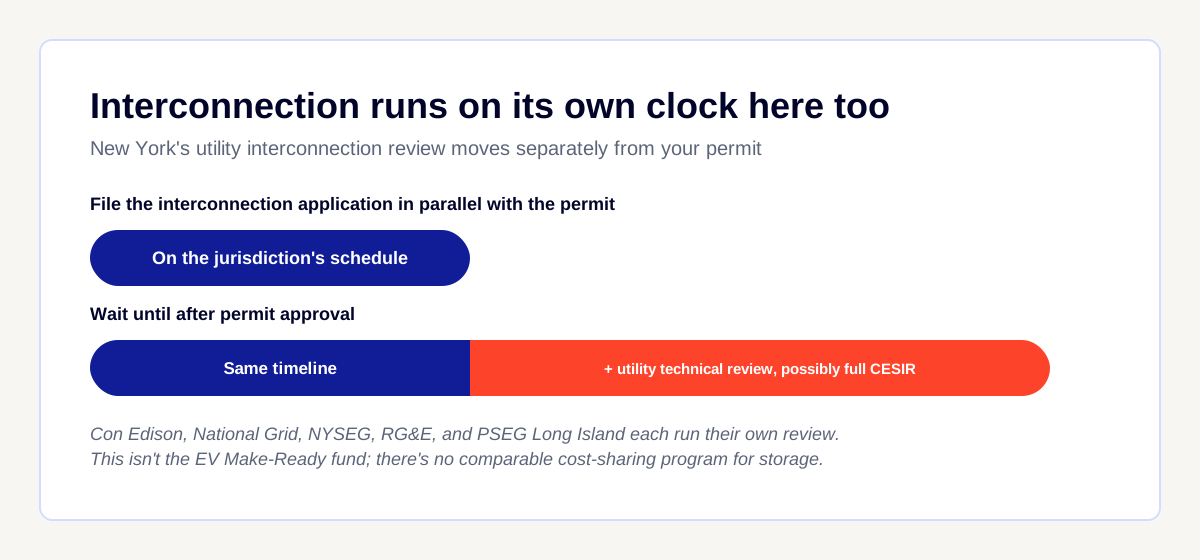
It doesn’t. The Joint Utilities’ EV Make-Ready Program was infrastructure cost-sharing specific to EV charging, and it stopped taking new applications in 2026. Battery storage interconnects through each utility’s own technical review instead, an engineering review, not a cost-sharing fund. Teams that assume storage gets a similar funding mechanism are planning around a program that was never available to it.
Starting interconnection after permit approval
Interconnection runs on the utility’s own schedule, separate from the jurisdiction’s permit and fire review. Filing with the utility in parallel with the permit application, rather than waiting for approval first, is the biggest schedule lever available on a commercial BESS project.
Wrong utility assumptions across a multi-site portfolio
Con Edison serves NYC and Westchester. National Grid covers Buffalo, Syracuse, Albany, and much of the Hudson Valley. RG&E, a separate Avangrid utility from NYSEG, serves greater Rochester. NYSEG covers the Southern Tier and Finger Lakes. PSEG Long Island serves Nassau and Suffolk. A portfolio spanning two or three of these needs separate interconnection planning for each, not one assumed timeline.
Local moratorium not caught before site control
Several Suffolk County towns adopted BESS moratoria following the East Hampton fire’s groundwater contamination fallout, and more jurisdictions are actively rewriting their codes in response. A site that looked clear six months ago may not be today. Checking current moratorium and code-amendment status locally, not just at the county level, is worth doing before committing capital.
Permitting shouldn’t be the bottleneck on your next storage site.
Rhonda makes permitting for commercial solar, battery storage, and EV charging infrastructure predictable. Pre-check your plan set against the right code, NYC’s or the state Uniform Code’s, and the specific local amendments for your jurisdiction before you submit, so corrections don’t cost you weeks. See how Rhonda can help.
← Back to the State and City Requirement Guide Library
Footnotes
- RiverheadLOCAL, “Riverhead weighs code changes after groundwater contamination near East Hampton BESS fire,” August 11, 2026 (riverheadlocal.com)
- Myers Emergency & Power Systems, EnerShed 2.0 UL 9540A 6th Edition fire test announcement, Business Wire, May 20, 2026 (businesswire.com)
- NYSERDA, Energy Storage Program, expanded 6,000 MW by 2030 target approved by the New York Public Service Commission, June 20, 2024, building on the December 2022 Energy Storage Roadmap (nyserda.ny.gov)
- East End Beacon, “After Romaine Demands Closure of East Hampton BESS, East Hampton Demands Changes to Its Operations” (eastendbeacon.com); WABC-TV/ABC7NY, “Water testing expanded near site of battery plant fire that led to contamination on Long Island” (abc7ny.com)
- New York Executive Law § 381, New York State Uniform Fire Prevention and Building Code Act
- 2025 New York State Uniform Fire Prevention and Building Code, effective December 31, 2025, referencing the 2023 NEC
- Local Law 128 of 2024 / 2025 NYC Electrical Code, effective December 21, 2025, referencing the 2020 NEC (nyc.gov/buildings)
- NEC Article 706, Energy Storage Systems, added 2017 (National Fire Protection Association, nfpa.org)
- NFPA 855, Standard for the Installation of Stationary Energy Storage Systems (nfpa.org)
- UL 9540 and UL 9540A test standards (UL Solutions, ul.com)
- FDNY Bureau of Fire Prevention, energy storage system permit and hazardous materials review process (nyc.gov/fdny)
- New York Daily News, “Battery storage is safe in New York,” op-ed by a former FDNY commissioner, May 3, 2026 (nydailynews.com)
- Newsday, “Judge orders Suffolk to issue permit for Holtsville battery plant; county appeals” (newsday.com)
- Joint Utilities of New York, EV Infrastructure Make-Ready Program Participant Guide, contrasted with utility-specific interconnection review for storage; Con Edison, National Grid, NYSEG, RG&E (Avangrid), and PSEG Long Island interconnection filings, NY Department of Public Service