Battery Energy Storage (BESS) Permit Requirements in Florida
Florida requires a building permit, an electrical permit, and in most jurisdictions a separate fire or hazmat permit for commercial battery energy storage (BESS). Fire and hazmat review, driven by NFPA 855 and UL 9540A, is often the reviewer that decides whether a layout works at all. Here's how the process works, and where projects most often get stuck.

Do you need a permit to install battery energy storage in Florida?
Yes. Commercial battery energy storage (BESS) installations in Florida need a building permit for the enclosure and foundation, an electrical permit for the wiring and interconnection equipment, and in most jurisdictions a separate fire or hazardous materials permit tied to the batteries themselves. All three are issued locally, the same authority-per-jurisdiction structure used across Florida’s 67 counties and 411 municipalities. What’s different from solar in Florida is that fire and hazmat review isn’t a secondary check riding along with the building permit. It’s often the reviewer that decides whether your layout works at all, driven by a standard, NFPA 855, that doesn’t have a real equivalent on the solar side.
How BESS Permitting Works in Florida
As with solar and EV charging infrastructure in Florida, the local jurisdiction is the point of contact for permitting, and each of the state’s 67 counties and 411 municipalities runs its own process. What’s different for BESS is the number of reviewers who get a vote. Solar plan review splits mostly between the building department for structural and the electrical department for PV wiring, with fire code mostly limited to roof access requirements. BESS routes through a third reviewer, fire or hazmat, whose sign-off often determines whether the proposed layout is even feasible before the building department gets to structural.
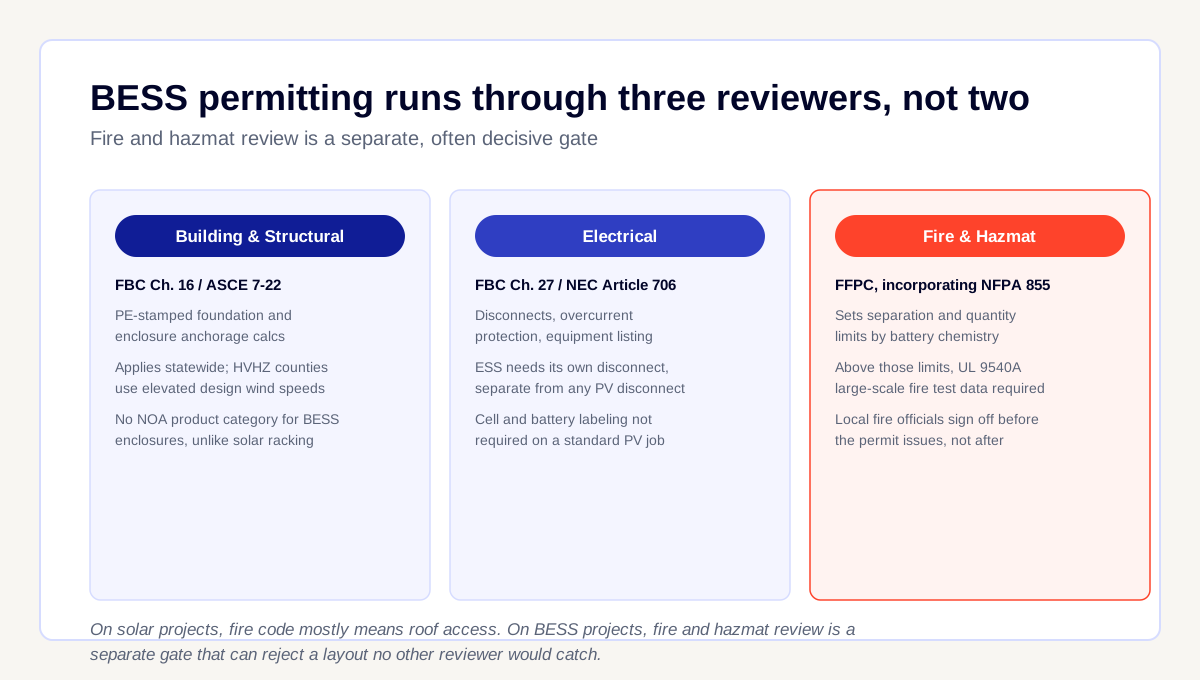
Wind load applies to BESS enclosures the same way it applies to solar racking, but there’s no dedicated product-approval category for it. The Florida Building Code (FBC), 8th Edition (2023), effective December 31, 2023, references ASCE 7-22 for structural wind design under Chapter 16, and that chapter doesn’t carve out an exception for energy storage. Every foundation, pad, and enclosure anchorage needs PE-stamped calculations tied to the site’s design wind speed, risk category, and exposure classification. Miami-Dade and Broward’s High-Velocity Hurricane Zone (HVHZ) pushes design wind speeds well above the statewide baseline, same as it does for solar. What’s different is that Florida doesn’t maintain a Miami-Dade Notice of Acceptance (NOA) product category for battery enclosures the way it does for racking, windows, and roofing. The anchorage design still has to clear HVHZ wind speeds; it just does it through project-specific structural calculations rather than a pre-approved product number.
The electrical permit runs under NEC Article 706, not Article 690. The FBC’s electrical chapter (Chapter 27) adopts the National Electrical Code by reference, currently the 2020 edition, and Article 706 is the section written specifically for stationary energy storage systems: disconnecting means, overcurrent protection, equipment listing, and cell and battery labeling. A one-line diagram that folds the ESS disconnect into the PV disconnect, treating a hybrid solar-plus-storage system as a single circuit, is a fast way to get sent back. Article 706 wants its own dedicated disconnect, clearly shown.
Fire and hazmat review runs on NFPA 855, a standard with no real solar equivalent. Florida’s Fire Prevention Code, 8th Edition (2023), also effective December 31, 2023, is based on the Florida-specific editions of NFPA 1 and NFPA 101, and incorporates NFPA 855, the Standard for the Installation of Stationary Energy Storage Systems, as the governing installation standard for ESS. NFPA 855 sets default separation distances and quantity limits by battery chemistry, commonly cited around 50 kWh per unit for indoor lithium-ion installations before spacing or fire-rated separation requirements tighten. Most containerized commercial and utility-scale systems exceed those defaults, and projects that do need UL 9540A large-scale fire test data showing that thermal runaway in one unit won’t propagate to the next. Fire officials review that data directly, and it’s their sign-off, not the building department’s, that often determines whether a proposed layout works at all.
Contractor licensing runs through the state, the same as solar, but through a different classification. Florida requires a state-issued license through the Department of Business and Professional Regulation (DBPR). Solar work qualifies under the Certified Solar Contractor (CV) classification, but that classification’s statutory definition, Fla. Stat. § 489.105, covers photovoltaic and solar thermal systems specifically and doesn’t extend to energy storage. Battery storage installation runs under the Certified Electrical Contractor (EC) license instead, since the underlying work is electrical scope under NEC 706. A submittal listing a CV contractor for standalone battery storage work, without a paired EC license covering the electrical scope, is worth double-checking before you submit.
Utility interconnection works differently for storage than it does for solar. Fla. Admin. Code R. 25-6.065, the Florida Public Service Commission’s interconnection rule, defines its three size tiers around “customer-owned renewable generation.” Stand-alone battery storage doesn’t generate anything, so it falls outside that definition, and outside the standardized tier timelines solar projects rely on. Utilities still review a BESS interconnection, especially when the system is designed to export power or requires equipment on their side of the meter, but they do it through their own process rather than the tiered structure the Public Service Commission requires for renewable generation. Storage paired with an on-site solar array is a different case: the combined system is often still reviewed under the same Rule 25-6.065 tiers, since the storage charges from a co-located renewable source.
Active Jurisdictions in Florida
These are the jurisdictions seeing the most commercial BESS permit activity, with the same profile as our solar and EV charging guides:
| Jurisdiction | Authority | Notes |
|---|---|---|
| Miami-Dade County | Miami-Dade Building Department + Miami-Dade Fire Rescue | HVHZ wind design applies to enclosure anchorage. Fire Rescue reviews ESS layouts against NFPA 855 as a separate track from the building permit. FPL territory. |
| City of Miami | Miami Building Department + City of Miami Fire-Rescue | Separate permitting from Miami-Dade County. HVHZ wind design applies. Fire-Rescue sign-off typically required before the electrical permit is finaled. FPL territory. |
| Broward County | Broward County Building Division + local fire authority | HVHZ applies countywide for structural review. Fort Lauderdale and Hollywood run separate building and fire departments from the county. FPL territory for most of the county. |
| Palm Beach County | Palm Beach County Building Division + Palm Beach County Fire Rescue | Outside HVHZ, but still a high-wind coastal county under ASCE 7-22. Fire Rescue reviews battery quantity and separation under NFPA 855. FPL territory. |
| Orlando / Orange County | Orange County Building Division + Orange County Fire Rescue | OUC serves Orlando proper; Duke Energy Florida serves surrounding Orange County. Neither follows the Public Service Commission’s tiers for stand-alone storage; confirm the serving utility’s own process before design. |
| Tampa / Hillsborough County | Hillsborough County Development Services + Hillsborough County Fire Rescue | TECO territory for most of the county. City of Tampa runs separate building and fire departments from the county. |
| Jacksonville | Jacksonville Building Inspection + Jacksonville Fire and Rescue Department | JEA is the municipal utility. BESS interconnection runs entirely through JEA’s own process, outside Public Service Commission jurisdiction. |
| Pinellas County | Pinellas County Building Department + local fire authority | Duke Energy Florida territory for most of the county. St. Petersburg and Clearwater run separate building and fire departments. |
Don’t see your jurisdiction? Florida has 411 incorporated municipalities. Contact us at hello@rhonda.build if you need requirements for a jurisdiction not listed here.
Relevant Code References
Florida Building Code (FBC), 8th Edition (2023)
Statewide baseline, effective December 31, 2023. Chapter 16 references ASCE 7-22 for structural wind design, applying to BESS foundations and enclosure anchorage the same as any other structure. Chapter 27 adopts the National Electrical Code, currently the 2020 edition, by reference for electrical work.
NEC Article 706 (adopted via FBC Chapter 27, 2020 NEC edition)
Governs energy storage system installation: disconnecting means, overcurrent protection, equipment listing, and cell and battery labeling, for stationary ESS installations. Requires its own dedicated disconnect, separate from any co-located PV system’s disconnect.
Florida Fire Prevention Code (FFPC), 8th Edition (2023)
Effective December 31, 2023, based on the Florida-specific editions of NFPA 1 and NFPA 101 (2021). Incorporates NFPA 855 as the governing installation standard for stationary energy storage systems.
NFPA 855, Standard for the Installation of Stationary Energy Storage Systems
Sets default separation distances and quantity limits by battery chemistry. Systems that exceed those defaults, which covers most containerized commercial and utility-scale installations, need UL 9540A large-scale fire test data to support an alternative design reviewed by the local fire official.
UL 9540 / UL 9540A
UL 9540 is the product listing standard for the energy storage system itself. UL 9540A is the large-scale fire test method evaluating whether thermal runaway in one unit propagates to adjacent units, the data set fire officials use to approve spacing or quantities beyond NFPA 855’s prescriptive defaults.
HVHZ provisions, FBC Chapter 16 (Miami-Dade & Broward counties)
Sets elevated design wind speeds for Risk Category II and higher structures. Unlike solar racking, BESS enclosures don’t have a dedicated Miami-Dade Notice of Acceptance (NOA) product category; anchorage design meets HVHZ wind speeds through project-specific PE-stamped calculations instead.
Fla. Stat. § 489.105, Contractor Classifications
Defines the Certified Solar Contractor (CV) classification around photovoltaic and solar thermal systems specifically; the definition doesn’t extend to energy storage. Standalone battery storage installation runs under the Certified Electrical Contractor (EC) classification instead.
CS/CS/CS/HB 683 (2025), amending Fla. Stat. § 553.791
Effective July 1, 2025. Groups “solar energy and energy storage installations” as single-trade work eligible for the accelerated, privately reviewed permitting track, but that track applies only to single-family and two-family dwellings. Commercial BESS projects fall under the general 20-business-day deemed-approval track instead.
Fla. Admin. Code R. 25-6.065, Interconnection and Metering of Customer-Owned Renewable Generation
Defines three size tiers for customer-owned renewable generation interconnection. Stand-alone battery storage isn’t “renewable generation” under the rule’s definition and falls outside these tiers; storage paired with on-site solar generation is typically still reviewed under them.
Common Permit Corrections and Rejections for Commercial BESS Projects in Florida
Commercial BESS permitting in Florida touches the local jurisdiction, the fire or hazmat authority, and the serving utility, each with its own review and its own way to send a project back. The corrections that show up most often fall into three categories.
Fire & Life Safety
Exceeding NFPA 855’s default separation or quantity limits without UL 9540A backup
Most containerized commercial systems exceed the prescriptive defaults built into NFPA 855. Submittals that don’t include UL 9540A large-scale fire test data to support the actual spacing and quantities shown on the site plan get sent back to the fire official before the building department even weighs in.
No PE-stamped foundation and anchorage calculations
Same as solar racking: the enclosure foundation and anchorage need wind uplift calculations tied to ASCE 7-22 and the site’s design wind speed. Unlike racking, there’s no Miami-Dade NOA product number to point to in HVHZ, so this needs a project-specific stamped package every time.
Missing fire department review track on the application
Fire or hazmat sign-off runs as a separate review track in most jurisdictions, not a stamp that rides along with the building permit. Submittals that route straight to the building department without flagging the ESS scope for fire review lose time getting redirected mid-process.
Electrical
ESS disconnect folded into the PV disconnect
On hybrid solar-plus-storage projects, treating the battery system and the PV array as a single circuit with one disconnect is a fast way to get a correction. NEC Article 706 wants its own dedicated ESS disconnect, clearly labeled and shown separately on the one-line diagram.
Battery listing and labeling incomplete
NEC 706 requires cell and battery listing information and labeling that doesn’t exist in a standard PV permit package. Submittals that reuse a solar electrical template without adding ESS-specific labeling come back with corrections.
Wrong contractor license on the application
Standalone battery storage runs under the Certified Electrical Contractor (EC) classification, not the Certified Solar Contractor (CV) classification used for PV work. A CV-only contractor listed on a storage-only project is a common intake-stage rejection.
Utility Coordination
Assuming BESS interconnection follows the same tiers as solar
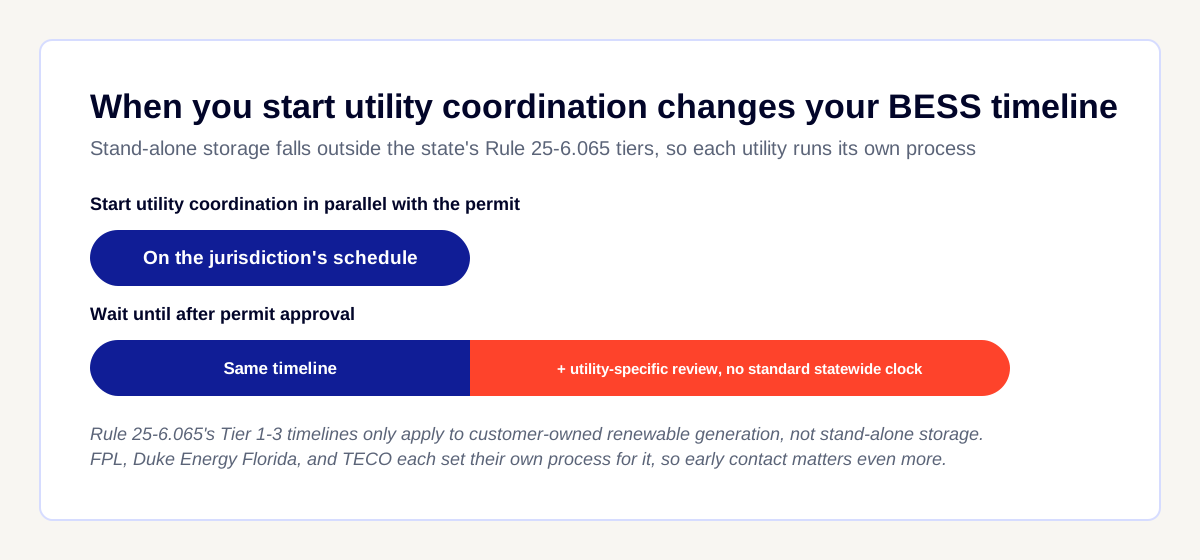
Standalone battery storage isn’t “customer-owned renewable generation” under Fla. Admin. Code R. 25-6.065, so it doesn’t get the standardized Tier 1 through Tier 3 timelines solar projects rely on. Each utility runs its own review for stand-alone storage, and starting that conversation after permit approval, rather than in parallel with it, is the biggest schedule risk on a BESS project.
Wrong utility assumed for the project address
FPL, Duke Energy Florida, and TECO each run their own process for utility-scale storage, while JEA, OUC, and other municipal utilities and cooperatives handle it entirely outside Public Service Commission jurisdiction. Confirm the serving utility and its specific BESS interconnection process before sizing the application.
Export capability not disclosed upfront
Whether the system is designed to export power back to the grid changes what the utility requires. A project that starts coordination assuming no export, then adds export capability later in design, often has to restart the utility review.
Permitting shouldn’t be the bottleneck on your next storage site.
Rhonda makes permitting for commercial solar, battery storage, and EV charging infrastructure predictable. Pre-check your plan set against Florida’s state code and the specific local amendments for your jurisdiction before you submit, so corrections don’t cost you weeks. See how Rhonda can help.
← Back to the State and City Requirement Guide Library
Footnotes
- Florida Building Code, 8th Edition (2023), Chapter 16, Structural Design (International Code Council / Florida Building Commission)
- Florida Building Code, 8th Edition (2023), Chapter 27, Electrical (International Code Council)
- ASCE 7-22 Wind Loads Fact Sheet (Florida Building Commission, floridabuilding.org)
- Florida Fire Prevention Code (FFPC) (Florida Department of Financial Services, Office of the State Fire Marshal)
- NFPA 855, Standard for the Installation of Stationary Energy Storage Systems (National Fire Protection Association)
- Understanding UL 9540A, NFPA 855 and Large-Scale Fire Testing for Battery Energy Storage Systems (UL Solutions)
- UL 9540A Test Method for Battery Energy Storage Systems (UL Solutions)
- Energy Storage Systems – NEC Article 706 (IAEI Magazine)
- Florida Statute § 489.105, Definitions (Contractor Classifications) (The Florida Senate)
- CS/CS/CS/HB 683 (2025), Construction Regulations, enrolled bill text (The Florida Senate)
- Florida Statute § 553.791, Alternative Plans Review and Inspection (The Florida Senate)
- Fla. Admin. Code R. 25-6.065, Interconnection and Metering of Customer-Owned Renewable Generation (Florida Public Service Commission)
- DBPR Electrical Contractors Licensing Board (Florida Department of Business and Professional Regulation)
- FPL, Energy My Way: Battery Storage (Florida Power & Light)
- FPL Net Metering Guidelines (Florida Power & Light)
- Duke Energy, Interconnection for Renewable Generation (Duke Energy Florida)
- Tampa Electric (TECO), Connecting Your Solar / Net Metering Application (Tampa Electric Company)