Battery Energy Storage (BESS) Permit Requirements in Arizona
Arizona's home rule structure works the same way for battery energy storage (BESS) as it does for solar, but the statute that limits when a jurisdiction can demand a structural stamp on a PV system doesn't extend the same protection to storage. Add a fire and hazmat authority that treats BESS as its own review, plus a wave of new local zoning setbacks, and Arizona's BESS permitting has a genuinely different shape. Here's how it works, and where projects get stuck.

Do you need a permit to install battery energy storage in Arizona?
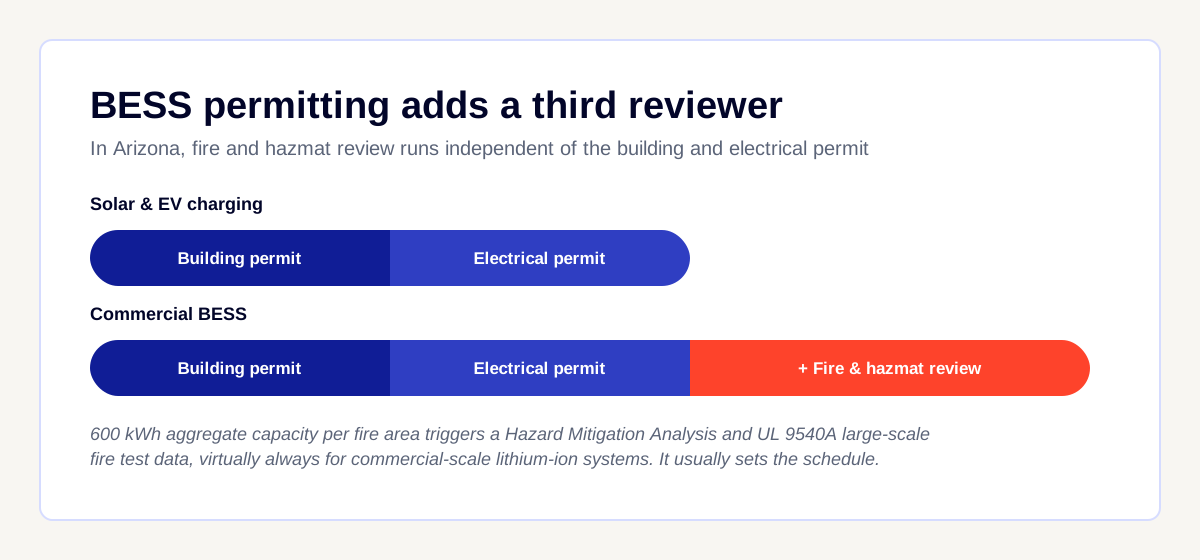
Yes. Commercial battery energy storage (BESS) projects in Arizona need a building permit for the pad, foundation, and enclosure, and an electrical permit for the wiring, disconnects, and interconnection equipment. Both are issued by the local jurisdiction, not a state agency. On top of both, fire and hazardous materials review kicks in once a project crosses a specific aggregate capacity threshold, and for commercial-scale lithium-ion systems, it always does.
That third reviewer is what makes BESS a different animal than solar in Arizona. Arizona’s home rule structure works the same way for both: each municipality picks its own adopted code edition, and a state statute limits when a jurisdiction can demand a professional engineer’s stamp. But that statute, ARS 9-468, is written for solar photovoltaic systems specifically, and doesn’t extend the same protection to standalone battery storage. Add a fire and hazmat authority that treats BESS as a co-equal reviewer rather than a subsection of roof access geometry, plus a fast-moving wave of local zoning setbacks with nothing to do with the building code, and BESS permitting looks different from solar even in the same city.
How BESS Permitting Works in Arizona
Arizona has no mandatory statewide building code. The Arizona Department of Fire, Building and Life Safety (DFBLS) oversees code adoption, but individual cities and counties choose their own edition of the IBC, IFC, and NEC, each with local amendments. That variance matters more for BESS than solar: the fire code’s energy storage provisions changed substantially between the 2018 and 2024 IFC editions, and plenty of Arizona jurisdictions are still enforcing the older one.
The building permit covers the pad, foundation, and enclosure anchoring, plus wind load calculations tied to whatever ASCE 7 edition the jurisdiction’s adopted IBC references. The same desert wind and monsoon considerations that show up on Arizona solar racking calculations apply here: Maricopa and Pima county jurisdictions often specify design wind speeds above the ASCE base map, and attachment details that don’t reflect the local amendment are a common structural correction.
The electrical permit is filed under whatever NEC edition the jurisdiction has adopted, which incorporates Article 706, added in 2017 specifically to govern energy storage system installation. Article 706 applies to any system over roughly 1 kWh, essentially every commercial project, and covers disconnecting means, system listing to UL 9540, wiring methods, and installation clearances. It’s a separate article from NEC 690, the one governing PV, so a combined solar-plus-storage project needs both fully addressed, not one folded into the other.
Fire and hazmat review is where BESS pulls away from solar hardest. The 2024 Arizona Fire Code, adopted by jurisdictions that have moved to that edition, addresses energy storage systems in Chapter 12, Section 1207, harmonized with NFPA 855. Section 1207.5.2 sets a maximum allowable quantity of 600 kWh aggregate lithium-ion capacity per fire area. Above that, a jurisdiction can approve the installation only if the developer provides a Hazard Mitigation Analysis (HMA) and UL 9540A large-scale fire test data showing a fire in one unit won’t propagate to the next.¹ Virtually every commercial and utility-scale project in Arizona blows past 600 kWh before the containers are delivered. Phoenix Fire Department has been especially active writing local amendments on top of this baseline: signage, HMA or failure modes and effects analysis for untabulated chemistries, emergency energy release, vehicle impact protection, spacing, gas detection, and explosion control.² Jurisdictions still on the 2018 IFC have thinner ESS provisions to work from: less to comply with, but also less clarity about what a reviewer will ask for.
In unincorporated county areas, fire authority isn’t always a single obvious call. The Arizona Office of the State Fire Marshal, part of the Department of Forestry and Fire Management, can hold concurrent or primary jurisdiction over larger or more hazardous facilities alongside the local county fire authority.³ In Maricopa and Pinal counties, a private fire district like Rural Metro Fire has taken on a specialized role reviewing BESS and hyperscale infrastructure projects directly, running commercial fire inspections and plan reviews as part of its regular service.⁴ Confirm which fire authority has jurisdiction over your site before your fire protection design is finalized, the same way you’d confirm which utility serves it.
A newer wrinkle solar permitting doesn’t have at all: local zoning setbacks for BESS, adopted separately from the fire code and moving fast. Maricopa County adopted a zoning ordinance in December 2025 setting a 100-foot BESS setback, informed by fire-safety input, after dropping an earlier 500-foot residential proposal.⁵ Mesa spent late 2025 debating far larger numbers: up to 1,000 feet from residential zoning and 400 feet from sensitive receptors like schools and parks, against a 100-foot baseline tied to NFPA 855 (the American Planning Association’s cited national average is 50 to 150 feet).⁶ These aren’t fire code numbers pulled from a standard table, they’re local zoning decisions that vary by jurisdiction and are still moving, which makes an early conversation with planning staff, not just the fire authority, part of siting a project correctly.
Contractor licensing follows the same electrical trade specialty structure as solar. A C-11 or CR-11 license covers commercial and dual-scope solar energy systems work, and that scope extends to battery storage integrated with a paired PV system.⁷ Standalone storage not paired with generation is checked against the general electrical contracting scope instead. Reviewers check the license class against the actual work described in the application, the same correction pattern that shows up on solar submittals.
Active Jurisdictions in Arizona
Arizona has 15 counties and 91 incorporated cities and towns. The Phoenix metro accounts for the largest share of commercial BESS activity, driven by utility-scale projects like APS’s Desert Bloom and Papago Storage facilities and SRP’s Signal Butte project, followed by Tucson. These are the jurisdictions with the most active commercial BESS permitting:
| Jurisdiction | Authority | Notes |
|---|---|---|
| Phoenix | Phoenix Planning and Development Dept.; Phoenix Fire Dept. (fire/hazmat) | Phoenix Fire has led the state on Chapter 12 BESS amendments: HMA/FMEA, signage, emergency energy release, explosion control. APS/SRP boundary runs through the city; confirm utility before design. |
| Scottsdale | Scottsdale Building Safety; Scottsdale Fire (fire/hazmat) | Separate portal and checklist from Phoenix. Primarily APS territory in north Scottsdale; SRP serves eastern areas. Confirm adopted IFC edition before design. |
| Tempe | Tempe Community Development; Tempe Fire Medical Rescue (fire/hazmat) | Mixed APS/SRP territory. Fire review runs on a separate track from the building and electrical permit. |
| Mesa | Mesa Development Services; Mesa Fire and Medical (fire/hazmat) | Primarily SRP territory. Still finalizing BESS zoning setbacks as of early 2026, debating separations up to 1,000 feet from residential zoning against a 100-foot NFPA 855-aligned baseline. Confirm current status before siting. |
| Chandler | Chandler Building Safety; Chandler Fire, Health and Medical (fire/hazmat) | SRP territory. Reviewers check racking, pad, and spacing details against the adopted IBC/IFC edition and local wind load amendments. |
| Gilbert | Gilbert Building Safety; Gilbert Fire and Rescue (fire/hazmat) | SRP territory. Active commercial and industrial BESS pipeline alongside solar. |
| Tucson | Tucson Planning and Development Services; Tucson Fire Dept. (fire/hazmat) | TEP territory. Ground-mount and containerized BESS need building, electrical, fire, and zoning review. |
| Maricopa and Pinal County (unincorporated) | County Development Services; county fire authority or a private district, e.g. Rural Metro Fire | Significant utility-scale activity given available desert land. Maricopa County’s 100-foot BESS zoning setback took effect December 2025. Confirm which fire authority has jurisdiction over the specific site. |
Don’t see your jurisdiction? Arizona has 91 incorporated cities and towns. Contact us at hello@rhonda.build if you need requirements for a specific Arizona jurisdiction.
Relevant Code References
International Fire Code, Chapter 12, Section 1207, as adopted with local amendments
Governs energy storage systems from a fire and life-safety standpoint: the 600 kWh aggregate lithium-ion maximum allowable quantity per fire area, and the Hazard Mitigation Analysis plus UL 9540A test data required to exceed it. Adopted edition varies by jurisdiction; the 2024 edition is harmonized with NFPA 855, while jurisdictions still on the 2018 edition have thinner ESS provisions.
NFPA 855, Standard for the Installation of Stationary Energy Storage Systems
The national installation standard the 2024 IFC’s energy storage chapter is harmonized with. Sets detailed spacing, fire protection, and operational requirements for stationary BESS by chemistry, and is the reference point Arizona jurisdictions cite when setting their own zoning setback numbers.
UL 9540 and UL 9540A
UL 9540 is the product listing standard for the energy storage system as a unit; Phoenix’s fire code amendments require it. UL 9540A is a large-scale fire test, not a certification, used to demonstrate whether a thermal runaway event in one battery unit will propagate to adjacent units.
NEC Article 706, Energy Storage Systems
Added to the National Electrical Code in 2017. Governs disconnecting means, system listing, wiring methods, and installation clearances for any system over roughly 1 kWh. Filed under whatever NEC edition the local jurisdiction has adopted, which varies by city the same way it does for solar.
Arizona Revised Statutes § 9-468 (municipalities) and § 11-323 (counties)
Limits when a jurisdiction can require a professional engineer’s stamp, but the statutory text is written for solar photovoltaic systems specifically and doesn’t extend the same PE-stamp floor to standalone battery storage.
Local BESS zoning setback ordinances
Not part of the fire or building code, but increasingly decisive. Maricopa County adopted a 100-foot BESS setback in December 2025. Mesa was still finalizing its own ordinance in early 2026, with distances under debate from 100 to 1,000 feet depending on the receptor.
Arizona Registrar of Contractors (ROC), A.R.S. Title 32, Chapter 10; Arizona Administrative Code R4-9-104
Arizona classifies solar under the electrical trade specialty rather than a standalone solar or storage license. A C-11 or CR-11 license covers battery storage integrated with a paired solar system; standalone storage is checked against general electrical contracting scope.
Arizona Corporation Commission Distributed Generation Interconnection Rules
Governs APS interconnection timelines for distributed resources, including storage: 15 business days for Track 1, 45 for Track 2, depending on size and grid impact. Storage needs its own application, separate from a paired solar array, since it can export independent of generation. SRP, a political subdivision, isn’t ACC-regulated and runs its own PowerClerk process.
Common Permit Corrections and Rejections for Commercial BESS Projects in Arizona
Commercial BESS permitting in Arizona touches the local jurisdiction’s building department, the fire and hazmat authority, and the serving utility, each with its own review and its own way to send a project back. The corrections that show up most often fall into three categories.
Fire & Life Safety
Missing Hazard Mitigation Analysis or UL 9540A test data above 600 kWh
Since almost every commercial BESS project exceeds the 600 kWh aggregate threshold in IFC Section 1207.5.2, HMA and UL 9540A documentation apply by default. A test report covering a different chemistry, enclosure type, or separation distance than what’s on the site plan doesn’t support the design, and fire authorities check the report against the actual proposal directly.
Zoning setback non-compliance treated as a fire code issue
BESS zoning setbacks, like Maricopa County’s 100-foot requirement, come from the planning and zoning process, not the fire or building code, and they’re moving targets in several jurisdictions right now. Site plans built to the fire code’s spacing requirements without checking the current local zoning setback separately get flagged in a review most teams aren’t expecting.
Assuming the fire authority is the same as the building department
In unincorporated county areas especially, the fire authority reviewing a BESS plan set might be the county fire district, the state fire marshal, or a private district like Rural Metro Fire, and it’s a separate submission with its own timeline. Projects that treat fire review as a formality tacked onto the building permit lose time they didn’t budget for.
Electrical
NEC Article 706 addressed as an afterthought on solar-plus-storage projects
Projects pairing PV with storage sometimes document Article 690 thoroughly and treat Article 706 as incidental. The two articles are reviewed separately, and both need complete documentation, disconnects, and UL 9540 listing specific to the storage system, not inherited from the PV side.
Wrong ROC license classification on the application
Battery storage integrated with a paired solar system needs a C-11 or CR-11 license; standalone storage is checked against general electrical contracting scope. A license class that doesn’t match the actual project scope is a common intake-stage rejection.
NEC and IFC edition mismatch across jurisdictions
Because Arizona leaves both NEC and IFC adoption to the local jurisdiction, enforced editions vary by city and sometimes lag the current published edition by several cycles. Plans built to the latest requirements for a jurisdiction still enforcing an older edition create mismatches that require resubmittal.
Utility Coordination
Starting interconnection after permit approval
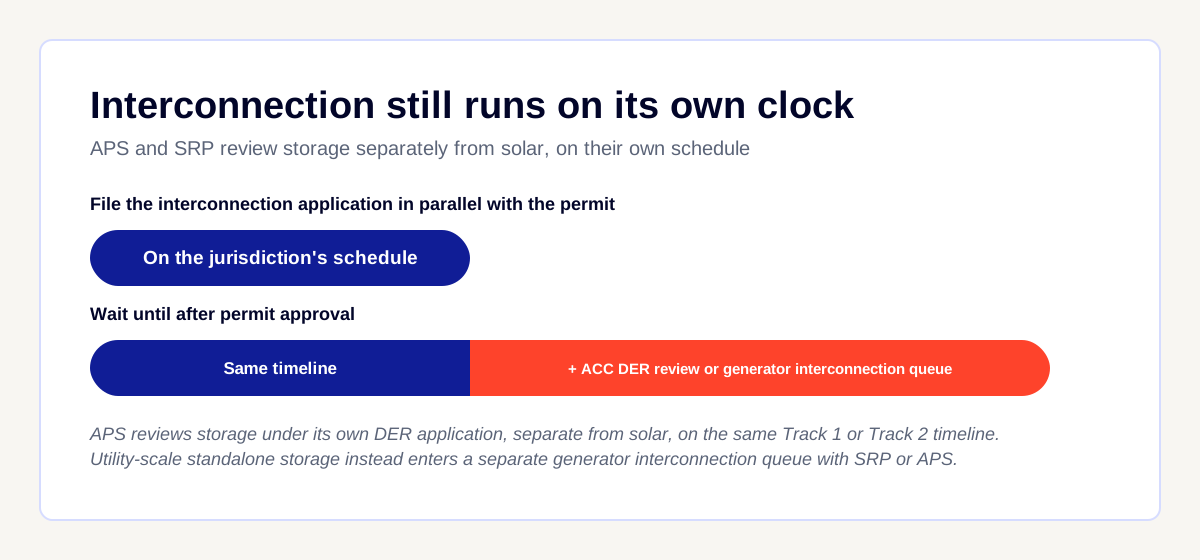
APS and SRP interconnection review runs on the utility’s own schedule, separate from the jurisdiction’s permit process, the same dynamic as solar. Filing the interconnection application in parallel with the permit is the biggest lever available to keep a BESS project on schedule.
Treating storage interconnection like a solar addendum
Storage can export to the grid independent of a paired solar array, so APS requires its own DER application for the storage component rather than folding it into the solar paperwork. Projects that assume one application covers both configurations run into gaps during utility review.
Utility-scale standalone storage filed on the wrong track
Smaller commercial storage can qualify for APS’s Track 1 or Track 2 DER review. Utility-scale standalone storage, the kind driving Arizona’s current BESS buildout, instead goes through a separate generator interconnection queue with its own study process and timeline. Confirm which process applies before assuming a Track 1 or Track 2 timeline.
Not confirming APS vs. SRP territory before design
The APS/SRP boundary runs through the Phoenix metro and isn’t always obvious from a street address. SRP requires a signed PowerClerk application and a study deposit before its Grid Impact Study even begins, and systems 1 MW-AC and larger need a relay schematic on top. Designing to the wrong utility’s assumptions creates rework late in the process.
Permitting shouldn’t be the bottleneck on your next storage site.
Rhonda makes permitting for commercial solar, battery storage, and EV charging infrastructure predictable. Pre-check your plan set against Arizona’s state code and the specific local amendments for your jurisdiction before you submit, so corrections don’t cost you weeks. See how Rhonda can help.
← Back to the State and City Requirement Guide Library
Footnotes
- Chapter 12 Energy Systems, Arizona Fire Code 2024 (up.codes); Mayfield Renewables, BESS Maximum Allowable Quantities at the C&I Scale
- Phoenix Fire Department Fire Prevention Section, Explanatory Policy Manual (phoenix.gov)
- Arizona Office of the State Fire Marshal, Department of Forestry and Fire Management
- Rural Metro Fire Steps Up as Specialized Responder for Arizona’s Solar, Battery Storage and Data Center Boom (PR Newswire, 2026)
- Maricopa County Board adopts major zoning overhaul, sets 100-foot BESS setback (Citizen Portal, December 2025)
- Mesa advances two battery energy storage zoning items after debate over 400- vs. 1,000-foot separations (Citizen Portal, December 2025)
- Arizona Registrar of Contractors (ROC), License Classifications (roc.az.gov); Arizona Administrative Code R4-9-104
- Arizona Revised Statutes § 9-468, Solar construction permits; standards; definition (Arizona State Legislature)
- NEC Article 706, Energy Storage Systems (NFPA 70), as adopted by individual Arizona jurisdictions; IAEI Magazine, Energy storage systems – NEC Article 706
- Understanding UL 9540A, NFPA 855 and Large-Scale Fire Testing for BESS (UL Solutions)
- New AZ Rules to Streamline Distributed Generation and Storage Interconnection to Grid (IREC); APS Interconnection Requirements for Distributed Generation
- SRP Commercial Distributed Energy Program Process Checklist (srpnet.com)
- APS, first solar partner on Arizona’s largest battery storage project (aps.com)